How to Use Psychological Whys to Fix the Real Problem, Not the Person
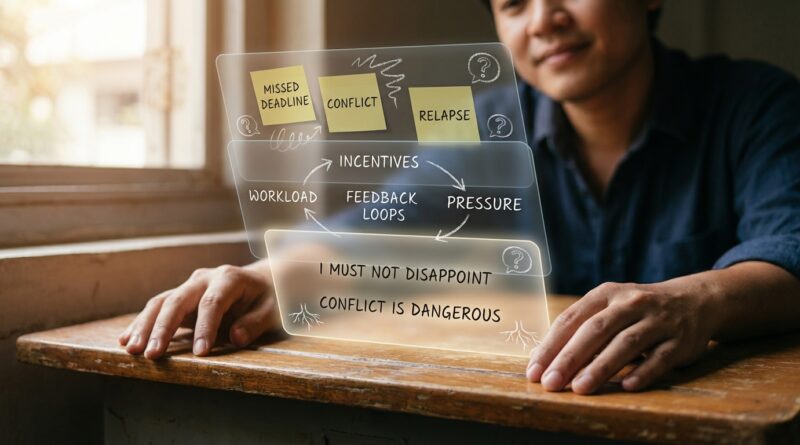
You can feel the eye-roll coming the moment a problem review ends with, “someone dropped the ball,” or worse, “you just need more discipline.” That kind of root cause analysis sounds tidy, but it rarely fixes anything. The same missed deadline happens again. The same argument comes back. The same habit you swore you would stop pops up next week. That is usually a sign you found a person to blame, not the real cause. A better approach is to ask why on three levels. First, what happened on the surface. Second, what system made it likely. Third, what story, fear, or hidden payoff kept the pattern alive. That is the heart of a useful psychological root cause analysis why framework. It takes less than ten minutes, works at work and at home, and helps you fix the setup instead of attacking the person inside it.
⚡ In a Hurry? Key Takeaways
- Most repeating problems have three layers: symptom, system, and inner narrative. Stop at layer one and you usually end up blaming people.
- Use a simple script. What happened? Why did the setup allow it? Why did this make sense to the people involved at the time?
- Keep it blameless. The goal is not to excuse harmful behavior. It is to build fixes that actually stick.
Why “the user messed up” is usually a bad answer
Sometimes a person did make the last visible mistake. That part can be true. It is just rarely the whole truth.
If a teammate keeps missing deadlines, maybe they estimated badly. But why were they guessing without enough information? Why was the timeline accepted without challenge? Why did everyone feel pressure to say “yes” to a date that already looked shaky?
If you keep agreeing to things and then resenting it, maybe you did say yes. But why did “no” feel risky? Why does approval feel safer than honesty? Why is your calendar full of things you never actually chose?
When the same pattern repeats, the real cause is often a mix of process and psychology. That is why a plain 5 Whys exercise can help, but only if you do not stop at “human error.”
The 3-layer map that makes root cause analysis more useful
Here is the small framework. You can run it on a sticky note, in a team retro, or during a tough conversation with yourself.
Layer 1: Symptom
This is the visible problem. Keep it factual.
Examples:
- We missed the product deadline by two weeks.
- I said yes to helping, then felt angry and trapped.
- Customers keep skipping an important setup step.
Layer 2: System
Ask what in the environment, process, incentives, timing, tools, or communication made the symptom more likely.
This is where blameless analysis starts to earn its keep. You are looking for conditions, not culprits.
Examples:
- Work was accepted before requirements were clear.
- No one had a safe way to push back on unrealistic dates.
- The form was confusing and the default option nudged people the wrong way.
- I answer requests too fast, usually from my phone, before I check my actual capacity.
Layer 3: Inner narrative
This is the part most teams skip. It is also the part that explains why smart people keep repeating patterns they can already see.
Ask what belief, fear, assumption, or hidden payoff made the system feel normal.
Examples:
- “If I question the deadline, I will look difficult.”
- “A good teammate always says yes.”
- “If we add one more approval step, leadership will think we are slow.”
- “Users should pay more attention,” which often hides “we do not want to admit the design is confusing.”
This is not pop psychology for the sake of it. It is practical. Inner narratives shape behavior. If you never name them, they keep running the show.
The 10-minute worksheet
Grab any frustrating repeat problem and fill in these three boxes.
Step 1: Name the symptom in one sentence
Use plain words. No judgment.
Prompt: What keeps happening?
Example: “Our team keeps missing deadlines in the final week of a project.”
Step 2: Ask two system whys
Only ask enough whys to find the setup. You do not need a courtroom cross-examination.
Prompts:
- What conditions made this likely?
- What part of the process quietly rewards this?
- Where was the friction, confusion, or missing handoff?
Example:
- Why are deadlines missed? Because final review work appears late.
- Why does review work appear late? Because dependencies are hidden until the build is nearly done.
Step 3: Ask one psychological why
This is the question that changes the quality of the answer.
Prompts:
- Why did this make sense to people at the time?
- What were they protecting?
- What belief made the bad pattern feel like the safest option?
Example: “People avoid raising dependency risks early because they think bringing bad news will make them look negative or unprepared.”
Step 4: Write one fix for each layer
If you only make a surface fix, the pattern often returns. Match the fix to the layer.
- Symptom fix: Rework the timeline for the current project.
- System fix: Add a dependency review at project kickoff and one at the halfway point.
- Narrative fix: Team lead says out loud, and repeats, “Raising risk early is good performance, not negativity.”
Example 1: “My team keeps missing deadlines”
What people often say
“The team needs to manage time better.”
What the 3-layer map might show
Symptom: Deadlines slip in the last 20 percent of the project.
System: Estimates are made before the work is fully understood. Meetings reward confidence. Risk reviews happen too late.
Inner narrative: People think saying “this needs more time” sounds weak. Managers think asking for certainty builds accountability.
Better fixes
- Separate rough estimates from committed dates.
- Require an assumptions list with every estimate.
- Praise early risk reporting in public.
Notice what did not happen here. We did not pretend personal responsibility does not matter. We just refused to stop there.
Example 2: “I keep saying yes, then resenting it”
What people often say
“You need stronger boundaries.”
What the 3-layer map might show
Symptom: You agree to requests you do not want, then feel angry later.
System: Requests come in fast. You answer in the moment. There is no pause rule. Your week has no buffer.
Inner narrative: “If I do not help right away, I am selfish.” Or, “If I say no, people may pull away.”
Better fixes
- Use a default response: “Let me check and get back to you.”
- Keep two open blocks in your week for unplanned asks.
- Practice a replacement belief: “A thoughtful no is kinder than a resentful yes.”
That last line matters because behavior change often fails when the old behavior still feels emotionally safer.
Example 3: “Users keep doing the wrong thing”
What people often say
“Users are careless.”
What the 3-layer map might show
Symptom: Customers skip a required setup step and then contact support.
System: The step is buried in a long flow, the wording is vague, and the page rewards speed over accuracy.
Inner narrative: The product team may believe “If we make this more obvious, the screen will look cluttered,” or “Users should figure it out.”
Better fixes
- Move the step earlier and make the consequence clearer.
- Test new wording with real users.
- Replace “they should know” with “what in the design teaches them?”
How to keep this blameless without getting vague
Some people hear “blameless” and worry it means nobody is accountable. That is not the idea.
Blameless means you do not confuse the last person touching the problem with the full cause of the problem.
You can still be clear. You can still say a commitment was missed, a choice caused harm, or a process was ignored. The difference is that you ask what made that outcome likely and repeatable.
A useful test is this. If your final answer could be pasted onto five different incidents without changing a word, it is probably too shallow.
Examples of shallow answers:
- People need to communicate better.
- Users need more training.
- I need more discipline.
Examples of useful answers:
- Status updates happen in three tools, so nobody sees a full picture.
- Training happens once, but the task is done months later under time pressure.
- I make decisions in the moment when I am tired and trying to avoid disappointing people.
A simple script you can use in meetings or tough conversations
If you want something you can actually say out loud, use this:
- Start with the fact: “What keeps happening?”
- Move to the setup: “What made that likely?”
- Add the human layer: “Why did this make sense at the time?”
- End with action: “What do we change in the process, and what belief or expectation also needs to change?”
That last question is the secret sauce in a psychological root cause analysis why framework. Process fixes matter. Story fixes matter too.
Common mistakes when using the 5 Whys
1. Asking “why” like an accusation
Tone matters. “Why did you do that?” can sound like a trap. Try “What was going on at that point?” or “What made that the sensible move at the time?”
2. Stopping at behavior
“They forgot” is not the end. Why was forgetting easy? Was there a reminder? Was the task designed to fit real life?
3. Turning one incident into a character judgment
Repeated misses can point to a pattern, but “he is unreliable” is not root cause analysis. It is a label pretending to be a diagnosis.
4. Ignoring hidden rewards
Bad systems often survive because they give somebody a short-term benefit. Speed looks good. Agreeing avoids tension. Silence protects status. If you miss the payoff, you miss the glue holding the pattern in place.
When this framework works best
Use it when a problem is recurring, emotionally loaded, or oddly resistant to common-sense fixes.
It works especially well for:
- Team retrospectives
- Product and user experience issues
- Relationship friction
- Habits that keep snapping back
- Any situation where “just try harder” has already failed
It is less useful for one-off random events. If a tree fell on the power line, you probably do not need a deep narrative analysis. But if your same conflict, defect, or overcommitment shows up every month, this is exactly the right tool.
Mini worksheet you can copy today
Problem: ________________________
Symptom. What keeps happening? ________________________
System. What conditions made it likely? ________________________
Psychology. What fear, belief, or hidden payoff kept the pattern going? ________________________
One fix for the symptom: ________________________
One fix for the system: ________________________
One fix for the narrative: ________________________
If you do nothing else, just fill in those seven lines. You will almost always leave with a clearer next step.
At a Glance: Comparison
| Feature/Aspect | Details | Verdict |
|---|---|---|
| Traditional root cause analysis | Often stops at the visible error or the person closest to it. | Fast, but often too shallow for repeat problems. |
| Blameless 5 Whys | Better at finding process gaps, incentives, and weak handoffs. | Much stronger, especially for teams. |
| Psychological root cause analysis why framework | Adds inner narratives, fears, and hidden payoffs to symptoms and systems. | Best choice when the same pattern keeps coming back. |
Conclusion
If you are tired of root cause analysis that ends with “someone messed up,” you are not being picky. You are noticing that the answer is incomplete. The stronger move is to separate what happened from the setup that allowed it and from the human story that kept it going. That is what makes this small framework so useful right now. It combines blameless analysis, the 5 Whys, and basic psychology into something you can run in under ten minutes. Use it on a missed deadline, a stubborn product issue, or a personal pattern like saying yes then feeling resentful. The payoff is simple but real. You stop chasing vague frustration and start seeing a three-layer map you can actually act on. That brings relief fast. More importantly, it gives you a better shot at fixing the real problem instead of turning a repeat pattern into a character flaw.