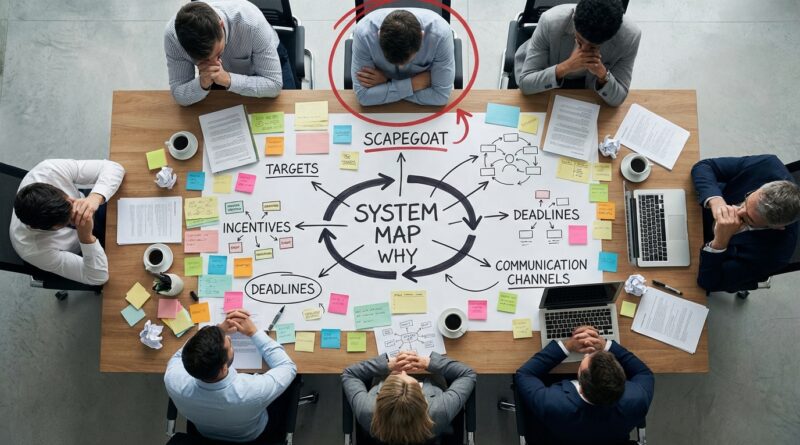
Why Your 5 Whys Ignore Power Structures: Use the ‘System Map Why’ To See The Real Root Problem
You know the meeting. An incident happened, a project slipped, or two teams are quietly at war. Someone says, “Let’s do a 5 Whys.” Twenty minutes later, the trail somehow ends at one very convenient conclusion. A person missed something. A manager failed to follow up. An engineer made a bad call. It looks tidy. It fits the form. And it often feels wrong. That frustration is valid. A lot of root cause work turns into a polite way to pin a system failure on the most visible human in the room. The problem is not that asking why is bad. The problem is that basic 5 Whys often ignores power, incentives, workload, mixed signals, and the unspoken rules people learn fast if they want to survive. If you want a better systemic root cause analysis psychological why framework, start with one simple upgrade. Stop asking only “why did this person do that?” Start asking “what system made that action likely?”
⚡ In a Hurry? Key Takeaways
- Classic 5 Whys often stops too early and blames a person when the real cause sits in targets, incentives, staffing, and power structures.
- Use a “System Map Why” by tracing the event across roles, rules, rewards, pressures, tools, and decision rights, not just one person’s choices.
- This approach supports psychological safety because it reduces blame and makes it easier to fix repeat problems before they become burnout or another incident.
Why the usual 5 Whys keeps landing on a person
The original idea behind 5 Whys is solid. Keep asking why until you reach the root. Simple. Useful. Better than stopping at “human error.”
But in real workplaces, “why” is not asked in a vacuum. It is asked inside a chain of command. Inside deadlines. Inside budget fights. Inside cultures where some questions are welcome and some are career-limiting.
That is why many teams do a root cause review and end up with something like this:
Why did production fail? Because the wrong change was approved.
Why was it approved? Because the reviewer missed the issue.
Why did they miss it? Because they were rushing.
Why were they rushing? Because they had poor time management.
Why did they have poor time management? Because they need coaching.
Nice and neat. Also suspicious.
Maybe the reviewer was covering two jobs. Maybe leadership rewarded speed and punished delay. Maybe the release checklist was outdated. Maybe everyone knew approvals were rubber-stamped at quarter end because revenue goals mattered more than caution. Once you see that, “poor time management” starts looking less like a cause and more like a symptom.
What a System Map Why does differently
A System Map Why keeps the helpful part of 5 Whys, asking deeper questions, but changes the unit of analysis. You are not just following one person’s decisions. You are mapping the forces around those decisions.
Think of it like switching from a flashlight to an overhead light.
Instead of one straight line of why, you draw a small map of contributing conditions. Then you ask why for each condition. That is how you get from “Sam skipped a step” to “the system made skipping that step normal, rewarded, or hard to avoid.”
The shift in one sentence
Classic 5 Whys asks, “Why did the person fail?”
System Map Why asks, “What conditions made this outcome predictable?”
The six areas to map every time
If you want a practical systemic root cause analysis psychological why framework, start by mapping these six areas around the event.
1. Goals and metrics
What was the team measured on? Speed, uptime, output, cost cuts, ticket closure, headcount savings?
People respond to scoreboards. If a team is praised for shipping fast and only punished for delays, quality shortcuts are not random. They are a rational response.
2. Incentives and consequences
What got rewarded? What got people in trouble?
Many companies say “raise risks early,” then punish the person who slows the launch. That gap matters. Official policy is not the real system. The real system is what happens to you when you follow or resist the pressure.
3. Rules, process, and tooling
Did the checklist help or just create busywork? Were tools confusing? Was the handoff process brittle? Was there a backup plan?
Bad process quietly trains workarounds. After a while, the workaround becomes “how we do things here.”
4. Workload and capacity
How many alerts, projects, meetings, or approvals were people handling? Were they tired? Understaffed? Context-switching all day?
When teams are overloaded, errors are not surprising. They are expected.
5. Power and decision rights
Who could say no? Who could delay the release? Who could ask for more testing? Who felt safe doing that?
This is the part many RCAs skip. If only senior people can challenge the plan, then junior people staying quiet is not a personal failing. It is a power pattern.
6. Culture and unwritten rules
What does everyone know but nobody says? “Don’t make leadership look bad.” “Don’t block sales.” “Just get it done.” “We always clean it up later.”
Those unwritten rules often explain more than the documented process ever will.
How to run a System Map Why in practice
You do not need special software. A whiteboard, shared doc, or incident template works fine.
Step 1: Write the event in neutral language
Not “Alex failed to follow process.”
Write, “A production change went live without the expected validation and caused an outage.”
Neutral wording matters. If blame sneaks into the first sentence, the rest of the session is already tilted.
Step 2: List contributing conditions, not just actions
Make a quick map with branches such as:
- Approval done under time pressure
- Reviewer was covering for absent teammate
- Checklist did not include this edge case
- Launch date tied to executive commitment
- Recent delays had been criticized heavily
- Rollback steps were unclear
Now you have a real system to inspect.
Step 3: Ask why on each branch
Take “approval done under time pressure.” Why?
Because release windows are too tight. Why?
Because launch dates are fixed before technical review. Why?
Because sales commitments are made first and delivery risk is discussed later.
Notice where you landed. Not at “be more careful.” At planning and power.
Step 4: Mark what is structural
As you map, label items like these:
- Policy problem
- Incentive problem
- Capacity problem
- Tooling problem
- Training gap
- Authority gap
- Cultural norm
This keeps the team from stuffing everything into “human error,” which is usually where learning goes to die.
Step 5: Design fixes at the system level
If your action items all sound like “remind staff,” “retrain team,” or “be more careful,” you are probably still too close to blame.
Better fixes sound like this:
- Separate approval quality from delivery speed metrics
- Require technical review before external commitments
- Reduce reviewer load during release windows
- Give on-call engineers authority to delay risky launches
- Update checklist based on actual failure paths
- Track and review repeated workaround behavior as process debt
A simple before-and-after example
Old 5 Whys result
Customer data import failed because an analyst used the wrong file format. Root cause: lack of attention to detail.
System Map Why result
The analyst used the wrong file format because the export screen presented two nearly identical options, training screenshots were outdated, the QA step had been removed to hit same-day turnaround targets, and staff had learned that asking for clarification was seen as slowing the queue.
See the difference? One version gives you a person to correct. The other gives you a system to improve.
Why this matters for psychological safety
Psychological safety is not about being nice in meetings. It is about whether people can surface risk, confusion, and bad news without paying for it later.
If every incident review ends with one person wearing the failure, people learn fast. Keep your head down. Share less. Protect yourself. That is how the next issue grows in silence.
A System Map Why helps because it makes the conversation less personal and more honest. People are far more likely to tell the truth about pressure, trade-offs, and hidden workarounds when they are not being lined up for a lesson in accountability theater.
Red flags that your RCA is missing the real problem
Watch for these signs:
- The root cause is a personality trait like “carelessness” or “complacency”
- Most action items are retraining or reminders
- No one asks who had power to change the conditions
- Metrics and incentives never come up
- The same type of incident keeps happening with different people
- Everyone privately knows the process is broken, but the report says it was followed incorrectly
If that list feels familiar, your process is probably finding a culprit, not a cause.
Questions to add to your next template
If you already have a 5 Whys or RCA form, you do not need to throw it out. Add these prompts:
- What goals or metrics shaped behavior in this situation?
- What trade-offs were people under pressure to make?
- What unwritten rules influenced decisions?
- Who had authority to stop, question, or delay the work?
- What normal workaround behavior showed up?
- What would have made the safer choice easier?
- If a different person had been in the same spot, how likely is the same outcome?
That last question is especially useful. If the answer is “pretty likely,” you are looking at system design.
What managers often get wrong here
Managers sometimes hear “system issue” and think it means “nobody is responsible.” That is not the point.
People still make choices. Standards still matter. But responsibility exists at more than one level. The front-line person is responsible for their actions. Leaders are responsible for the conditions surrounding those actions. If you only inspect the first layer, you keep reproducing the same failure with new names attached.
That is why good analysis is not softer. It is stricter. It asks more of the organization, not less.
At a Glance: Comparison
| Feature/Aspect | Details | Verdict |
|---|---|---|
| Classic 5 Whys | Fast, simple, and useful for obvious process misses, but it often follows a single line of causation and stops at the nearest human decision. | Good starter tool, weak on power structures and hidden system pressure. |
| System Map Why | Maps goals, incentives, workload, rules, authority, and culture before asking why across each branch. | Better for complex incidents, burnout patterns, recurring team conflict, and organizational learning. |
| Action outcomes | Blame-focused reviews produce retraining and reminders. System-focused reviews produce design changes to process, metrics, staffing, and decision rights. | Choose system-level fixes if you want fewer repeats instead of cleaner paperwork. |
Conclusion
If your root cause process keeps ending with one person, trust your gut. You are probably not seeing the whole picture. A lot of the better thinking around psychological safety and incident review is finally saying the quiet part out loud. Burnout, repeated mistakes, and team blowups are usually shaped by system design, not just personal weakness. The good news is you do not need to scrap your current process. You can upgrade it. Add a System Map Why to your next review and look at incentives, workload, authority, and unwritten rules alongside human choices. That small shift helps teams stop punishing the most visible person in the chain and start redesigning the forces that made the outcome predictable. That is where the real fix usually lives.