Why Your 5 Whys Keep Blindly Trusting AI: The Simple ‘AI-Assisted Why’ That Stops Automation Bias Before It Starts
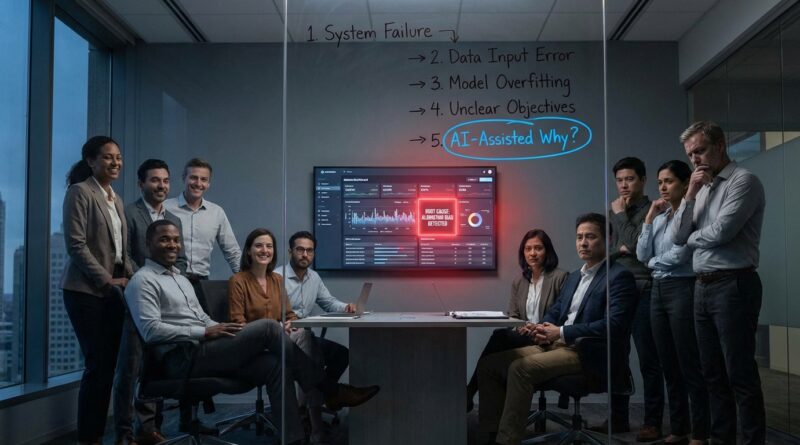
You can feel it happening in real time. The dashboard flags a likely cause. The AI agent writes a neat little explanation. Everyone in the room goes quiet for half a second, then starts nodding along because, honestly, it sounds right. That is exactly how smart teams end up fixing the wrong thing. If you have ever ignored your own doubts because the model looked more certain than you felt, you are not careless. You are human. And that is the problem. Research on automation bias in AI-assisted root cause analysis shows people tend to accept machine suggestions too quickly, especially when the clock is ticking and the charts look polished. The answer is not to ban AI from incident reviews. It is to change who owns the final “why.” A simple human-first method, which I call the AI-Assisted Why, keeps AI as a helper, not the narrator of your postmortem.
⚡ In a Hurry? Key Takeaways
- Automation bias in AI-assisted root cause analysis happens when teams trust the AI’s explanation too fast and stop testing alternatives.
- Use an “AI-Assisted Why” process where humans state the first why in their own words before seeing or accepting the model’s root cause chain.
- This keeps AI useful for evidence gathering and pattern spotting, while reducing the risk of confident but wrong fixes.
Why this keeps happening
The classic Five Whys was supposed to make teams think more clearly. You keep asking why until you get to the underlying cause, not just the surface symptom.
Now AI tools can do that in seconds. They read logs, scan alerts, summarize tickets, and spit out a clean causal chain. On paper, that sounds great.
In practice, it creates a trap.
When a model offers the first explanation, it becomes the anchor. People naturally compare every later idea to that first answer. If the model sounds confident, or if the chart looks scientific, the anchor gets even heavier. Under time pressure, people often stop exploring other possibilities and switch into confirmation mode. They start looking for proof that the AI was right, instead of asking whether it was wrong.
That is the heart of automation bias in AI-assisted root cause analysis. The machine is not just helping. It is quietly steering.
What automation bias actually looks like in a meeting
It rarely looks dramatic. It looks normal.
The subtle version
The AI says a database timeout caused the outage. A senior engineer has a nagging feeling that the timeout was a symptom, not the cause. But the model already linked the timeout to three prior incidents, complete with a confidence score. Nobody wants to sound vague next to a polished answer, so the team moves forward with the database fix.
A week later, the real issue returns. It turns out a deployment process had been saturating connections long before the timeout appeared.
The rushed version
In healthcare, operations, and infrastructure, people make decisions under stress. That is when machine suggestions feel especially comforting. The AI offers a tidy story. The human brain, already overloaded, says, “Good enough. Let’s go.”
The danger is not that people stop thinking. It is that they think inside the AI’s frame.
Why “confidence” is the worst part
Most people do not trust AI because they think it is magic. They trust it because it sounds organized.
That is what makes this tricky. A clean summary feels safer than messy human uncertainty. But root cause analysis is often messy at first. The honest answer early in an incident is usually, “We have two or three plausible paths, and we need to test them.”
AI often compresses that uncertainty into one convincing narrative. That may help with speed, but it can hurt accuracy.
If the model presents one path too early, your team may stop asking the most useful question in any RCA: “What else could explain this?”
The fix: a human-first “AI-Assisted Why”
You do not need a giant new framework. You need one rule change.
Before the team accepts any AI-generated why-chain, one human owner must state the first why in plain language, based on observed facts only.
That is the AI-Assisted Why.
How it works
Step 1. Start with the symptom, not the AI summary.
Write down what happened in simple terms. Example: “Customers could not complete checkout between 2:10 and 2:24 PM.”
Step 2. Ask the first why without the model’s conclusion.
A human has to answer first. Example: “Why could customers not complete checkout? Because the payment service stopped returning successful responses.”
Step 3. Ask what evidence supports that answer.
Logs, metrics, timelines, user reports, system traces. No guessing yet.
Step 4. Only now bring in the AI.
Use the AI to suggest additional causes, missing evidence, contradictory signals, or similar prior incidents.
Step 5. Force at least one rival explanation.
Ask the AI and the humans for one alternative causal path that also fits the known facts.
Step 6. Keep the final why in human words.
The final root cause statement should be written and approved by a person, not pasted from the model output.
This matters more than it sounds. The psychological root of the decision stays with the team. The AI helps gather and compare. It does not become the author of truth.
What AI should do in RCA, and what it should not do
Good jobs for AI
AI is excellent at scanning huge logs, spotting timing patterns, clustering similar incidents, summarizing noisy data, and surfacing forgotten dependencies. That is real value.
Bad jobs for AI
AI should not be the sole owner of the causal narrative. It should not be allowed to present a single “most likely root cause” as if the case is closed before the team tests alternatives.
Think of it like a very fast research assistant. Helpful. Tireless. Still not the person who signs off on the diagnosis.
A simple script your team can use
If you want to put this into practice tomorrow, try this script during your next review:
1. Human lead: “State the symptom and timeline in one sentence.”
2. Human lead: “Give the first why based only on observed evidence.”
3. AI tool: “List supporting evidence, missing evidence, and one conflicting clue.”
4. Team: “Name one alternate explanation.”
5. AI tool: “Compare both explanations and note what data would separate them.”
6. Human lead: “Write the current best root cause statement in plain language, with confidence level and open questions.”
That one change can stop the whole meeting from sliding into “the model said so.”
How to spot that your team is already over-trusting AI
Watch for these warning signs:
- The AI explanation gets shown before the raw incident timeline.
- People ask, “Does the data support the model?” instead of, “What does the data say?”
- No one writes down a competing explanation.
- The confidence score gets treated like proof.
- The final postmortem language sounds machine-written and oddly certain.
- Teams keep closing incidents fast, but the same class of problem returns.
If that last one sounds familiar, you are not doing root cause analysis. You are doing root cause storytelling.
Why this matters so much in healthcare, ops, and infrastructure
These are environments where speed matters and ambiguity is expensive. That is exactly where AI can help most, and where automation bias can do the most damage.
In infrastructure, a wrong fix can trigger another outage. In healthcare, a confident but incomplete explanation can shape decisions that affect patient care. In operations, the cost may be hidden at first. Teams keep patching symptoms, burning time, and trusting a system that keeps sounding smarter than it is.
The point is not to slow everybody down. It is to slow down at the right moment. Two extra minutes spent protecting the first why can save days of repeat failure later.
The practical rule to remember
Here is the simplest version.
Humans own the first why. AI helps with the next evidence.
If you remember only that, you will already be ahead of many teams adopting AI-driven RCA tools right now.
At a Glance: Comparison
| Feature/Aspect | Details | Verdict |
|---|---|---|
| AI-led Five Whys | Fast and tidy, but often anchors the team around the model’s first explanation. | Useful for drafts, risky as the main decision path. |
| Human-only Five Whys | Can capture context and judgment well, but may miss patterns hidden in large data sets. | Safer for ownership, weaker for scale and speed. |
| AI-Assisted Why | Humans state the first why and own the final cause statement, while AI gathers evidence and suggests alternatives. | Best balance for accuracy, speed, and bias control. |
Conclusion
AI-driven RCA agents are spreading fast for a reason. They really can help teams sort through chaos, find patterns, and move quicker. But the research warning is worth taking seriously. Automation bias and anchoring bias can pull people toward a polished answer long before the hard thinking is done, especially when everyone is under pressure. The good news is you do not have to choose between old-school manual reviews and blind trust in the machine. A practical, human-first AI-Assisted Why keeps the key decision point where it belongs, with people. Let the model scan, summarize, and suggest. Just do not let it own the story of why something happened. If your team keeps the first why human, you can get the benefits of AI reasoning without turning every incident review into a lesson in how confidence fooled the room.