Why Your 5 Whys Keep Ignoring Systemic Pressure: The Simple ‘Environment Why’ That Exposes the Real Source of Your Stress
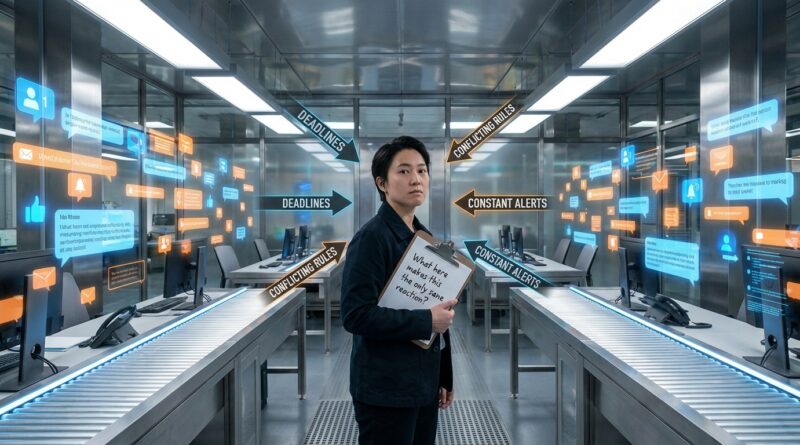
You tweak your routine, read the mindset books, promise yourself you will stay calm next time, and then it happens again. The stress spikes the second you open Slack, check your trading app, or sit down in that one weekly meeting. That loop is exhausting because it makes everything feel personal. Like if you were just more disciplined, less reactive, more focused, this would stop. But often the pattern is not living inside you alone. It is built into the environment around you. The rules, the alerts, the incentives, the room setup, the reporting line, the unspoken “always on” norm. That is where the simple Environment Why comes in. It adds one missing question to root cause analysis environment psychology: “What in the system keeps recreating this reaction?” Ask that, and you stop treating recurring stress like a character flaw. You start seeing pressure as something designed, repeated, and often fixable.
⚡ In a Hurry? Key Takeaways
- The missing step in many “5 Whys” exercises is asking what part of the environment keeps producing the same behavior or stress.
- Map the pressure points around you. Look at tools, rules, incentives, timing, and social norms before blaming your personality.
- If a problem returns in the same setting over and over, that is useful data. It may point to a system issue, not a personal failure.
Why the usual 5 Whys can miss the real problem
The classic 5 Whys method is useful because it pushes past the first obvious answer. But many people run it in a very narrow way.
They ask:
Why am I anxious before this meeting?
Because I do not feel prepared.
Why do I not feel prepared?
Because I am behind on the project.
Why am I behind?
Because I get distracted.
Why do I get distracted?
Because I lack focus.
Why do I lack focus?
Because I need better habits.
See what happened? Every answer drifted back toward the self. Maybe some of that is true. But it also may be incomplete.
What if the meeting agenda arrives five minutes before the meeting? What if half the work depends on late approvals? What if your chat tools interrupt you every three minutes? What if the culture rewards instant replies over deep work?
Now the story looks different.
The missing question: The Environment Why
Here is the simple add-on:
Ask, “What in the environment makes this outcome likely?”
Not possible. Likely.
That wording matters. You are not looking for a dramatic villain. You are looking for the background pressure that keeps nudging people into the same result.
The Environment Why works especially well when:
- the same problem shows up in the same place or time
- multiple people have similar reactions
- you keep “fixing yourself” but the pattern returns
- the issue gets worse around certain tools, people, or routines
If anxiety appears on cue when the environment appears on cue, that is not random. That is a clue.
What counts as “environment”?
People often hear “environment” and think only of the physical room. That is part of it, but not all of it.
1. Rules
Formal policies and informal expectations. Response-time rules. Approval chains. Meeting habits. Performance metrics.
2. Tools
The app design, notification settings, dashboards, and workflows that shape how your day feels. A trading app that flashes red every minute creates a different mental state than one built for calm review.
3. Incentives
What actually gets rewarded. Speed over accuracy. visibility over substance. risk-taking over recovery. If the reward system pushes one way, behavior follows.
4. Social norms
The things nobody writes down but everybody feels. “Reply fast.” “Do not ask basic questions.” “Always have a strong opinion.” “Being busy means being valuable.”
5. Timing and load
Back-to-back meetings. Poor handoff timing. Sleep-depriving schedules. A workflow that forces big decisions when people are tired is part of the problem.
6. Physical and sensory cues
Noise, lighting, privacy, interruptions, the seat position in a room, even whether a conversation happens in front of other people.
A simple example from work
Say your team keeps calling one person “too sensitive” in meetings.
A self-focused analysis might end with “they need thicker skin.”
The Environment Why asks:
- Are disagreements happening in a public setting?
- Does the manager only challenge people in live meetings, not in private?
- Is there no agenda, so people get blindsided?
- Are updates framed like status judgments instead of problem-solving?
- Is the loudest voice getting rewarded as “leadership”?
Suddenly the issue may not be sensitivity. It may be a meeting design that turns every update into a low-grade threat display.
A simple example from trading and money stress
This shows up all the time with trading psychology.
Someone says, “I panic sell. I need more discipline.”
Maybe. But ask the Environment Why:
- How often are price alerts firing?
- Is the app designed to trigger urgency?
- Are you checking positions during work, when your attention is already split?
- Are you in online groups where every dip feels like an emergency?
- Did you create rules in advance, or are you making decisions in the heat of the moment?
That is root cause analysis environment psychology in plain English. You are not only studying your emotions. You are studying the setup that keeps producing them.
Why this matters for anxiety
Anxiety gets framed as internal so quickly that people miss an obvious pattern. The body often reacts very logically to the conditions around it.
If your job punishes uncertainty, your nervous system will hate ambiguity. If your app is built like a slot machine, your attention will scatter. If every meeting carries a risk of public embarrassment, your heart will race before you sit down.
That does not mean every feeling is caused by the outside world. It means the outside world may be doing more shaping than you have been told to notice.
And that is good news, because systems can be changed.
How to run an Environment Why in 10 minutes
Step 1: Name the recurring moment
Pick one repeatable stress point. Be specific.
Not “work stresses me out.”
Try “I feel dread 15 minutes before the Monday pipeline meeting.”
Step 2: List what is consistently present
Write down the stable parts of the environment:
- people involved
- tools open
- time of day
- format
- stakes
- what gets measured
- what happens right before and after
Step 3: Ask five environment questions
Use these prompts:
- What rule or expectation is active here?
- What tool or interface is shaping my behavior?
- What gets rewarded in this situation?
- What social norm is making it hard to act differently?
- What part of the setup would make almost anyone more tense?
Step 4: Change one condition, not your whole personality
Turn off push alerts. Ask for agendas 24 hours early. Move the conversation to a smaller room. Block trading reviews to one set time. Use a checklist before entering a volatile app. Replace public critique with written comments.
Small environmental changes often beat giant self-improvement plans.
Signs the system, not just you, is the main driver
- You feel better almost immediately when away from the setting.
- Other people quietly report the same issue.
- The stress returns on a schedule.
- You have tried personal fixes and they only work briefly.
- The problem is strongest around a specific tool, person, or process.
That pattern does not prove the environment is the only cause. But it strongly suggests it is part of the cause. And if it is part of the cause, it belongs in the analysis.
Do not throw out personal responsibility. Put it in the right place.
This is not about saying, “Nothing is my fault.” It is about being accurate.
Personal habits matter. Boundaries matter. Therapy, rest, and better routines matter too. But when the environment keeps pushing the same button, self-blame becomes a dead end.
A better question is, “What can I improve in myself, and what must change around me for that improvement to stick?”
That balance is where real progress starts.
When your 5 Whys keeps circling the same answer
If your analysis keeps ending with some version of “I need to be better,” you may be stuck inside your own blind spots. That is exactly where a second lens helps. We covered a similar trap in Why Your 5 Whys Keep Hitting a Wall: The Simple ‘Bias Check Why’ That Finally Gets You Past Your Own Blind Spots. The Bias Check Why helps you catch distorted assumptions. The Environment Why helps you catch repeated pressure from the system itself.
Together, they give you a much fairer picture of what is actually going on.
Questions you can use today
If you want a quick diagnostic, start here:
- Where does this problem happen most often?
- What changes when I leave that setting?
- Who benefits if this pattern continues?
- What behavior is the current system rewarding?
- What is considered “normal” here that may not be healthy?
- What single condition could I change this week to test the theory?
Those questions are simple on purpose. The goal is not to sound smart. The goal is to see clearly.
At a Glance: Comparison
| Feature/Aspect | Details | Verdict |
|---|---|---|
| Standard 5 Whys | Good for tracing causes, but often drifts toward personal explanations if you do not question the setting. | Useful, but incomplete on its own. |
| Environment Why | Looks at rules, tools, incentives, timing, and social norms that keep reproducing the same stress or behavior. | Best for recurring problems tied to a place, process, or platform. |
| Best first action | Change one environmental factor and watch whether the pattern shifts, even slightly. | Low-cost, practical test that gives real-world evidence fast. |
Conclusion
If you have been stuck in a loop of fixing yourself while the same anxiety keeps returning on contact with the same app, meeting, workflow, or team dynamic, you are not imagining the pattern. Right now there is a surge of content on analysis paralysis, trading psychology, and systemic anxiety that still treats the individual as the main problem. Our community needs the opposite. We need a clear, practical way to map how rules, tools, incentives, and unspoken norms quietly push people toward the same stuck patterns. That is the value of the Environment Why. It gives you an immediate diagnostic you can run today on your team, your workflow, or your daily habits. Not to dodge responsibility, but to stop pathologizing yourself for a problem the system keeps recreating. Once you can see the pressure clearly, you can start changing the conditions instead of just blaming the person living inside them.