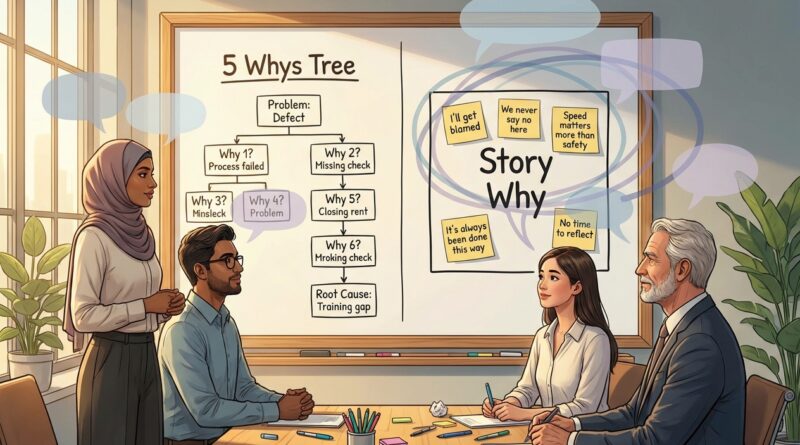
Why Your 5 Whys Keep Missing Culture: The Simple ‘Story Why’ That Reveals the Real Root Cause
You do the 5 Whys. You build the timeline. You check the logs, the handoffs, the policy gaps, maybe even your own bias. And still, the answer feels weirdly incomplete. That is frustrating because you can tell the process fix is only half right. The issue keeps coming back, or people quietly resist the solution. In many teams, that happens because the real problem is not just what people did. It is the story they are telling themselves about what the problem means. “Leadership never listens.” “If I raise this, I get punished.” “Speed matters more than quality here.” Those stories shape behavior long before a broken workflow shows up on a chart. If your root cause analysis skips them, you may fix the visible failure and miss the cultural engine underneath it. That is where a simple extra question helps. Ask not just why the event happened, but why this story about the event feels true to the people involved.
⚡ In a Hurry? Key Takeaways
- Your 5 Whys can miss culture because they explain actions and process gaps, but not the beliefs driving those actions.
- Add one more question: “What story are people telling themselves about this problem, and why does that story make sense here?”
- This helps you avoid blame, spot fear and power issues early, and build fixes people will actually accept.
Why a solid root cause analysis can still feel off
Most teams are pretty good at finding the mechanical cause.
A task was unclear. A handoff failed. The alert came too late. Nobody owned the decision. Those are real causes. You should fix them.
But culture often hides in the gap between what people say and what they actually do.
That is why a team can agree in the meeting, then ignore the fix later. It is why a process that looks perfect on paper falls apart in real life. The formal cause may be correct, but the psychological root cause analysis 5 whys culture piece is missing.
People act from stories. Stories about risk. Stories about status. Stories about who gets blamed. Stories about what success really means in this company.
What “Story Why” means in plain English
The Story Why is simple. After your usual 5 Whys, ask one more structured question:
“What story are people telling themselves about this situation, and why does that story feel believable here?”
This is not therapy. It is not mind reading. It is a practical way to surface the unwritten rules that shape behavior.
For example:
- “We skipped the review because deadlines matter more than quality.”
- “We stayed quiet because speaking up makes you look difficult.”
- “We worked around the system because official channels are too slow.”
Now you are getting somewhere. Those are not just opinions. They are clues.
Why the usual 5 Whys misses culture
It follows events, not meaning
The 5 Whys is great at tracing a chain of events. It asks what led to what.
Culture lives in meaning. What did people think would happen if they followed the rule? What did they think the company really rewarded?
People answer with safe facts
In most postmortems, people share the least risky explanation first.
“The documentation was outdated” is safer than “Nobody wanted to challenge the director.” Both may be true. Only one tells you why the pattern survives.
Process fixes feel more objective
Teams like fixes they can point to. New checklist. New owner. New dashboard.
That feels clean. Story-level causes are messier, but they are often what decides whether the clean fix survives first contact with real people.
How to use the Story Why without turning the meeting into a blame session
Step 1: Finish the normal analysis first
Do not skip facts. Build the timeline. Confirm what happened. Find the obvious process and system gaps.
The Story Why works best after you have a shared picture of the event.
Step 2: Ask for the likely story, not the “correct” story
Use language like this:
- “What might people have believed in that moment?”
- “What would make that choice feel reasonable to them?”
- “What story about success or risk seems to be operating here?”
This lowers defensiveness right away.
Step 3: Look for repeated phrases
If you hear versions of the same sentence from different people, pay attention.
Examples:
- “Around here, you need approval for everything.”
- “Nobody wants bad news late in the quarter.”
- “If it is not urgent for leadership, it does not get resourced.”
Repeated phrases are culture breadcrumbs.
Step 4: Test the story against behavior
Do not treat every story as fact. Ask what behavior it explains.
If the story is “raising risks gets punished,” do people delay escalation? Do they soften language? Do they route concerns privately instead of openly?
If yes, the story is doing real work whether leadership intended it or not.
A quick example
Say a product launch slipped because testing started late.
The normal 5 Whys might say:
- Testing started late because requirements changed.
- Requirements changed because stakeholders gave feedback late.
- Feedback came late because review meetings were delayed.
- Meetings were delayed because calendars were packed.
- Calendars were packed because planning was unrealistic.
Not wrong. But still incomplete.
Now add the Story Why:
What story were people telling themselves?
Maybe it was, “If we push back on the launch date, leadership will see us as blockers.”
That changes the fix.
Now you do not just improve planning. You also change how risk is raised, how schedule pressure is discussed, and how leaders respond when teams say a date is unsafe.
How Story Why connects to power
Sometimes the story people tell is shaped by hierarchy, not just habit.
If junior staff believe challenging senior people is career risk, that is not a communication problem. It is a power problem wearing a communication costume.
That is where system thinking helps. If you want to go one layer deeper, this piece on Why Your 5 Whys Ignore Power Structures: Use the ‘System Map Why’ To See The Real Root Problem fits well with the Story Why approach. Story tells you what people believe. System mapping helps show why those beliefs keep getting reinforced.
Questions that work well in real meetings
You do not need fancy language. Try these.
- “What made this choice feel like the safest one at the time?”
- “What do people here believe happens when someone raises a concern early?”
- “What unwritten rule might be shaping this behavior?”
- “If a new hire watched this happen, what would they assume gets rewarded here?”
- “What story would explain why smart people kept repeating this pattern?”
Notice the tone. Curious, not accusing.
Common mistakes to avoid
Do not psychoanalyze individuals
This is about shared patterns, not diagnosing one person’s motives.
Do not stop at one story
Different groups may hold different stories about the same event. Leadership, operations, and frontline staff often see very different realities.
Do not confuse a story with an excuse
Understanding why behavior made sense to people does not mean the behavior was fine. It means you are finally fixing the right thing.
Do not force a culture answer for every problem
Sometimes the issue really is just bad tooling or poor staffing. Use the Story Why when the facts are right there but the solution still does not seem like it will stick.
What a better fix looks like
When you include story-level analysis, your fixes get more human.
Instead of “add a required escalation step,” you might also add:
- leader scripts that reward early bad news
- retrospectives that protect dissent
- clear examples of when pushing back is expected
- metrics that do not reward silence and last-minute heroics
That is the difference between a process patch and a fix that can survive real culture.
At a Glance: Comparison
| Feature/Aspect | Details | Verdict |
|---|---|---|
| Standard 5 Whys | Good for tracing event chains, process gaps, and obvious failure points. | Useful, but often incomplete when behavior is shaped by fear or norms. |
| Story Why | Asks what people believed, what unwritten rule was active, and why that belief felt true. | Best for finding cultural and psychological drivers behind repeated problems. |
| Combined approach | Uses facts, systems, and story-level beliefs together to design stronger fixes. | Strongest option if you want changes that stick outside the slide deck. |
Conclusion
If your root cause analysis keeps producing fixes that look smart but do not change much, you are probably not failing at logic. You are missing the human layer. Right now teams are drowning in frameworks and AI tools for root cause analysis, but they are still blindsided by culture clashes, quiet resistance and unspoken fears that no dashboard will ever show. Asking one more structured why about the story people are telling gives you a fast, practical way to spot those hidden patterns. It helps you avoid blame-heavy investigations, understand what behavior really makes sense inside your culture, and build fixes that hold up in messy real life, not just in a neat meeting summary.