Why Your 5 Whys Keep Recycling Opinions: The Simple ‘Fact Map Why’ That Stops Fake Root Causes At The Start
You know the meeting. Someone says, “Let’s do a quick 5 Whys.” Ten minutes later, the room is full of confident theories, old grudges, and one person insisting the real issue is “lack of accountability.” It feels serious. It sounds smart. Then the fix goes live and nothing improves. That is maddening, especially when everyone genuinely wants to solve the problem.
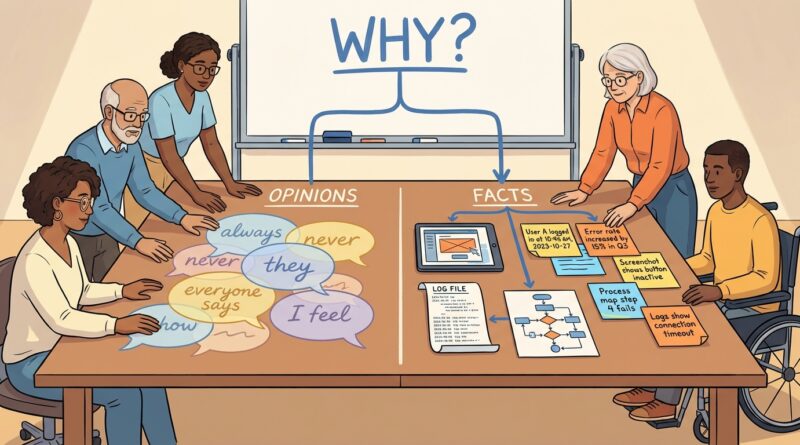
The usual failure is not that 5 Whys is broken. It is that the team starts asking why before agreeing on what is actually true. If the first statement is shaky, every “why” after that just recycles opinions. A simple fix is to build a quick “Fact Map Why” first. That means separating verified observations from guesses, then running your Whys only on facts the group can point to in the real workflow. It slows the first five minutes and saves the next five weeks.
⚡ In a Hurry? Key Takeaways
- 5 Whys root cause analysis works far better when you start with shared facts, not opinions about what probably happened.
- Use a simple “Fact Map Why” by listing observed events, evidence, and unknowns before asking the first why.
- This cuts blame, stops argument loops, and leads to fixes that stand up in the real workflow.
Why 5 Whys keeps turning into a debate club
5 Whys is supposed to help teams dig into cause and effect. But in practice, many sessions start with a sentence like, “The operator skipped the check,” or “The delay happened because communication was poor.”
Those sound like facts. Often, they are not. They are interpretations.
Once an opinion sneaks in at the start, the rest of the exercise becomes a chain of opinion defending itself. You are no longer finding causes. You are building a story that feels neat.
That is why teams can run several 5 Whys sessions on the same recurring problem and land in different places each time. The process looks structured, but the foundation is sand.
Facts vs opinions in root cause analysis
When people search for “5 whys root cause analysis facts vs opinions,” this is usually the pain underneath it. They do not need another template. They need a way to stop mixing what was seen with what was assumed.
What counts as a fact?
A fact is something the team can verify.
- The order entered the queue at 9:14 a.m.
- The required field was blank.
- The alarm triggered three times in one shift.
- Step 4 took 18 minutes longer than normal.
- The checklist version on the station was two revisions old.
What counts as an opinion or story?
- The team was careless.
- Training is bad.
- The software is confusing.
- No one owns the process.
- People were rushing.
Those may turn out to be true. But at the start, they are still claims. Treating them as facts too early is where most bad analysis begins.
The simple “Fact Map Why” method
This is the easy fix. Before anyone asks why, build a quick fact map. Think of it as a parking area for reality.
Step 1: Write the problem as an observable event
Not “shipping failed because planning was weak.”
Write, “Order 4837 shipped 2 days late after waiting 11 hours for approval between Step 3 and Step 4.”
That sentence is boring. Good. Boring is useful here.
Step 2: Split the board into three columns
- Known facts
- Assumptions or interpretations
- Unknowns we need to check
Now the team has permission to say what they think without sneaking it into the evidence pile.
Step 3: Build a timeline
Ask, “What happened first, next, then next?”
Use timestamps, handoffs, screenshots, logs, physical observations, defect counts, queue times, or actual work samples. Timelines are great because they calm the room down. People stop arguing in generalities and start looking at sequence.
Step 4: Mark every statement with its source
For each item, note where it came from.
- System log
- Audit trail
- Direct observation
- Operator interview
- Customer complaint
- Guess that still needs checking
This one step changes the quality of the conversation fast.
Step 5: Only ask “Why?” on verified facts
If the fact is “Approval sat untouched for 11 hours,” now ask why that happened.
If someone says, “Because nobody cared,” stop. That is not a fact. Ask, “What evidence do we have for that?”
You are not being difficult. You are protecting the analysis.
A quick example of bad 5 Whys vs better 5 Whys
The shaky version
Problem: Customer refund was delayed.
- Why? Because support was slow.
- Why? Because the team is understaffed.
- Why? Because management does not prioritize service.
- Why? Because leadership focuses on sales.
- Root cause: leadership priorities.
That may feel satisfying. It is also a great way to start a political fight.
The fact-mapped version
Observable problem: Refund request #2218 took 6 business days. Standard is 2.
Known facts:
- Request entered system Monday at 10:02 a.m.
- It waited 31 hours in a manual review queue.
- Required proof document was attached, but tagged incorrectly.
- Three agents reopened the case.
- The queue rule sends incorrectly tagged cases to manual review.
Now ask why:
- Why did it wait 31 hours? Because it went to manual review.
- Why did it go there? Because the document tag did not match the rule.
- Why did the tag not match? Because agents used two similar labels for the same document type.
- Why were there two labels? Because the form update added one label but the old label stayed active.
- Why did that happen? Because form changes were released without cleaning up downstream queue rules.
Now you have something you can actually fix.
Why this works psychologically, not just logically
People do not walk into analysis meetings as neutral robots. They walk in with memories, pressure, loyalties, and pet explanations.
Some want to protect their team. Some want to prove a long-running point. Some are simply guessing because nobody has the data in front of them.
A fact map helps because it lowers the social temperature. It gives everyone a fair place to put ideas without forcing the room to accept them as true too early. That matters.
It reduces status battles
The loudest person no longer wins by sounding certain.
It reduces blame language
Teams stop saying “who failed?” and start asking “what in the process happened?”
It makes unknowns visible
That is huge. Good analysis is not pretending you know. It is knowing what you still need to check.
How to use this with fishbone diagrams without making a mess
Fishbone diagrams can still be useful. The problem starts when teams fill every branch with untested reasons and then act as if the diagram itself proves something.
Use the fishbone after the fact map, not before.
A better order looks like this
- Write the observable problem.
- Build the fact map.
- Identify unknowns and verify the most important ones.
- Run 5 Whys on the strongest facts.
- Use a fishbone only if you need to group possible contributors for further checking.
That order keeps your tools honest. The fishbone becomes a thinking aid, not a wall of attractive guesses.
Three phrases that improve the meeting immediately
If you lead these sessions, a few simple lines can rescue the whole discussion.
“What did we observe, exactly?”
This pulls people back from labels and toward evidence.
“How do we know that?”
Not rude. Just clean.
“Is that a fact, an interpretation, or an unknown?”
This is the core sorting question. Use it over and over.
What to do when the data is incomplete
This is real life. Sometimes the logs are messy. The timestamp is missing. The person who handled the case is off this week.
You can still work well.
Do not fake certainty
If something is unknown, label it unknown.
Use the smallest testable next step
Check 10 samples. Watch one shift. Pull one day of queue data. Interview two people who touched the work. You do not always need a giant study. You do need enough evidence to stop pure storytelling.
Delay the final root cause statement if needed
That feels uncomfortable to some teams, but it is far better than declaring a neat answer that falls apart next week.
How to tell if your current 5 Whys habit is broken
You are probably recycling opinions if any of this sounds familiar:
- The same “root causes” appear in every meeting, like communication, training, or accountability.
- Different groups analyze the same issue and reach completely different conclusions.
- People spend more time defending departments than describing workflow.
- Actions are vague, like “retrain staff” or “improve ownership.”
- The problem comes back even after the action is marked complete.
Those are not small warning signs. They are your system telling you the analysis is starting too far from the facts.
What a strong corrective action looks like
When the root cause is anchored to verified process facts, the fix gets more practical.
Weak action: “Coach staff to be more careful.”
Stronger action: “Remove duplicate document labels, update the queue rule, and test 20 recent refund cases to confirm routing behaves as expected.”
One is a wish. The other changes the conditions that created the delay.
A simple meeting template you can use tomorrow
1. Define the event
What happened, where, when, and by how much did it miss the expected result?
2. Build the fact map
List known facts, interpretations, and unknowns.
3. Verify the biggest unknowns
Do a quick check before going further.
4. Run 5 Whys on verified facts
Keep asking for evidence at each step.
5. Write the cause statement carefully
Use process language. Name the mechanism, not the villain.
6. Design a fix that changes the system
Then decide how you will confirm it worked in the real workflow.
At a Glance: Comparison
| Feature/Aspect | Details | Verdict |
|---|---|---|
| Starting point | Traditional weak sessions often begin with a theory. Fact Map Why begins with observable events and evidence. | Start with facts every time. |
| Team conversation | Opinion-led meetings drift into blame and repeated arguments. Fact-mapped meetings separate knowns, guesses, and unknowns. | Better clarity, less heat. |
| Quality of fixes | Guess-based causes produce vague actions like retraining or reminders. Fact-based causes point to process changes you can test. | Much stronger chance the fix sticks. |
Conclusion
If your root cause sessions keep producing weak fixes, the problem may not be the 5 Whys itself. It is often the missing step before the first why. Teams are blending assumptions, memory, and confidence, then treating the result like analysis. That is why so many people are frustrated right now, especially when 5 Whys gets mixed with fishbone diagrams and nobody stops to agree on what is actually happening in the process.
The good news is that this is fixable. A simple, psychology-aware Fact Map Why gives your team a way to separate stories from facts, lower the blame, and focus on causes you can actually verify. Do that, and 5 Whys becomes useful again. Not a checkbox ritual. A real thinking tool that leads to actions that survive contact with real life.