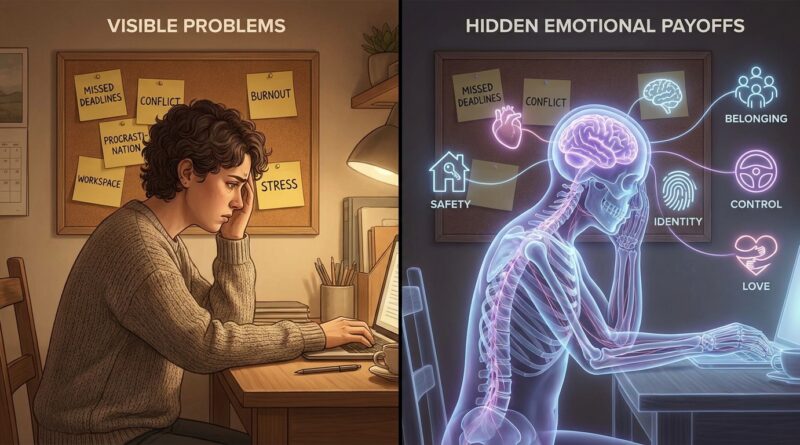
Why Your 5 Whys Keep Missing Hidden Payoffs: The Simple ‘Payoff Why’ That Explains Why You Cling To Problems That Hurt You
You do the 5 Whys. You write down the pattern. You trace it back neatly. Maybe you even have a color-coded note app proving you understand the problem. And still, nothing changes. That is maddening. It can make you feel lazy, broken, or weirdly resistant to your own best interests. Usually, though, the missing piece is not more logic. It is the hidden payoff. In plain English, some part of the problem is helping you, even while it hurts you. Maybe overworking wins you praise. Maybe procrastinating protects you from being judged. Maybe staying in the same conflict keeps you from facing a scarier choice. The simple “payoff why” asks one extra question after your usual root cause analysis. What do I get to keep, avoid, prove, or protect by staying this way? That question often explains why smart insight keeps stalling before real change.
⚡ In a Hurry? Key Takeaways
- Your 5 Whys may miss the real driver if they stop at logic and never ask what emotional benefit the problem is secretly providing.
- Add a “payoff why” to your root cause analysis by asking, “What does this pattern help me avoid, protect, or receive?”
- This is not about blaming yourself. It is about spotting the hidden deal your brain made so you can replace it with a healthier one.
Why the usual 5 Whys can fall short
The 5 Whys is useful. It helps you move past surface excuses and spot patterns. It works well for process problems, missed deadlines, repeated mistakes, and all sorts of workplace messes.
But people are not factory lines.
When the same painful pattern keeps coming back, a clean logical explanation is often only half the story. You might figure out that you overcommit because you fear disappointing people. True. Helpful. Still not enough.
The missing part is this. Fear of disappointing people may also earn you something. Approval. A sense of worth. Relief from conflict. A temporary feeling of safety.
That benefit is the hidden payoff.
If you do not name it, your root cause analysis can become a very smart description of why you are stuck, without becoming a path out.
What is a hidden payoff?
A hidden payoff is the emotional job a bad pattern is doing for you.
It is “hidden” because you usually do not choose it on purpose. In fact, if someone accused you of wanting the problem, you would probably say, “Absolutely not.” Fair enough. You do not want the pain. But a part of you may want what the pain brings with it.
Common hidden payoffs
Here are a few examples people run into all the time:
- Overworking. Payoff: praise, control, feeling needed, avoiding rest that feels unsafe.
- Procrastination. Payoff: protection from full effort and possible failure, excuse if the result is poor.
- Staying in constant conflict. Payoff: familiar emotional intensity, avoiding grief, avoiding bigger decisions.
- People-pleasing. Payoff: belonging, reduced tension, identity as the “good” one.
- Never finishing projects. Payoff: you never have to test whether your real best work is enough.
None of these are silly. They are often old survival strategies with new branding.
The simple “payoff why” to add to root cause analysis
If you are using the 5 Whys, do your normal chain first. Then add one more question.
The question
What do I get to keep, avoid, prove, or protect by continuing this pattern?
That is the payoff why.
It shifts the focus from “Why am I like this?” to “What job is this behavior doing for me?” That is a much kinder and often more accurate question.
Other useful versions of the same question
- What feels safer if I stay the same?
- What discomfort would change force me to face?
- What identity do I get to hold onto through this problem?
- Who might react if I changed?
- What short-term relief is this giving me?
A quick example
Let’s say your repeating problem is burnout.
Your 5 Whys might look like this:
- I am burned out because I keep taking on too much.
- I take on too much because I do not say no.
- I do not say no because I worry people will think I am difficult.
- I worry about seeming difficult because I learned being easy to manage kept me accepted.
- I link acceptance with over-functioning.
That is already insightful. But now add the payoff why.
What do I get by staying in this pattern?
Maybe the answer is:
- I get praise.
- I get to feel indispensable.
- I avoid the guilt of letting people down.
- I do not have to face the fear that I am only valuable when I am useful.
Now we are getting somewhere.
The hidden payoff explains why the pattern survives even after you understand it. Burnout is not just a scheduling issue. It is part of a private emotional contract.
Why this matters so much right now
A lot of people are learning root cause tools from productivity culture, leadership newsletters, coaching clips, and AI-driven business advice. That is not a bad thing. Clear thinking helps.
But many of those tools quietly assume that once you see the cause, you will naturally change the behavior.
That is often not how humans work.
Especially not in seasons of burnout, career pivots, money stress, caregiving strain, relationship resets, or plain old exhaustion. In those moments, people do not just repeat habits because they are irrational. They repeat them because the habits still solve something, even badly.
That is why the search for the hidden payoff why we repeat the same problems root cause analysis matters. It gives you a fuller map.
How to find your hidden payoff without turning it into self-attack
This part matters. If you ask the payoff question in a harsh voice, you will get defensive fast.
Do not ask, “How am I sabotaging myself now?”
Ask like a gentle investigator.
Step 1: Name the repeating pattern clearly
Keep it concrete. Not “my life is a mess.” More like:
- I agree to things I resent.
- I wait until the last minute on important work.
- I keep revisiting a dead-end relationship.
Step 2: Run your usual 5 Whys
Write the chain. Keep going until you reach something that feels emotionally real, not just socially acceptable.
Step 3: Add the payoff why
Ask:
- What does this protect me from?
- What does this help me get?
- What feels risky about stopping?
Step 4: Look for the short-term reward
Hidden payoffs are often immediate. Relief now. Approval now. Delay now. Numbness now.
The long-term cost may be huge, but the short-term reward is what keeps the loop alive.
Step 5: Build a replacement, not just a removal
This is the part people skip.
If overworking gives you praise and safety, you cannot just “stop overworking” and expect your nervous system to clap. You need a new way to get reassurance, structure, worth, rest, or support.
In other words, do not yank away the old coping tool before offering yourself a better one.
What hidden payoffs are not
It helps to be clear here.
They are not proof that you want to suffer
No. It means some part of your system is trying to help, just with outdated software.
They are not an excuse to stay stuck
Once you can name the payoff, you can start negotiating with it. That is power, not surrender.
They are not always huge childhood revelations
Sometimes the payoff is very ordinary. “If I do not try, I do not have to find out I am average.” That is painful, but it is also straightforward.
How to “upgrade the deal” you made with yourself
This is where change starts to stick.
Think of the hidden payoff as an old subscription you forgot you signed up for. It keeps charging you. It still provides one useful feature, so you keep tolerating the rest.
You do not need to shame yourself for subscribing. You need a better plan.
Example upgrades
- Old deal: If I overdeliver, I get approval. New deal: I will ask for clear feedback and practice being valued without constant proving.
- Old deal: If I procrastinate, I avoid judgment. New deal: I will make smaller public drafts so feedback feels less all-or-nothing.
- Old deal: If I keep rescuing everyone, I stay needed. New deal: I will build connection through honesty, not usefulness alone.
The point is not to become perfect. It is to find another way to meet the need the bad pattern was clumsily meeting.
Questions worth journaling on
If you want to dig into this on your own, try these:
- What problem do I keep analyzing without changing?
- What is the cost of this pattern?
- What is the immediate benefit?
- What emotion does this behavior save me from feeling?
- If I stopped tomorrow, what would suddenly become uncomfortable?
- What healthier support would I need to change safely?
You may not get the answer in one sitting. That is normal.
When to get outside help
Sometimes hidden payoffs are tied to trauma, chronic stress, grief, abuse, or deep identity wounds. If your answers feel heavy, confusing, or emotionally intense, it may help to work with a therapist, coach, or trusted support person.
This is not a failure of self-awareness. Sometimes you cannot read the label from inside the jar.
At a Glance: Comparison
| Feature/Aspect | Details | Verdict |
|---|---|---|
| Standard 5 Whys | Good at finding logical causes, process gaps, habits, and triggers. | Useful, but often incomplete for emotional patterns. |
| Payoff Why | Asks what the problem helps you keep, avoid, prove, or protect. | Often the missing bridge between insight and action. |
| Best path to change | Combine both. Find the cause, then replace the hidden payoff with a healthier option. | Most realistic and most likely to stick. |
Conclusion
If you keep repeating the same root cause analysis and still end up in the same place, you are not necessarily missing discipline. You may be missing the emotional logic. A lot of people are learning 5 Whys, pre-mortems, and similar tools right now, but those methods often leave out a hard truth. We often keep painful patterns because they are secretly doing an emotional job for us. Naming that job is the bridge between insight and real behavior change, especially in a year full of burnout, career pivots, and relationship resets. When you can say, “Ah, this problem has been protecting me, rewarding me, or helping me avoid something,” the shame drops a notch. Then you can make a better deal with yourself. Not “just stop.” Something smarter. Something kinder. And finally, something that has a real chance of lasting.