Why Your 5 Whys Keep Chasing Symptoms: The Simple ‘Iceberg Why’ That Shows You The Layer You’re Really Stuck In
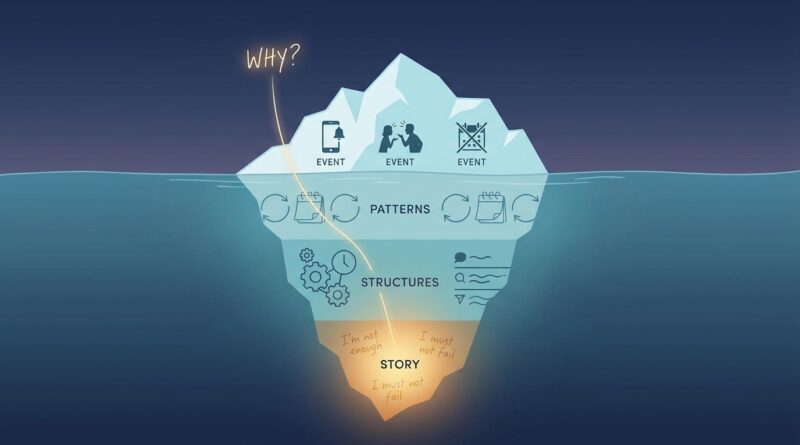
You ask why. Then why again. Maybe five times. And somehow you still end up in the same argument, the same overdraft, the same Sunday-night dread before work. That is maddening, especially when you are honestly trying to get to the root of it. The problem often is not that you failed to think hard enough. It is that you kept digging in the same layer. You stayed in behavior, or emotion, or beliefs, when the real block was sitting somewhere else entirely. That is where the Iceberg Why helps. It takes the usual root-cause idea and adds a simple picture. Four stacked layers. What happened on the surface, the patterns under that, the system shaping those patterns, and the deeper story or identity holding the whole thing in place. Once you can see the layer you are actually stuck in, your “whys” stop sounding smart and start becoming useful.
⚡ In a Hurry? Key Takeaways
- Your 5 Whys may fail because you are drilling deeper inside one layer of the problem instead of moving between layers.
- Use the Iceberg Why by checking four levels in order: event, pattern, system, and identity or meaning.
- This is a practical thinking tool, not a replacement for therapy, financial advice, or crisis support when the problem is serious.
Why the usual “keep asking why” can stall out
The classic 5 Whys is useful. It works well for many technical problems. A machine stopped. A process broke. A shipment got delayed.
But people are not machines. Families are not factory lines. Teams, habits, money stress, and burnout are messy. They have history. They have pressure from outside. They have stories attached to them.
So what happens? You ask “why” five times and get a chain that sounds smart but changes nothing.
For example:
I missed my deadline.
Why? I procrastinated.
Why? I was tired.
Why? I stayed up late.
Why? I was stressed.
Why? I care too much.
Fine. Maybe true. But what do you do with that on Tuesday?
The problem is that each answer stayed inside roughly the same layer. Personal behavior and immediate feelings. You kept drilling down in one vertical tunnel. Meanwhile, the real issue might be a workload system, a fear of criticism, a bad sleep environment, unclear priorities from your boss, or an identity story like “if it is not perfect, it is not safe to submit.”
The Iceberg Why, in plain English
If you have ever seen the iceberg model, you already know the basic picture. A small piece is visible above water. Most of it sits below.
The Iceberg Why combines that picture with root cause analysis. Instead of just asking why over and over, you ask what layer this answer belongs to.
The four layers
1. Event. What just happened?
This is the visible tip. The fight. The missed payment. The panic attack before a meeting. The employee quitting.
2. Pattern. What keeps happening?
This is where you stop treating one bad Tuesday like a random fluke. Is this the third missed payment? The same type of argument every month? The same crash after every busy season?
3. System. What setup makes that pattern likely?
This is the layer people often skip. Rules, incentives, habits, schedules, workflows, family roles, app design, office culture, budget structure. The system is the stage on which the pattern keeps replaying.
4. Identity or meaning. What deeper belief, fear, loyalty, or self-story is keeping the system in place?
This is the layer under the system. “I have to be needed.” “Rest is laziness.” “Talking about money means failure.” “If I set a boundary, people leave.”
Not every problem needs all four layers. But most repeating ones touch at least three.
Why this works better than flat problem solving
Most of us treat problems like they are one-dimensional. One cause. One fix. One neat answer.
Real life is stacked. Your behavior may be driven by a system. The system may be protected by an old identity story. That story may be triggered by a current pattern. If you only fix one piece, the others quietly rebuild the problem.
That is why people “understand” their issue and still repeat it.
They found an answer. Just not the right layer.
A napkin sketch you can use in two minutes
Draw a simple iceberg. Or just make four horizontal lines on a page.
Label them:
- Event
- Pattern
- System
- Identity / Meaning
Then fill them in with one sentence each.
The script
Event: What happened?
Pattern: When else does this happen?
System: What setup, incentives, habits, roles, or environment keep this going?
Identity/Meaning: What belief, fear, loyalty, or self-image makes that setup hard to change?
That is the whole tool.
Simple on purpose.
Example 1: The same relationship fight, again
Event: We fought because one person came home late and did not text.
Pattern: We keep having the same fight about “small” things that become huge.
System: There are no clear expectations around communication, both people are overloaded, and conflict only happens when one person has already hit their limit.
Identity/Meaning: One person hears lateness as “I do not matter.” The other hears requests for updates as “I am being controlled.”
Now compare that with a flat 5 Whys.
Why did we fight? Because you were late.
Why were you late? Work ran over.
Why did work run over? My boss asked me to stay.
Why did you not text? I forgot.
Why did you forget? I was stressed.
None of that is false. It is just not enough.
The useful move is not “remember harder.” It is building a system plus naming the deeper story. Maybe a shared rule for updates. Maybe a conversation about what lateness means emotionally before the next crisis hits.
Example 2: Money problems that keep “surprising” you
Event: You overused your credit card again this month.
Pattern: It happens whenever there is stress, a social event, or an irregular expense.
System: Your budget only covers ideal weeks, savings are not separated, bills are scattered across dates, and your spending apps make tapping easy but tracking annoying.
Identity/Meaning: Part of you links spending with relief, generosity, status, or “finally feeling normal.” Another part avoids looking at money because it brings shame.
If you stay at the event layer, the answer becomes “be more disciplined.”
If you reach the system layer, the answer might be automatic transfers, one weekly money check-in, sinking funds for irregular costs, and fewer hidden triggers.
If you reach the identity layer, you may realize you are not fighting math. You are fighting shame, scarcity memories, or a need to look okay in front of other people.
Example 3: Burnout that keeps coming back
Event: You crash every few months and lose motivation.
Pattern: You overcommit, perform well, ignore fatigue, then hit a wall.
System: Your workplace rewards urgency, your calendar has no recovery time, and at home you do not count invisible labor as real labor.
Identity/Meaning: You believe your worth comes from being useful, easy, and impressive.
This is where the iceberg model root cause psychological why framework becomes more than a buzz phrase. It helps you see that burnout is not always “working too hard.” Sometimes it is identity glued to a system that never says stop.
How to tell which layer you are stuck in
Here are some clues.
You are stuck in the event layer if:
- You keep focusing on the latest incident.
- You talk about what happened more than what repeats.
- Every solution is about reacting faster next time.
You are stuck in the pattern layer if:
- You can describe the loop clearly, but it still runs.
- You say things like “this always happens” without changing the setup.
- You have insight, but no structural change.
You are stuck in the system layer if:
- You keep redesigning routines, tools, and schedules, but the same emotional charge returns.
- You optimize everything except the belief underneath it.
- You create good plans you somehow refuse to follow.
You are stuck in the identity layer if:
- Every problem turns into a deep personal meaning crisis.
- You understand your childhood beautifully but still do not change your calendar, budget, or communication habits.
- You use insight as a substitute for action.
That last one matters. Some people live too shallow. Some live too deep. Both can miss the fix.
The mistake people make with “root cause”
They assume there is one root.
Often there is not. There is a stack.
The event is fed by a pattern. The pattern is fed by a system. The system is protected by identity. If you ignore the stack, the problem regrows.
Think of weeds. Cutting the leaf is not the same as fixing the soil.
How to use the Iceberg Why in real time
When something goes wrong, try this short version:
- Name the event in one sentence.
- Name the repeating pattern in one sentence.
- Name one system factor you can actually change this week.
- Name one belief or fear that makes that change feel hard.
Then do not make a giant life plan. Make one move per layer.
A practical template
Event move: Clean up the immediate mess.
Pattern move: Track when this happens for two weeks.
System move: Change one rule, tool, schedule, or environment cue.
Identity move: Write the belief in a blunt sentence and test a healthier replacement.
Example:
“I snapped at my partner.”
Event move: apologize.
Pattern move: notice if this happens after long workdays.
System move: no serious talks in the first 20 minutes after getting home.
Identity move: challenge “If I admit I am overwhelmed, I am weak.”
Questions that actually get you unstuck
Try these instead of asking “why” in the exact same tone five times:
- What happened?
- What has been happening more than once?
- What setup makes this easy to repeat?
- What am I protecting by keeping that setup?
- What would feel risky about changing it?
- What layer have I ignored so far?
That last question does a lot of work.
When this tool is most useful
The Iceberg Why shines when the problem is repetitive, emotional, and a little embarrassing.
Things like:
- the same couple fight
- the same work conflict
- the same late fee
- the same spiral into overthinking
- the same self-sabotage before progress
If the issue is a one-off technical failure, standard root cause analysis may be enough.
If the issue involves trauma, abuse, addiction, severe depression, or danger, this can still be a helpful map, but it is not the whole answer. Please bring in professional support.
What not to do
Do not use the identity layer as a weapon
Saying “your real issue is abandonment” in the middle of a fight is a great way to start a worse fight.
Do not skip the system layer
This is the layer most people miss. They either stay superficial or go straight into childhood stories. Meanwhile the actual fix might start with sleep, workload, money automation, or clearer rules.
Do not confuse explanation with permission
Understanding why you do something does not erase the need to change it.
Do not wait for a perfect root cause
You do not need the final answer to make a better move. Often one clear system change reveals the next layer.
At a Glance: Comparison
| Feature/Aspect | Details | Verdict |
|---|---|---|
| Classic 5 Whys | Good for linear problems, but can stay trapped in one layer if the issue is human and messy. | Useful starting point, not always enough. |
| Iceberg Why layers | Checks event, pattern, system, and identity or meaning, so you can spot where the real blockage sits. | Better for repeating personal and team problems. |
| Real-world action | Works best when you pair insight with one concrete change in routine, environment, or communication. | Most useful when it leads to a small test this week. |
Conclusion
If your usual root-cause thinking keeps leading to the same dead end, the problem may not be your honesty or effort. You may just be using a flat map for a stacked problem. That is why the Iceberg Why helps. It gives you a simple picture you can sketch on a napkin, then use right away. Event. Pattern. System. Identity. Four layers, one clearer way to think. At a time when people are flooded with talk about bias, emotion, identity, algorithms, and social pressure, it is surprisingly easy to keep treating problems like they have only one dimension. This framework fixes that without turning your Tuesday afternoon into a graduate seminar. Use it for the fight that keeps returning, the budget that keeps slipping, the job stress that keeps rebuilding itself. When you can see the layer you are really stuck in, your next step gets smaller, clearer, and a lot more likely to work.