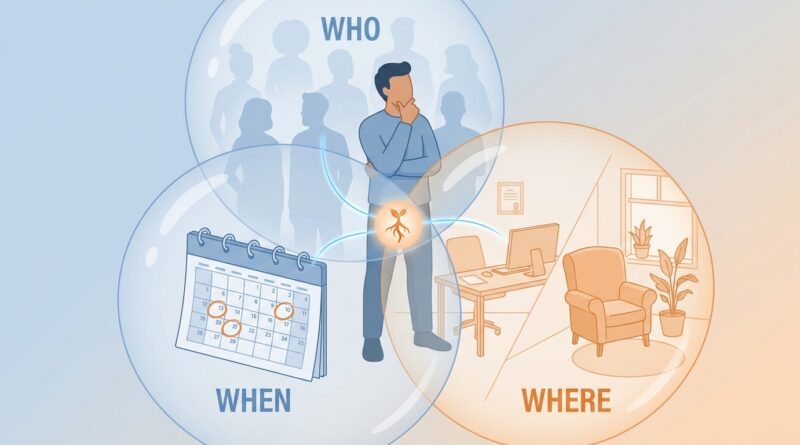
Why Your 5 Whys Keep Ignoring Context: The Simple ‘Situation Why’ Behind Problems That Only Happen With Certain People or Places
You ask why five times, fill a page with arrows and sticky notes, and somehow still miss the most obvious part. The problem only happens with one person, one team, one client, or in one place. That is maddening. It also makes a lot of people blame themselves for things that are not fully about them. If you are calm all week but unravel in one standing Monday meeting, that is not random noise. It is a clue. A standard 5 Whys session often acts like behavior happens in a vacuum. Real life does not work that way. Context changes pressure, timing, power, energy, and risk. If your notes never explain why the issue appears only in that one setting, your root cause work is incomplete. The missing step is simple. Add a “situation why” before you decide the problem is your personality, your discipline, or your character.
⚡ In a Hurry? Key Takeaways
- Situational root cause analysis with 5 Whys works better when you ask not just “why did this happen?” but also “why does it happen here, with them, or at this time?”
- Before blaming yourself, compare when the problem shows up versus when it does not. The difference often points to the real trigger.
- This matters for mental health too. Mislabeling a situational problem as a personal flaw can fuel shame, burnout, and bad fixes.
Why the usual 5 Whys can miss the real issue
The classic 5 Whys is useful. It helps you move past surface symptoms and look for causes. But people often use it too narrowly.
They ask, “Why did I shut down in the meeting?” Then they write things like, “I was unprepared,” “I lack confidence,” or “I need better communication skills.” Maybe some of that is true. But if you only shut down in one meeting and not in the other nine, those answers are not enough.
The missing question is this. Why there?
That is the heart of situational root cause analysis 5 whys. You are not only asking why the problem happened. You are asking why it happened in that specific setting, with that specific mix of people, timing, expectations, or constraints.
What a “situation why” actually means
A situation why is the context layer behind a problem.
It looks at conditions, not just character. It asks what was different about the environment when the issue showed up.
Examples of situation factors
These are the kinds of things that often get left out:
- Who was in the room
- Power dynamics
- Time of day or day of week
- Whether the problem happened in public or private
- Noise, interruptions, or meeting overload
- Ambiguous instructions
- Past conflict with a person or team
- How much sleep, food, or recovery you had
- Whether stakes felt real or imagined
Those things are not side notes. They are often the reason the problem appears at all.
The clue most people ignore
If something happens only on Mondays, only with one client, only during family visits, or only when a certain manager is involved, that pattern is data.
Do not smooth it away by saying, “Well, I just need to be better under pressure.” Maybe. But maybe Monday means no recovery from the weekend travel. Maybe that client interrupts constantly. Maybe that manager asks questions in a way that feels like a trap. Maybe the family visit drops you back into an old role you thought you had outgrown.
Patterns tied to place, people, or timing are usually not accidents. They are signposts.
How to add a situation layer to the 5 Whys
You do not need a whole new system. Just add one extra branch.
Step 1: Write the problem in a very specific way
Skip vague statements like “I keep failing at communication.”
Try something like this instead. “I freeze and say too little during the Monday leadership call with Client X.”
Now you have something you can actually test.
Step 2: Ask the normal why
Example:
- Why did I freeze? Because I felt put on the spot.
- Why did I feel put on the spot? Because I was asked for updates I did not have.
- Why did I not have them? Because the data comes in late on Monday morning.
That is useful. Keep going if it helps.
Step 3: Now ask the situation why
Ask these right next to the usual chain:
- Why does this happen in this meeting but not others?
- What is different about this person, place, or time?
- What condition is present here that is absent elsewhere?
- What changes if I move the same task to a different setting?
Using the same example, you might find:
- This client asks for unscripted status updates in front of senior leaders.
- The meeting is first thing Monday, before the reporting pipeline is stable.
- The account lead often speaks over me, which raises stress and makes it harder to think.
Now the picture is cleaner. This is not just “I am bad at speaking.” It may be “The setup combines missing data, public pressure, and interruption.” That leads to much better fixes.
Personal cause versus situational cause
Most problems are not 100 percent one or the other. They are usually a mix.
When it is more personal
You likely need skill-building or self-work when the issue shows up across many contexts.
- You interrupt everyone, not just one person
- You miss deadlines in different roles and settings
- You panic in most forms of public speaking
When it is more situational
You likely need a context fix when the issue is clustered around specific conditions.
- You only panic with one manager
- You only procrastinate on one type of task
- You only feel “lazy” in one workspace
- You only fight with your partner during travel or family events
This is where Why Your 5 Whys Keep Ignoring Context: The Simple ‘Situation Why’ Behind Problems That Only Happen With Certain People Or Places lands so well. The big idea is not to excuse everything. It is to stop misdiagnosing patterns that are clearly tied to a setting.
What this looks like in real life
At work
You think you are disorganized because one project keeps slipping. But only that project slips. Why? The stakeholder changes direction every week, approvals come late, and nobody agrees on scope. The real issue may be unstable inputs, not your discipline.
In relationships
You think you are “too sensitive” because you get defensive with one friend. But not with others. Why? That friend jokes at your expense in groups and denies it later. The pattern may be boundary erosion, not oversensitivity.
With self-improvement
You think you lack willpower because you cannot stick to a habit. But the habit fails only when you try to do it at night after a draining commute. The issue may be energy timing, not motivation.
Questions that help separate “me” from “this situation”
If you are stuck, ask these plainly:
- Where does this problem not happen?
- Who can I do this successfully with?
- What is different in those better cases?
- What happens right before the issue starts?
- What part of the setup raises pressure, confusion, or shame?
- If I changed only the context, would the problem shrink?
That last question matters a lot. If a small context shift creates a big improvement, that is strong evidence you were not dealing with a pure character flaw.
Run small experiments, not identity verdicts
This is the part people skip. They jump from one bad pattern to a big story about who they are.
Try experiments instead.
Examples of good experiments
- Move a hard conversation from a group setting to a one-on-one
- Ask for an agenda before the meeting
- Schedule the task at a different time of day
- Bring notes so you are not relying on memory under pressure
- Set a boundary with the person who derails the interaction
- Track whether the issue drops when one variable changes
If the problem improves, great. You learned something real. If it does not, you keep testing. That is far more useful than deciding you are broken.
Why this matters for mental health
When people ignore context, they often turn every repeated problem into a personal defect.
That is heavy. It feeds shame. It can make you over-correct, over-apologize, and stay in unhealthy setups longer than you should. It can also make teams fix the wrong thing. They send someone to training when the real issue is role confusion, bad timing, or a manager who creates fear.
Situational root cause analysis 5 whys is not about dodging responsibility. It is about putting responsibility in the right place.
Sometimes the answer is, “I need a new skill.” Sometimes it is, “This environment keeps triggering the same failure mode.” Those are different problems. They need different fixes.
Common mistakes to avoid
1. Treating one pattern as your whole identity
If it only happens in one context, do not label your whole personality from it.
2. Using context as an excuse for everything
Context matters, but it does not erase your part. Look for the mix. Maybe the environment is bad and you also need better preparation or boundaries.
3. Asking abstract whys
“Why am I like this?” is usually a dead end. “Why does this happen in that meeting after that email chain?” is much better.
4. Ignoring body and energy signals
Hunger, sleep debt, noise, overstimulation, and time pressure all shape behavior. They count as root causes too.
A simple template you can use
Try writing your next problem like this:
Problem: I shut down during Tuesday planning calls with Team B.
Usual why: I am worried I will say the wrong thing.
Situation why: Team B challenges ideas publicly before I have complete information.
Evidence: I speak normally in one-on-ones and in calls with Team A.
Test: Send pre-reads, ask for decision questions in advance, and share updates after data is confirmed.
Result: See whether shutdown drops over the next three meetings.
That is practical. It also keeps you honest.
At a Glance: Comparison
| Feature/Aspect | Details | Verdict |
|---|---|---|
| Traditional 5 Whys | Good for tracing a chain of causes, but it can drift toward personal blame if context is not included. | Useful starting point, but incomplete on its own. |
| Situation Why | Adds the missing context by asking why the issue happens with certain people, places, or timing. | Best for patterns that are selective, repeated, and environment-specific. |
| Best next action | Compare where the problem appears versus where it does not, then test one context change at a time. | Most likely to produce clean insight and better boundaries. |
Conclusion
If your 5 Whys never explains why the problem shows up only with one person, one team, or one place, you probably do not have the full answer yet. That does not mean the method is useless. It means the method needs context. Adding a simple situation why can help you stop turning every hard pattern into a verdict about your personality. That is important right now, because a lot of people are trying to fix themselves for problems that are actually situational, not personal. That confusion quietly drives shame, burnout, and bad decisions. When you separate “this is about me” from “this is about this setup,” you protect your mental health, set better boundaries, and run smarter experiments. And that gives any why-based framework a much better shot at finding the real cause, not just the most painful one.