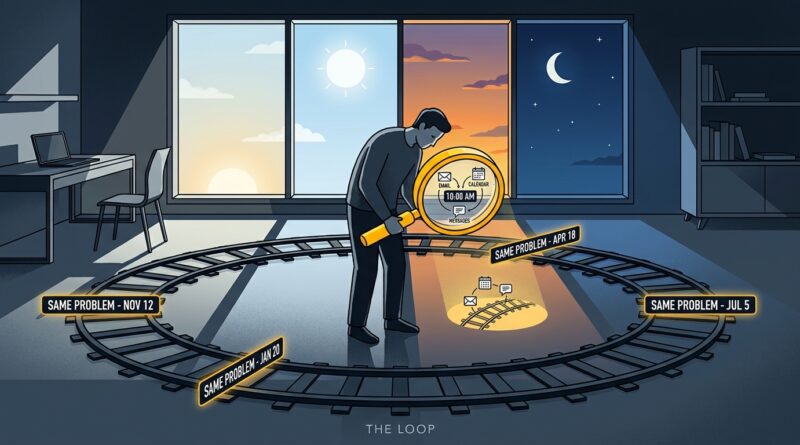
Why Your 5 Whys Keep Ignoring Time: The Simple ‘Timeline Why’ Behind Problems That Quietly Repeat For Years
You fix the problem. You talk it through. You ask “why” five times. Everyone nods. Then, somehow, the exact same mess shows up again a few months later. That is maddening, and it can make you feel like either your analysis was weak or your discipline is. Often, neither is true. The missing piece is time.
A lot of root cause analysis looks for reasons, but skips rhythm. It asks what caused the issue, not when the issue becomes most likely. That matters more than people think. Some problems are not random. They follow a schedule, a season, a stress build, or a predictable dip in energy. If you ignore that pattern, your fix can look smart on paper and still fail in real life. A simple “Timeline Why” helps you map when the problem starts gathering steam, when it peaks, and when a small intervention has the best chance of working. It is quick, practical, and surprisingly good at exposing why old problems quietly repeat for years.
⚡ In a Hurry? Key Takeaways
- Root cause analysis time patterns matter because many recurring problems are tied to predictable windows, not just bad decisions or weak systems.
- Draw a simple timeline of when the problem starts, worsens, peaks, and fades. Then test one small change at the earliest repeatable point.
- This is useful for habits, team friction, burnout, and procrastination, but it is not a substitute for medical, legal, or mental health support when those are needed.
Why the usual 5 Whys can miss the real pattern
The 5 Whys is helpful because it slows you down. It pushes past the first easy answer. But it has a blind spot. It often treats a problem like a frozen snapshot.
Something went wrong. You investigate. You explain it. Done.
Real life is messier than that. A lot of recurring problems are not single events. They are loops. They build over time, hit at familiar moments, and then disappear just long enough for you to stop watching.
Think about these examples:
- You procrastinate most heavily on Thursday afternoons, not all week.
- Your team gets snappy in the final three days before a deadline, not at the start of a project.
- You burn out every quarter, right after a big push, not because you are “bad at balance” every day.
If your analysis only asks “Why did this happen?” you may get a sensible answer. But if you also ask “Why then?” you often get the answer that actually changes behavior.
What a Timeline Why actually is
A Timeline Why is just a simple question set:
- When does this problem usually begin?
- What tends to happen right before it?
- When is it strongest?
- When does it ease up?
- What time-based condition keeps repeating?
That is it. No fancy software needed. A sticky note will do.
You are not replacing root cause analysis. You are adding time back into it. That is the heart of good root cause analysis time patterns work. You are trying to spot whether the cause is not just a belief, process, or skill gap, but a repeating time window where the problem gets an opening.
The simple Timeline Why method
1. Name the recurring problem plainly
Keep it boring and specific.
Not: “I am terrible at follow-through.”
Better: “I avoid planning next week’s work late Friday afternoon.”
Not: “Our team communication is broken.”
Better: “Status meetings become tense during the second half of every sprint.”
2. Sketch the timeline
Draw a line across a page. Mark a cycle that fits your problem.
- A day
- A week
- A month
- A quarter
- A project cycle
Then mark four points:
- Start of buildup
- Noticeable slide
- Peak problem moment
- Recovery or reset
You are looking for shape, not perfection.
3. Ask “Why then?” at each point
This is where the useful detail shows up.
For example:
- Why does procrastination start at 2 p.m. and not 10 a.m.?
- Why do arguments happen at the end of the month and not the beginning?
- Why does burnout hit after successful launches, not failed ones?
You may find things like decision fatigue, calendar pileups, recovery debt, social pressure, or a handoff gap that only appears near deadlines.
4. Find the earliest predictable opening
This part matters. Do not focus only on the moment of explosion.
The best intervention is often earlier.
By the time a person is already overwhelmed, avoidant, or defensive, the pattern is in full swing. You want the first repeatable point where the slide begins.
5. Test one small change in that window
Not a life overhaul. One small change.
Examples:
- Block 20 minutes before your known procrastination window for setup work.
- Move the most conflict-prone team discussion two days earlier.
- Add a recovery day after intense launches instead of waiting for exhaustion to hit.
Then watch what happens for two or three cycles.
A real-world example: recurring procrastination
Let’s say someone keeps putting off an important weekly report. They do a normal 5 Whys and come up with this:
- Why was the report late? I delayed it.
- Why did I delay it? It felt annoying.
- Why did it feel annoying? It is mentally heavy.
- Why is it mentally heavy? The data is messy.
- Why is the data messy? I collect it from too many places.
That is not wrong. In fact, it is pretty good.
But six weeks later, the same delay happens again.
Now add a Timeline Why:
- When does the delay start? Usually Wednesday after lunch.
- When is the report due? Thursday morning.
- What happens Wednesday after lunch? Back-to-back meetings and a mental energy drop.
- When is the task easiest? Wednesday at 10 a.m.
- What change might help? Pull data collection into Wednesday morning before meetings begin.
Same person. Same task. Different result, because time was the missing cause layer.
Why this works so well for burnout and recurring conflict
Burnout and conflict often get explained in very broad ways.
“We care too much.”
“We need better boundaries.”
“People do not communicate well.”
Sometimes those are true. But they are so broad that they are hard to act on this week.
A Timeline Why makes the problem more practical.
For burnout
Ask:
- At what point in the month or quarter does energy reliably dip?
- What kind of work stacks up before that dip?
- What recovery never happens in time?
You may find that burnout is not constant. It might spike after travel, after launches, or after long stretches of context switching.
For recurring conflict
Ask:
- When do the same people start clashing?
- What stage of the workflow are they in?
- What deadline, handoff, or ambiguity shows up right before the tension?
That often reveals that the conflict is less about personality and more about timing pressure.
Timeline Why versus trigger analysis
Time patterns and triggers often overlap, but they are not the same thing.
A trigger is the spark. A time pattern is the window in which the spark is more likely to catch.
For example, a critical comment might trigger a bad meeting. But if those comments land worst when the team is sleep-deprived and one day from deadline, time is part of the story too.
If that sounds familiar, this companion read is worth your time: Why Your 5 Whys Keep Missing Triggers: The Simple ‘Cue Why’ Behind Problems That Only Start After Something Small Happens. It pairs nicely with the timeline idea because many repeating problems need both views.
Common mistakes people make with root cause analysis time patterns
Trying to explain everything with personality
It is easy to say, “I am just a procrastinator,” or “Our manager hates conflict.” Sometimes the simpler truth is that a predictable time window keeps setting everyone up badly.
Studying only the failure moment
If you only inspect the crash, you miss the drift that came before it.
Changing too much at once
If you rewrite your whole routine, schedule, process, and tool stack in one go, you will not know what helped. Start small.
Ignoring recovery patterns
Some problems repeat not because the active work is wrong, but because the reset period is too short or too weak.
A five-minute Timeline Why template
Here is a simple version you can copy:
- Problem that keeps repeating: ________
- What cycle fits it best? Day, week, month, quarter, project
- When does the buildup begin? ________
- When does it peak? ________
- When does it fade or reset? ________
- Why is that timing important? ________
- What is the earliest repeatable point to intervene? ________
- What is one small change to test there? ________
You can do this alone, with a manager, or with a team in under ten minutes.
When this approach is especially useful
Use a Timeline Why when:
- The same issue comes back even after good discussions
- Your explanation sounds right, but does not hold over time
- The problem feels vague, seasonal, or oddly rhythmic
- You need a practical next step instead of another long post-mortem
It is especially good for personal habits, meeting problems, recurring stress, planning failures, and deadline behavior.
At a Glance: Comparison
| Feature/Aspect | Details | Verdict |
|---|---|---|
| Standard 5 Whys | Good for finding logical causes behind a specific incident, but it can treat repeat problems like one-time events. | Useful, but incomplete for patterns that quietly repeat. |
| Timeline Why | Maps when a problem starts building, peaks, and resets, so you can spot recurring time windows. | Best when timing seems to matter as much as motive. |
| Best first intervention | A small change placed at the earliest reliable point in the pattern, not at the final blow-up moment. | Usually the most practical and sustainable fix. |
Conclusion
Right now, a lot of people talk about root cause analysis like it is a one-time diagnostic exercise. You investigate, find the answer, and move on. But many real-world problems do not work that way. They return on a rhythm. They wait for a familiar stretch of stress, fatigue, deadline pressure, or low attention, and then they start again.
That is why a simple Timeline Why is so useful. It gives you a practical way to spot the repeating time pattern underneath procrastination, recurring conflict, and periodic burnout. More important, it helps you test one small change in the time window that matters most, instead of endlessly arguing about motives, beliefs, or systems.
If you are stuck on the same issue again this week, do not assume you missed the “real” root cause. You may have missed the clock. Sketch the pattern on paper. Ask why then. That small shift can turn a smart analysis into a fix that actually sticks.