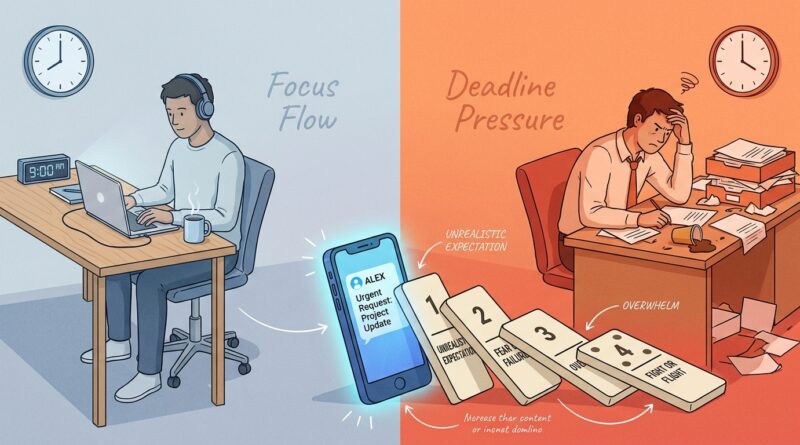
Why Your 5 Whys Keep Missing Triggers: The Simple ‘Cue Why’ Behind Problems That Only Start After Something Small Happens
You are not imagining it. The same problem really can keep coming back without starting the same way every time. One day it is a short email. Another day it is a Slack ping, a look from your boss, or a harmless comment from someone you love. Suddenly your chest tightens, your mood drops, or your brain checks out, and now you are left trying to explain why such a small thing hit like a truck. That is where a lot of “root cause” advice falls apart. It starts too late. It studies the meltdown, the argument, the shutdown, or the procrastination, but skips the tiny moment that lit the fuse. If your 5 Whys keep leading to vague answers like “I am stressed” or “I need better boundaries,” you may be missing the real start point. The fix is often not another deep personality analysis. It is a much simpler question. What was the cue?
⚡ In a Hurry? Key Takeaways
- Your emotional trigger root cause analysis may be failing because you are asking why after the reaction, not what cue started it.
- Track the first small trigger for a week, such as a message tone, time of day, person, phrase, or notification, before doing the usual 5 Whys.
- This is not about blaming yourself for being “too sensitive.” It is about spotting patterns early enough to reduce stress before it snowballs.
Why the usual 5 Whys can miss the real problem
The 5 Whys is a useful tool. Ask why something happened, then ask why that answer happened, and keep going until you hit the root cause.
That works well for visible failures. A missed deadline. A broken process. A fight. A panic spiral. A day lost to doomscrolling.
But there is a catch. If you start your questions too far downstream, you get a neat explanation for the wrong starting point.
Example:
Why did I snap in the meeting? Because I felt criticized.
Why did I feel criticized? Because the feedback sounded harsh.
Why did it sound harsh? Because I was already on edge.
Why was I on edge? Because I slept badly.
Why did I sleep badly? Because I am stressed.
None of that is exactly wrong. It is just incomplete.
The missing piece is the cue. What was the exact thing that flipped the switch in that moment? Maybe it was not “feedback” in general. Maybe it was one sentence. One person. One public comment instead of a private one. One message that arrived at 4:47 p.m. when your brain was already cooked.
What “Cue Why” means
Think of Cue Why as a prequel to the 5 Whys.
Before asking why you reacted, ask why it started right then.
That sounds small, but it changes everything. Instead of treating your emotional response like a character flaw, you start treating it like a pattern with a trigger.
The core question
Ask this first: What happened in the 10 seconds before my mood, energy, or behavior changed?
That is the cue. It might be:
- A Slack ping from one specific coworker
- A certain notification sound
- A phrase like “quick question” that usually means more work
- A time of day when your self-control drops
- A family member using a certain tone
- Seeing unread messages pile up
Once you spot the cue, then the rest of your root cause analysis gets sharper.
Why small triggers hit so hard
Small things are rarely small by themselves. They are loaded.
Your brain stores associations fast. A short email may not just be a short email. It may remind you of old criticism, job insecurity, conflict, embarrassment, or pressure to perform. So the current event is tiny, but the meaning attached to it is huge.
This is why people often say, “I know it should not bother me this much, but it does.”
You are not reacting only to the thing. You are reacting to the thing plus everything it represents.
Cues are often hidden in plain sight
Most people look for giant causes because giant reactions feel like they must come from giant problems.
Often, they do not.
The start of the spiral can be weirdly ordinary. A red badge icon. A calendar reminder. A phrase your manager always uses before changing plans. A text that says, “Can we talk?”
The body notices before the rational mind catches up.
How to do emotional trigger root cause analysis that actually helps
If you want your emotional trigger root cause analysis to be useful, separate the event into stages.
Stage 1: Find the cue
Ask:
- What was the first noticeable thing?
- Who or what was involved?
- What changed in my body first?
- Did this happen at a certain time, in a certain app, or with a certain person?
Be painfully specific. “Work stress” is too broad. “A Slack message from Sam with no greeting” is specific enough to test.
Stage 2: Ask why that cue has power
Now do the deeper questions:
- Why does that message style hit me?
- What do I assume it means?
- What past experience does it remind me of?
- What am I afraid will happen next?
This is where you may uncover fear of conflict, fear of disappointing people, old criticism, or simple exhaustion.
Stage 3: Change the system around the cue
Once you know the trigger, do not rely only on willpower. Change the setup.
You can:
- Mute or batch notifications
- Move hard conversations earlier in the day
- Ask people to send feedback in a clearer format
- Create a pause routine before opening certain apps
- Rename a recurring event in your calendar so it feels less threatening
This is often more effective than trying to “be less reactive.”
A simple real-world example
Let’s say every few days you become anxious and avoid work.
The usual 5 Whys might say:
I avoid work because I am overwhelmed. I am overwhelmed because I have too much to do. I have too much to do because my role is unclear.
Again, useful. But still broad.
Cue Why might reveal something more practical:
The avoidance starts after seeing an email from a certain client. That client often asks for urgent changes. Their subject lines are vague. You have learned to expect surprise demands.
Now the problem is no longer “I am bad at coping with stress.”
Now it is: “This cue reliably creates anticipatory stress.”
That gives you options. You can open those emails only at set times. You can use a template reply. You can ask for clearer requests. You can prepare a checklist before reading them.
Different diagnosis. Better fix.
Sometimes the cue is really about power
Not all triggers are sensory or timing-based. Some are relational.
If one person’s comment hits harder than the exact same comment from someone else, power may be part of the story. A manager, parent, senior colleague, or dominant partner can turn a neutral cue into a loaded one because the stakes feel higher.
That is where it helps to pair Cue Why with Why Your 5 Whys Keep Ignoring Power Dynamics: The Simple ‘Authority Why’ Behind Problems You Don’t Feel Safe Questioning. Sometimes the real issue is not just what triggered you. It is who triggered you, and what it feels unsafe to say back.
What to track for one week
You do not need a giant spreadsheet. A notes app works fine.
When you notice a sudden emotional shift, jot down five things:
- The cue. What happened right before the shift?
- The context. Where were you, what time was it, what were you already doing?
- The body signal. Tight chest, clenched jaw, stomach drop, brain fog, urge to hide?
- The story. What did your mind instantly tell you this meant?
- The behavior. Did you shut down, lash out, procrastinate, over-explain, scroll, or people-please?
By day five or six, patterns usually start to show up. Not always dramatic ones. Often boring ones. And boring is good, because boring patterns are easier to interrupt.
Common cues people miss
Digital cues
- Notification sounds
- Unread counts
- Calendar alerts
- Subject lines like “following up”
- Typing indicators in chat apps
Language cues
- “We need to talk”
- “Quick question”
- “Per my last email”
- “Interesting” said in a certain tone
Timing cues
- Late afternoon decision fatigue
- Sunday evening dread
- Right after back-to-back meetings
- Just before lunch when blood sugar is low
Social cues
- One person interrupting you
- A delayed reply from someone important to you
- Being left off a meeting invite
- A sarcastic joke that lands like criticism
What not to do
Do not use Cue Why to prove you are broken.
The goal is not to build a more detailed case against yourself. It is to notice what reliably starts the chain reaction so you can respond earlier.
Also, do not assume every trigger must be traced to some giant childhood revelation by Friday. Sometimes the answer really is practical. You are overloaded. The app is too noisy. The person communicates poorly. The meeting is always scheduled when your brain is done for the day.
Simple does not mean fake. Simple often means useful.
At a Glance: Comparison
| Feature/Aspect | Details | Verdict |
|---|---|---|
| Classic 5 Whys | Good for digging into visible problems after they happen, but it can skip the tiny event that set everything off. | Useful, but often starts too late for emotional patterns. |
| Cue Why | Focuses on the first trigger, such as a phrase, ping, time of day, or person, before doing deeper analysis. | Best for catching recurring stress at the switch-flip moment. |
| Best practical fix | Combine both. Spot the cue first, then ask why that cue carries so much weight, then change the setup around it. | Most effective and easiest to turn into daily habits. |
Conclusion
If you keep asking, “Why am I like this?” you will usually end up with answers that feel heavy, vague, and not very helpful. Try a gentler question instead. “Why did it start right then?” That is the heart of Cue Why. Right now people are drowning in burnout, anxiety, and decision overload, and too much advice still tells them to push through or think positive. But recurring stress usually has a starting signal. A ping. A phrase. A time of day. A person. When you spot that cue early, your emotional trigger root cause analysis becomes practical instead of punishing. You are no longer doing cleanup after the spiral. You are catching the spark before it becomes a fire. And that is often the first real bit of relief people feel in a long time.