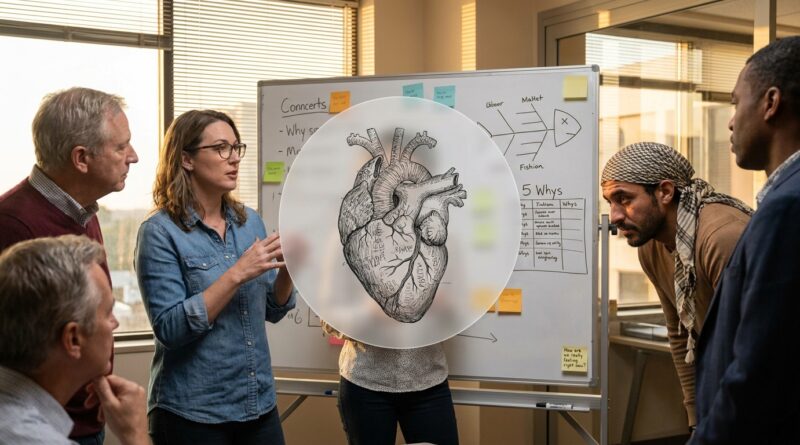
Why Your 5 Whys Keep Ignoring Feelings: The Simple ‘Emotion Why’ Behind Problems Data Can’t Explain
You know the meeting. The team puts the issue on a whiteboard, maps the workflow, fills out the fishbone, and asks “why” five times with total discipline. Everyone nods. The root cause gets labeled as “unclear process,” “training gap,” or “communication issue.” Then the same problem shows up again next month. That is maddening, especially when you did the method exactly right. The problem usually is not that 5 Whys is useless. It is that it tracks actions and systems better than it tracks fear, resentment, stress, embarrassment, or plain old exhaustion. People rarely say, “I skipped the step because I felt rushed and did not want to look slow.” But that hidden sentence often explains more than the official answer. If your team wants better root cause analysis, you do not need to throw out your tools. You need to add one more question. Ask the Emotion Why.
⚡ In a Hurry? Key Takeaways
- The missing piece in many 5 Whys sessions is emotion. People often act from stress, fear, shame, or frustration, not just bad process.
- Add an “Emotion Why” after your usual analysis. Ask what the person may have been feeling at that moment, and how that feeling shaped the choice.
- This is not about blame or therapy. It is a practical way to improve psychological safety and get to causes that data alone cannot show.
Why classic root cause tools keep missing the real problem
5 Whys, fishbones, incident reviews, and retrospectives are all good tools. They help teams slow down and think instead of react. But they tend to favor what is easy to document.
Steps. Handoffs. Policies. Metrics. Timing.
Those things matter. But people do not make decisions like robots. They make them while tired, overloaded, worried about getting blamed, annoyed with a coworker, or scared of looking incompetent.
That emotional layer is often the difference between what the process says should happen and what actually happened.
So when teams say, “We still do not know why this keeps happening,” what they often mean is, “We traced the workflow, but we never talked about what the people in that workflow were feeling.”
What the “Emotion Why” actually is
The Emotion Why is a simple add-on to your normal root cause analysis.
After you ask the usual operational questions, ask this:
What emotion made this choice feel reasonable in the moment?
That is the key. Not what emotion should have been there. Not what emotion sounds professional. What emotion made the action make sense at the time.
Here are a few examples:
- Fear. “I did not escalate because I thought I would get blamed.”
- Shame. “I did not ask for help because I felt I should already know this.”
- Frustration. “I skipped the checklist because it slows me down and no one listens when I flag that.”
- Exhaustion. “I saw the issue, but I had nothing left in the tank.”
- Social risk. “I agreed in the meeting because I did not want to challenge the manager.”
None of that usually appears on a fishbone diagram. Yet it often explains why the problem survives every process fix.
Why this matters for psychological safety
If you are searching for better ways to connect 5 whys, psychological safety, and emotions, this is the bridge.
Psychological safety is not just a nice team vibe. It changes what people say, hide, admit, and avoid. If the room feels unsafe, your 5 Whys will collect polished answers instead of true ones.
That is why some teams keep landing on fuzzy root causes like “lack of ownership” or “communication breakdown.” Those phrases can be true, but they are often too vague to fix. They also tend to hide the human motive underneath.
For example:
- “Communication breakdown” may really mean “people were afraid to speak up.”
- “Lack of ownership” may really mean “burned-out staff stopped caring because nothing changed last time.”
- “Training issue” may really mean “new hires felt too embarrassed to admit they were lost.”
Once you name the emotional reality, the fix gets clearer.
A quick example: the recurring missed handoff
Let’s say a customer request keeps getting dropped between Sales and Support.
Your standard 5 Whys might look like this:
- Why was the request missed? Because it was not entered into the ticketing system.
- Why was it not entered? Because Sales sent it by chat instead.
- Why did Sales use chat? Because it was faster.
- Why did they need speed? Because the customer was upset and wanted a quick answer.
- Why was there no time for proper entry? Because the handoff process is too slow.
That leads to a process fix. Maybe a shorter form or a faster intake route. Good idea. But it may still fail.
Now add the Emotion Why.
Why did chat feel like the better option in that moment?
Answer: because the Sales rep felt pressure and panic. They believed that if they paused to log the request properly, they would look unresponsive to the customer and get heat from their manager.
Now your solution changes. You still improve the handoff. But you also deal with the pressure pattern. Maybe managers stop rewarding speed that bypasses quality. Maybe the team creates a “fast but logged” path. Maybe leaders say clearly that proper entry will not be punished.
Same workflow. Better diagnosis.
How to add an Emotion Why without making people cringe
This is where some managers get nervous. They hear “emotions” and picture a forced group therapy session. That is not the goal.
You are not asking people to spill their childhood story in a postmortem. You are asking one practical question about decision-making under pressure.
Use neutral language
Try questions like:
- What felt risky in that moment?
- What were you trying to avoid?
- What felt urgent or uncomfortable here?
- What made the shortcut feel like the safest or fastest move?
- What would have been socially hard about doing it the “right” way?
These questions are easier to answer than “Tell me your feelings.” They still get you to the same place.
Ask about the moment, not the person’s character
Bad: “Why are you careless?”
Better: “What was happening in that moment that made this step easier to miss?”
The first triggers defensiveness. The second invites honesty.
Make it safe to tell the truth
If people think honesty will be used against them, they will give you clean, lifeless answers.
Set the tone up front:
- We are looking for conditions, not a villain.
- If stress, fear, or confusion played a role, say so.
- We want the real story, not the most polished one.
The 5 signs your team is missing the Emotion Why
- The same issue keeps returning after multiple process fixes.
- Your root causes sound generic, like “communication” or “human error.”
- People agree quickly in meetings, but behavior does not change later.
- No one mentions pressure, fear, burnout, or conflict, even when you know those exist.
- The official process looks fine on paper, but people keep working around it.
If that list feels familiar, your analysis probably is not wrong. It is incomplete.
A simple Emotion Why framework you can use tomorrow
Here is a fast version you can plug into your next review.
Step 1: Run your normal 5 Whys
Do not abandon the basics. Map the facts first.
Step 2: Circle the moment of choice
Find the point where a person made a call, skipped a step, stayed silent, rushed, or chose the workaround.
Step 3: Ask the Emotion Why
What emotion or social pressure made that choice feel reasonable?
Step 4: Separate system fixes from safety fixes
You may need both.
- System fix: simplify a form, reduce steps, clarify ownership.
- Safety fix: reward speaking up, reduce blame, train managers to respond better to bad news.
Step 5: Test the new answer
Ask, “If we fix the process but not the pressure, will this still happen?”
If the answer is yes, you are not done.
Do not confuse Emotion Why with excuse-making
This part matters. Naming emotion is not the same as excusing behavior.
If someone cut a corner because they were scared, the missed step still matters. If someone stayed silent because the boss was intimidating, the silence still had an impact.
The point is not to shrug and say, “Well, feelings happened.” The point is to understand what drove the behavior so you can prevent a repeat.
Good analysis balances accountability with reality.
The body often joins the story too
Sometimes the emotional pattern is tied to a physical stress response. People freeze. They fawn. They avoid conflict. They get tunnel vision. If that sounds familiar, you may also like Why Your 5 Whys Keep Ignoring Your Body: The Simple ‘Signal Why’ That Explains Why You Freeze, Fawn Or Flee Instead Of Act.
That idea fits nicely here. Sometimes a team problem is not just a bad workflow. It is a room full of nervous systems trying to stay safe.
What leaders should do differently
If you lead meetings, retrospectives, incidents, or improvement work, this starts with you.
Reward truth, not polish
When somebody says, “I did not escalate because I thought I would look incompetent,” do not punish the honesty. That honesty is gold.
Watch for repeated emotional patterns
If every issue involves rushing, fear of blame, or silent disagreement, that is not random. That is culture showing up in your root cause data.
Fix the environment, not just the form
You can rewrite checklists all day. If the emotional cost of following them stays too high, people will still avoid them.
At a Glance: Comparison
| Feature/Aspect | Details | Verdict |
|---|---|---|
| Classic 5 Whys | Great for tracing sequence, process gaps, and operational causes. Weak at uncovering fear, shame, burnout, or social pressure unless someone volunteers it. | Useful, but often incomplete on its own. |
| Emotion Why add-on | Adds one targeted question about what the person was feeling or trying to avoid in the moment of choice. | Fast, practical, and often reveals the repeat driver. |
| Psychological safety impact | When teams feel safe, they give real answers. When they do not, they hide behind vague process language. | Essential if you want honest root cause analysis. |
Conclusion
Right now, plenty of teams are doubling down on 5 Whys, fishbones, and templates while quietly wrestling with psychological safety, burnout, and unspoken frustration. That is why the same “process issue” keeps coming back wearing a new hat. The Emotion Why gives you a simple way to plug human reality into the tools you already use. You do not need to scrap your RCA habits. Just stop ending the conversation at the workflow. Ask what felt risky, stressful, embarrassing, or urgent in the moment. That is often where the real answer lives. Once teams can name those hidden motives, they stop blaming vague systems for everything and start fixing the conditions that keep problems alive. That is the practical gap many conversations about high-performing teams hint at, but rarely make concrete.