Why Your 5 Whys Keep Ignoring Habits: The Simple ‘Autopilot Why’ Behind Problems You Swear You’ll Fix Tomorrow
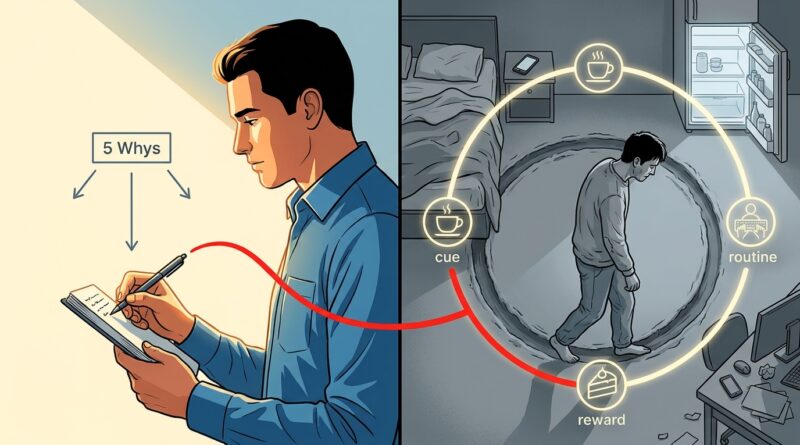
You do the 5 Whys. You write down the pattern. You feel that little rush of relief, like, “Finally. I understand why this keeps happening.” Then three days later you do the exact same thing again. That is maddening. It also does not mean you are lazy, weak, or somehow broken. It usually means your analysis stopped one layer too soon. Most people use 5 whys root cause habits work on paper, but miss the part that actually runs everyday behavior. Autopilot. The cue, routine, and reward loop your brain starts before your thoughtful self even shows up. If your root cause answer is only a belief, intention, or personality story, it may sound smart but still fail in real life. The missing question is simple. What happens automatically, right before the problem, that makes the old behavior easy and the better behavior almost invisible?
⚡ In a Hurry? Key Takeaways
- Your 5 Whys may be incomplete if it explains the problem but never identifies the habit loop that triggers it on autopilot.
- Add one more question. “What happens automatically right before this?” Then change the cue, friction, or environment, not just your intention.
- If a repeating behavior affects safety, money, health, or relationships in a serious way, habits matter, but outside help can matter too.
Why insight keeps failing you
The classic 5 Whys is useful. It helps you move past the first obvious answer.
Why was I late? I overslept. Why did I oversleep? I stayed up too late. Why did I stay up too late? I was scrolling. Why was I scrolling? I felt stressed. Why was I stressed? I avoided planning my day.
That sounds solid. It may even be true.
But it still does not explain why your hand reached for the phone again the next night without a debate, without a plan, and almost without your permission.
That is the gap. You found a reason. You did not find the autopilot.
The missing step: the Autopilot Why
Here is the simple fix. After your fifth why, ask one more question.
Ask this exactly
What happens automatically, right before the problem, that starts the loop?
This is your Autopilot Why. It is less about your life story and more about the sequence.
Not just “I am stressed.” More like this:
- I sit on the couch.
- The TV goes on.
- My phone is already in my hand.
- I open one app without thinking.
- Twenty minutes disappear.
That is gold, because now you can interrupt something real.
Habits are not opinions. They are loops.
Most repeated behavior is held together by a loop:
- Cue: what starts it
- Routine: what you do
- Reward: what you get from it
The reward is often tiny. Relief. Numbing out. Stimulation. Escape. Familiarity.
The problem is that standard root cause analysis often stops at a logical answer, while habits keep firing at a mechanical level.
You may know you should prepare tomorrow’s lunch. But if every night you finish dinner, sit down, and tell yourself you will “rest for one minute,” that sequence may be stronger than your insight.
Your brain loves efficiency. Habits are its favorite shortcut.
What the normal 5 Whys sounds like, versus what helps
Example 1: You keep missing workouts
Standard 5 Whys answer: I do not work out because I lack consistency. Why? My schedule is too busy. Why? I overcommit. Why? I do not set boundaries. Why? I want to please people.
Useful? Yes.
Enough to change Tuesday morning? Not really.
Autopilot Why: When my alarm rings, my workout clothes are in the closet, my phone is on the nightstand, and I check messages before my feet hit the floor.
Now we have something to work with.
- Put clothes and shoes by the bed
- Charge phone across the room
- Use a separate alarm
- Make the first action “put on shoes,” not “decide whether to work out”
Example 2: You keep snapping at people in the afternoon
Standard 5 Whys answer: I am overwhelmed and unsupported.
Again, maybe true.
Autopilot Why: At 2:30 p.m. I am hungry, switching tasks, and answering messages while trying to finish one last thing before a meeting.
That suggests a different fix:
- Block 2:20 to 2:35 for food and reset
- Pause notifications before the task switch
- Do not start high-friction conversations in that window
Why this matters more than another perfect explanation
A lot of people right now are using AI tools and printable templates to think through personal and work problems. That can help. But there is a trap. Better wording can make a bad diagnosis sound wise.
If your conclusion is impressive but not interruptible, your problem will come back.
That is why the Autopilot Why matters. It turns analysis into design. It asks, “What tiny part of the system keeps recreating this?”
How to do a habit-aware 5 Whys
Here is a simple version you can use today.
Step 1: Name one repeated problem
Keep it concrete. Not “my life is chaotic.” Try “I keep missing my first priority every morning.”
Step 2: Do the normal five whys
Write them quickly. Do not worry about making them sound smart.
Step 3: Add the Autopilot Why
Ask:
- What happens in the 60 seconds before this?
- What object, place, time, person, or feeling starts the loop?
- What do I do before I am fully choosing?
Step 4: Find the easiest interruption point
You do not need a dramatic overhaul. Start with the smallest break in the chain.
- Move the app off the home screen
- Put the charger in another room
- Prep the file before the meeting ends
- Set out the thing your future self needs
- Make the bad habit slower
- Make the good habit obvious
Step 5: Test the environment, not your character
This is a big one. Do not ask, “Can I be more disciplined?” Ask, “Did the setup make the better move easier?”
A quick habit worksheet you can steal
Use this format:
- Problem: I keep putting off the task that matters most.
- 5 Whys answer: I avoid it because I am afraid I will do it badly.
- Autopilot Why: When I open my laptop, email is already open and gives me easier wins.
- Interrupt: Open laptop to a blank document, not inbox.
- Replacement action: Work 10 minutes on the hard task before checking messages.
- Make it visible: Put the task name on a sticky note on the keyboard.
Notice the shift. We did not argue with fear. We changed the runway.
When the habit is not the whole story
Sometimes your autopilot is tied to something deeper. A hidden fear. A role you are still protecting. A quiet promise you made to yourself years ago.
If you keep “accidentally” choosing the behavior that preserves comfort, identity, or belonging, your loop may be serving a loyalty you have not named yet. In that case, you may want to read Why Your 5 Whys Keep Ignoring Hidden Commitments: The Simple ‘Loyalty Why’ Behind Self‑Sabotage You Secretly Defend. It pairs well with the Autopilot Why, because sometimes the habit is the vehicle and the hidden commitment is the fuel.
Common mistakes people make with habit-based root cause analysis
They make the answer too emotional
“Because I am overwhelmed” might be true, but it is not specific enough to interrupt.
They make the answer too moral
“Because I am undisciplined” is usually just self-blame wearing glasses.
They try to remove a habit without adding a replacement
Your brain hates empty space. If you stop one loop, give it somewhere else to go.
They change the goal but not the cue
If the cue stays untouched, the old path stays fast.
What good solutions usually look like
They are boring. That is actually good news.
Good solutions often look like:
- one app moved
- one snack packed
- one alarm relocated
- one task prepared the night before
- one room arranged differently
This does not feel dramatic. It works anyway.
At a Glance: Comparison
| Feature/Aspect | Details | Verdict |
|---|---|---|
| Standard 5 Whys | Good at finding logical causes, beliefs, and patterns behind a problem. | Helpful for insight, but often not enough for daily behavior change. |
| Autopilot Why | Focuses on the cue, sequence, and reward that happen automatically right before the behavior. | Best for interrupting repeat problems in real life. |
| Best intervention style | Change environment, add friction to the bad loop, reduce friction for the better action. | Small setup changes usually beat stronger willpower. |
Conclusion
The reason your 5 whys root cause habits work keeps stalling is not that insight is useless. It is that insight is not the same as interruption. You can understand yourself perfectly and still lose to a loop that starts before you are fully paying attention. That is why the Autopilot Why matters. It gives you a practical way to spot the cue, change the setup, and make the next better move easier than the old one. Right now, a lot of people are playing with AI prompts and 5 Whys templates to solve work and life problems, but they are still stuck because they are documenting patterns more clearly, not stopping them. Focus on the Autopilot Why today, and you turn root cause analysis into something far more useful. A way to change what happens tomorrow morning, not just explain what happened last week.