Why Your 5 Whys Keep Ignoring Power Dynamics: The Simple ‘Power Why’ That Reveals Who Benefits From Your Problem Staying Stuck
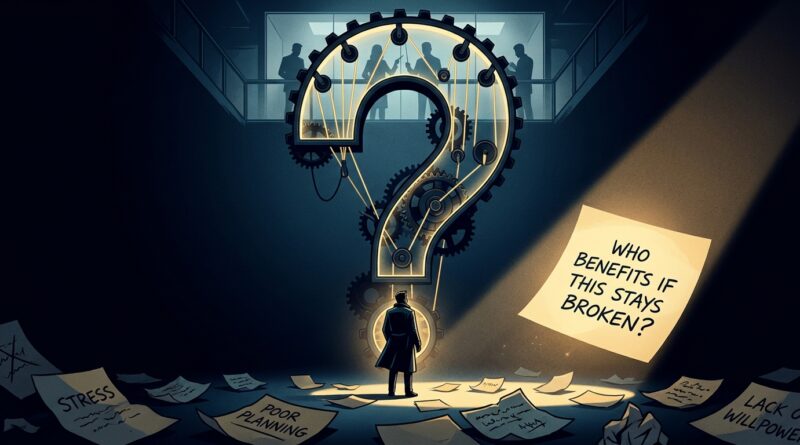
You can do a perfect root cause analysis and still stay stuck. That is the maddening part. You ask why five times. You journal. You go to therapy. You hold team retros. You promise yourself this time you have finally found the real issue. Then the same problem shows up again with a different haircut. More burnout. The same fight. The same coworker bottleneck. The same people-pleasing spiral. If that sounds familiar, you are not failing at self-awareness. You may be missing one very plain question. Who benefits if this problem does not get solved? That is the “Power Why.” It does not replace the usual 5 Whys. It adds the part most people skip. Power. Comfort. Convenience. Status. Control. Once you can spot the hidden deal keeping a problem alive, you stop treating it like a personal flaw and start seeing the system that keeps rewarding the mess.
⚡ In a Hurry? Key Takeaways
- Root cause analysis power dynamics matter because problems often continue not from confusion alone, but because someone gains comfort, control, or cover from the status quo.
- After your usual “why” chain, ask one more question: “What gets easier for whom if this stays the same?” Write down names, roles, and rewards.
- The goal is not to blame or start a fight. It is to see the hidden deal clearly enough to change boundaries, incentives, and expectations safely.
Why the usual 5 Whys can miss the real story
The 5 Whys is useful. It helps you move past surface excuses.
But it has a blind spot. It often assumes the problem exists because no one understands it well enough. That is sometimes true. A broken process can come from bad handoffs, poor training, or simple habit.
But some problems stick around because they serve somebody.
That “somebody” is not always a villain. It might be your boss avoiding hard staffing decisions. It might be a partner who gets emotional support without having to change. It might be you, if over-functioning helps you feel needed. It might be a whole team that keeps one “helpful” person overloaded so nobody else has to learn a messy task.
That is why a plain root cause analysis can lead to neat diagrams and zero change. It explains the mechanism, but not the incentive.
If you have ever sat through a meeting where people said “communication needs to improve” and then did absolutely nothing different, you will probably appreciate this related piece, Why Your 5 Whys Keep Ignoring Power: The Simple ‘Leverage Why’ That Reveals Who Actually Benefits From Your Problems. Same basic issue. A lot of smart analysis, not enough attention to who is comfortable with the current setup.
The “Power Why” in one sentence
After asking why the problem happens, ask this: Who benefits, stays comfortable, keeps control, avoids risk, or escapes accountability if this problem continues?
That is the Power Why.
It works because it turns your attention from symptoms to incentives.
What counts as a “benefit”
Benefit does not always mean money or some evil master plan.
It can mean:
- Less work
- More control
- Less conflict
- Protection from blame
- Keeping status
- Getting emotional labor for free
- Not having to learn a new skill
- Avoiding a scary conversation
That is why this question is so useful in personal life too, not just at work.
A simple example from work
Let’s say one person on a team is always overwhelmed.
The normal 5 Whys might look like this:
- Why are they overwhelmed? They have too many tasks.
- Why do they have too many tasks? People keep sending work to them.
- Why do people keep sending work to them? They are the fastest and most reliable.
- Why are they the fastest and most reliable? They have the most experience.
- Why has the team not spread that knowledge? Training never became a priority.
That sounds smart. It is not wrong.
But now ask the Power Why.
Who benefits if this stays the same?
- The manager avoids making a hiring case.
- The rest of the team avoids learning hard tasks.
- The overloaded employee keeps their identity as the indispensable one.
- Leadership gets acceptable output without paying the true cost.
Now you can see why the problem keeps returning. The system is rewarding the pattern.
Without changing those rewards, “better communication” will do very little.
A simple example from relationships
Maybe you keep saying yes when you want to say no.
The standard explanation might be: “I am a people pleaser because I fear rejection.” Fair enough. That can be true.
But try the Power Why.
Who benefits if I keep overgiving?
- Other people keep getting convenience.
- The relationship avoids tension in the short term.
- You get to feel good, useful, and hard to replace.
- No one has to face whether the connection is balanced.
That changes the whole picture. It is not just your personality. It is a quiet agreement. You provide comfort. Others provide approval, or at least less friction. The problem survives because the deal works well enough for everyone except the exhausted person carrying it.
Why this matters for burnout
Burnout often gets framed as a time-management problem.
Sometimes it is. A full calendar is a full calendar.
But often burnout sticks because of power. One person absorbs overflow. One person keeps morale up. One person translates chaos into something usable. Everyone says they appreciate them. Very few help change the structure.
If your burnout keeps returning after every planner, app, and productivity reset, ask:
- What work am I doing that lets other people stay disorganized?
- Who gets relief from my over-functioning?
- What tension enters the room if I stop?
Those answers are uncomfortable. They are also usually more useful than another color-coded checklist.
How to use the Power Why without becoming cynical
This is important.
The goal is not to walk around assuming everyone is manipulating you. Most people are not running an evil scheme. They are protecting comfort, routines, and social safety. So are you. So am I.
The Power Why is just a tool for seeing what the current setup rewards.
Try this four-step mini process
1. Name the repeating problem clearly.
Keep it plain. “I keep getting pulled into last-minute work.” “Our team keeps revisiting the same conflict.” “I keep doing emotional cleanup for everybody.”
2. Do your normal why chain first.
That still matters. You need the practical mechanics.
3. Add the Power Why.
Ask:
- Who benefits if this does not change?
- Who avoids discomfort if this stays the same?
- Who carries the cost, and who avoids it?
- What hidden deal is operating here?
4. Change the deal, not just the story.
This is the part that matters. If the rewards stay the same, the problem usually stays too.
What “changing the deal” can look like
You do not need a dramatic confrontation every time.
Sometimes the change is small and practical.
At work
- Stop accepting “urgent” work without a tradeoff.
- Ask managers to rank priorities in writing.
- Move knowledge out of one person’s head and into shared docs.
- Track hidden labor so the cost becomes visible.
In relationships
- Pause before automatic yeses.
- Name patterns without attacking character.
- Ask for reciprocity in concrete ways.
- Let small discomfort happen instead of fixing it instantly.
With yourself
- Notice where being “the reliable one” has become a trap.
- Ask what identity payoff you get from staying over-responsible.
- Practice disappointing people in low-stakes ways.
Questions that get better answers than “Why am I like this?”
That question usually sends you straight into self-blame.
Try these instead:
- What pattern keeps repeating even after insight?
- Who pays for this pattern, and who is protected by it?
- What becomes harder for others if I stop doing my part in this pattern?
- What truth would the group have to face if the problem were actually solved?
- What am I calling a personal flaw that may actually be a role I got trained into?
Those questions are often where root cause analysis power dynamics become visible. You stop asking only what is broken. You start asking what the breakage is doing for the system.
Common signs power is distorting your “why”
If any of these sound familiar, the Power Why is worth trying:
- The same issue keeps being explained but never changed.
- The proposed fix always lands on the person already carrying the most.
- Everyone agrees there is a problem, but no one wants to touch roles, authority, or incentives.
- The “solution” is vague, like communicate better or be more resilient.
- People who benefit from the pattern get to define the problem.
That last one is huge.
If the people protected by the current setup are also the ones naming the cause, you may get a very tidy explanation that carefully avoids accountability.
What if the person benefiting is you?
Sometimes the answer will point back at you. That is not bad news. It is useful news.
Maybe your stress earns praise. Maybe your rescuing keeps you central. Maybe staying confused keeps you from having to choose. Maybe “I am too nice” sounds gentler than “I avoid conflict until I resent everyone.”
That is not a moral failure. It is a pattern.
The point is not shame. The point is choice.
At a Glance: Comparison
| Feature/Aspect | Details | Verdict |
|---|---|---|
| Standard 5 Whys | Good for finding process gaps, habits, and surface causes, but it can miss who is rewarded by the problem staying in place. | Useful, but incomplete on its own. |
| Power Why | Adds one more question about comfort, control, avoided risk, and who carries the cost. | Best for recurring problems that survive “good insight.” |
| Real change | Happens when you change boundaries, incentives, visibility, or roles, not just your explanation of the issue. | This is where stuck patterns finally start to move. |
Conclusion
A lot of advice about root causes, complexity, and systems thinking sounds smart but stays abstract. It tells you to think deeper, but not what to look for when a problem keeps surviving every new insight. The missing piece is often power. Quiet power. Everyday power. The kind that hides in convenience, avoided conflict, status, and unspoken roles. The Power Why gives you a small, practical skill you can use today in conflicts, burnout, people-pleasing, and team issues. Ask who benefits, who pays, and what hidden deal keeps the pattern going. That shift can save you from years of blaming your personality for something the system keeps rewarding. Once you see the deal, you can start renegotiating it. That is when change has a real chance to stick.