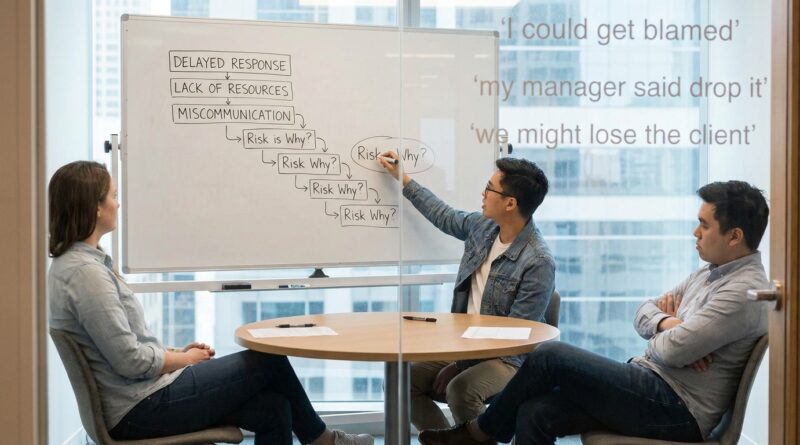
Why Your 5 Whys Keep Ignoring Safety: The Simple ‘Risk Why’ Behind Problems You’re Afraid To Write Down
You know this meeting. A system breaks, a release goes sideways, a customer gets hit, and everyone gathers for a calm, professional root cause review. Someone starts the 5 Whys. The first two answers sound real enough. Then the room gets weird. People get vague. They say things like “communication issue” or “lack of visibility.” Nobody says, “We skipped the check because the deadline was impossible,” or “I saw the risk but didn’t want to be the blocker,” or “Our manager made it clear that bad news was not welcome.” That is the part most root cause tools miss. They assume people feel safe enough to tell the truth. Often, they do not. If your post-mortems keep producing tidy answers but the same problems return, you may not have a process problem first. You may have a safety problem hiding inside your analysis.
⚡ In a Hurry? Key Takeaways
- The missing piece in many post-mortems is the “Risk Why,” meaning what felt too risky for people to say or do at the time.
- When you run 5 Whys, add a simple question: “What made the honest action or honest answer feel unsafe here?”
- AI tools and dashboards can spot patterns, but they cannot fix silence caused by fear, blame, or job security concerns.
Why normal root cause analysis breaks down
The classic 5 Whys is useful. Fishbone diagrams can help too. But both have a quiet assumption built in. They assume the people in the room will say what they really know.
That sounds reasonable until you remember how real workplaces work.
People protect themselves. They protect their manager. They protect teammates. They avoid putting ugly truths into writing. They avoid saying the thing that might get them labeled “negative,” “not a team player,” or “hard to work with.”
So the analysis gets cleaned up before it even starts.
You end up with answers like:
- Documentation was outdated.
- Ownership was unclear.
- Monitoring gaps delayed detection.
- There was a handoff issue.
All of those may be true. None of them may be the real reason people acted the way they did.
What “Risk Why” means
The Risk Why is the hidden answer to this question:
What felt risky about telling the truth, raising the concern, slowing things down, or doing the safer thing?
It is a psychological root cause analysis risk why. Not just what failed in the system, but what made people unwilling or unable to respond honestly inside that system.
Examples help:
- Why was the test skipped? Because the release window was tight.
- Why was the release window tight? Because leadership promised the date already.
- Why didn’t anyone push back? Because missing the date got more attention than shipping safely.
- Risk Why: Speaking up felt career-limiting.
Or this one:
- Why was the alert ignored? Because it had fired falsely before.
- Why wasn’t that fixed? Because the team had no spare capacity.
- Why didn’t anyone escalate the risk? Because they expected blame for “complaining.”
- Risk Why: Escalation felt personally unsafe.
That last step matters because it changes the fix. Without it, you tune alerts and move on. With it, you also address the fear that kept the signal buried.
The signs your team is hiding the real story
You usually do not need a survey to spot it. The pattern shows up in the meeting itself.
People switch to bland language
Specifics disappear. Names, decisions, tradeoffs, and pressure all get replaced by soft phrases.
The same root cause keeps appearing
If every incident ends with “better communication,” you are not finding root causes. You are using wallpaper.
No one mentions power
Real organizations run on incentives, status, deadlines, and fear. If none of that appears in the write-up, something is missing.
The written report sounds cleaner than the hallway talk
If people say one thing privately and another thing in the document, your process is collecting safe answers, not honest ones.
Why this matters even more now
Teams are using more automation, more telemetry, more dashboards, and more AI to make sense of incidents. That is helpful. In cloud infrastructure and microservices especially, machine help can spot timing issues and system patterns faster than people can.
But tools can only analyze what is visible.
They can see latency spikes. They can see retry storms. They can see config drift. They cannot see the sentence that was never said in Slack because someone did not want to look difficult. They cannot see the risk log that stayed unwritten because nobody wanted to own the bad news.
That is why a technical post-mortem can be perfectly organized and still miss the true source of repeat failures.
How to add the Risk Why to your 5 Whys
You do not need to throw out your current process. Just add one branch.
Start with the normal chain
Ask the standard “Why did this happen?” questions. Build the timeline. Note technical factors, process gaps, and decision points.
Then ask a second kind of why
At each key decision point, ask:
- What made the safer action harder here?
- What made speaking up risky here?
- What was someone protecting?
- What answer would be hard to put in writing?
- What did people believe would happen if they raised this earlier?
That is the Risk Why branch.
Separate facts from blame
This is where many teams get nervous. Asking about fear is not the same as hunting for a villain.
You are not asking, “Who failed?”
You are asking, “What conditions taught people that honesty, caution, or escalation came with a cost?”
That is a system question too.
A simple template you can use in your next post-mortem
Try a section in your incident review called Hidden Risk Factors. Under it, answer these:
- What did people notice before the problem got worse?
- What stopped them from acting sooner?
- What would have felt risky to say out loud at the time?
- What incentives, deadlines, or power dynamics shaped that choice?
- What change would make the honest action safer next time?
This tends to surface things your technical timeline misses.
You may learn that the issue was not only lack of runbooks. It was that junior staff had been burned before for making noise. Or that the rollback path existed, but using it would have embarrassed the wrong person. Or that the team had normalized unsafe shortcuts because saying no to speed was treated as poor performance.
What to do if people still will not say it
Sometimes the room is too tense. That is normal.
Collect input before the meeting
Ask for private notes first. A simple prompt works: “What part of this incident would be uncomfortable to say in a group?”
Do not force public confession
If someone hints at pressure or fear, do not make them prove it in front of everyone. Capture the pattern without exposing the person.
Watch your language
Replace “Why didn’t you?” with “What made that difficult?” Replace “Who owns this?” with “Where did ownership become risky or unclear?” Small wording changes matter.
Fix one visible thing quickly
If people take a risk and tell the truth, reward that with action. Not praise alone. Action. If nothing changes, they will not do it again.
Risk Why and Tradeoff Why often show up together
In many teams, fear is tied to conflicting goals. Ship fast, but do not break anything. Cut costs, but increase resilience. Move ownership down, but punish mistakes harshly.
That is where this related idea comes in. If your analysis keeps stopping at polite answers, it is worth reading Why Your 5 Whys Keep Missing Conflicting Goals: The Simple ‘Tradeoff Why’ Behind Problems That Never Really Go Away. Tradeoffs and risk often travel as a pair. People hide the truth not only because they are scared, but because the organization asked them to balance impossible goals and pretend the balance was easy.
What good looks like
A strong post-mortem does not just explain the outage. It explains the silence around the outage.
It says things like:
- Engineers had seen the deployment risk, but prior pushback had been penalized as delay.
- On-call responders hesitated to escalate because previous escalations drew blame before facts were clear.
- The checklist existed, but speed pressure made using it socially costly.
Those are not messy side notes. They are core root causes.
Once you can say that plainly, your fixes get better too:
- Change success metrics so safe delay is not punished.
- Create a documented no-fault escalation path.
- Require leaders to log declined risk warnings, not just approved launches.
- Let post-mortem contributors comment anonymously when needed.
At a Glance: Comparison
| Feature/Aspect | Details | Verdict |
|---|---|---|
| Standard 5 Whys | Good for tracing process and technical chains, but often assumes people will speak freely. | Useful, but incomplete when fear is in the room. |
| Risk Why | Adds a direct look at what made honesty, escalation, or caution feel unsafe. | Essential for recurring problems that survive “good” post-mortems. |
| AI and dashboard analysis | Great at spotting technical patterns, weak at detecting fear, blame avoidance, and hidden pressure. | Best used with human safety checks, not as a replacement for them. |
Conclusion
If your team keeps fixing the same class of problem, do not assume the missing answer is buried deeper in the logs. It may be buried in what people are afraid to say. That is the heart of psychological root cause analysis risk why. Right now, lots of teams are leaning on AI and dashboards to do more of this work, especially in cloud infrastructure and microservices. Those tools help, but they still fail for one stubborn human reason. People do not say what they really know when it feels unsafe. Add the Risk Why to your next post-mortem and you give yourself a better shot at the truth. That helps founders, managers, and individual contributors fix recurring problems at their real source, instead of running another polished technical review that politely ignores fear, blame, and job security.