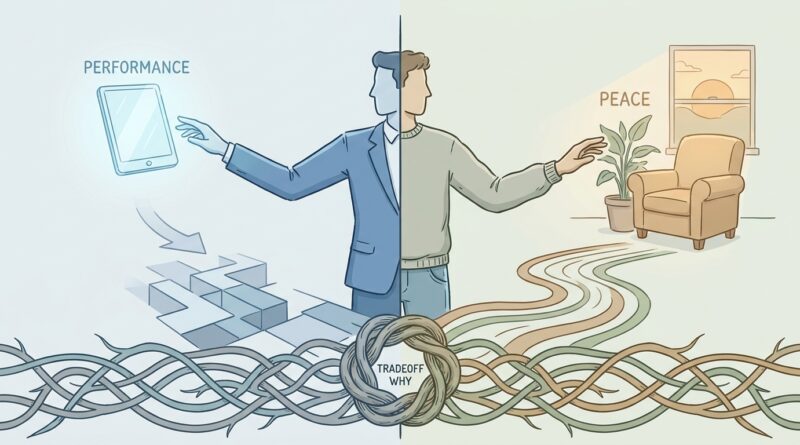
Why Your 5 Whys Keep Missing Conflicting Goals: The Simple ‘Tradeoff Why’ Behind Problems That Never Really Go Away
You know the feeling. You run a neat little 5 Whys session, everyone nods, the logic looks solid, and for a week it seems like the problem is fixed. Then it comes back. Same mess. Same frustration. At that point, it is easy to think the team missed a step or did the method badly. But often the issue is not bad analysis. It is that the problem is being held in place by conflicting goals. One part of the system, team, or even your own mind wants one thing. Another part wants the opposite. Both make sense. Both have benefits. And your standard root cause chain keeps missing that tug-of-war. That is where a simple “Tradeoff Why” helps. It adds one uncomfortable but honest question to your analysis. Not just “Why does this keep happening?” but “What are we protecting, preserving, or avoiding by letting it keep happening?” That question changes everything.
⚡ In a Hurry? Key Takeaways
- Your 5 whys root cause analysis can fail when the real cause is not one broken thing, but two valid goals in conflict.
- Add a “Tradeoff Why” by asking, “If this problem disappeared, what would become harder, riskier, or more uncomfortable?”
- This is not about blaming people. It is about spotting hidden incentives and psychological protection so recurring problems stop sneaking back.
Why the usual 5 Whys can feel weirdly incomplete
The classic 5 Whys is built on a simple idea. Keep asking why until you reach the root cause. That works well for straightforward failures. A file was deleted. Why? Permissions were too broad. Why? The setup was rushed. Why? There was no review step. Great. You can fix that.
But recurring human problems are often not that tidy.
Why do meetings run long? Why does nobody speak up? Why does your team keep missing deadlines even after better planning? Why do you keep procrastinating on work you actually care about?
In these cases, there may not be one clean cause sitting at the bottom like a loose wire. There may be a tradeoff. The behaviour solves one problem while creating another.
That is why people feel almost gaslit by root cause advice online. They do the steps correctly. They get a logical answer. They make changes. Yet the pattern returns, because the “cause” they found was only half the story.
What a “Tradeoff Why” actually is
A Tradeoff Why is a plain-English question you add when your 5 whys leads to fixes that never stick.
The question
What benefit, protection, or avoided cost is this problem quietly providing?
Or even more simply:
If this problem stopped tomorrow, what would we lose?
That sounds backward at first. Why would anyone want a problem?
Usually they do not want the problem itself. They want the safety, speed, harmony, control, status, or comfort that comes with allowing it.
That is the hidden tradeoff.
A simple example most people will recognise
Let’s say a manager keeps jumping in to “help” with team tasks. The team becomes dependent. Work bottlenecks around that manager. Everyone agrees it is a problem.
So the 5 Whys might go like this:
Why is work delayed? Because too much depends on the manager.
Why does too much depend on the manager? Because the team asks for approval on small decisions.
Why do they ask for approval? Because decision rights are unclear.
Why are they unclear? Because processes were never documented.
Why were they never documented? Because scaling happened too fast.
That all sounds reasonable. It may even be true.
But if you fix only that chain, the behaviour may still come back.
Now add the Tradeoff Why.
What would be lost if the manager stopped stepping in?
Maybe quality would dip for a while. Maybe the manager fears looking unnecessary. Maybe the team avoids blame by pushing decisions upward. Maybe “helpfulness” is the socially acceptable cover for trust issues.
Now you are finally looking at the real engine of the problem.
Conflicting goals are not bad. Hidden conflicting goals are.
This is the part many frameworks skip.
Most recurring problems survive because they serve two goals at once. One visible, one hidden.
Common conflict pairs
Here are a few that show up all the time:
- Speed vs accuracy
- Harmony vs honesty
- Autonomy vs control
- Short-term relief vs long-term progress
- Looking competent vs asking for help
- Consistency vs flexibility
- Growth vs stability
Take procrastination. The visible goal is “finish the project.” The hidden goal might be “avoid the shame of doing it imperfectly.”
Take endless meetings. The visible goal is “make decisions together.” The hidden goal might be “spread responsibility so no one gets blamed.”
Take poor documentation. The visible goal is “save time.” The hidden goal might be “keep key knowledge close to the experts who gain status from being needed.”
Once you see the conflict, the repeat pattern makes sense.
Why 5 whys root cause analysis conflicting goals is such a common blind spot
Because the method itself invites a single-file story. One cause leads to another, then another, until you arrive at the answer. Real life is often messier. Human systems do not move in a straight line. They balance tensions.
That does not make 5 Whys useless. It just means it needs help.
In fact, this is similar to another common trap. Some teams use 5 Whys and end up blaming a person instead of seeing the wider setup. If that sounds familiar, this piece on Why Your 5 Whys Keep Blaming People: The Simple ‘System Why’ That Stops You Turning Every Problem Into A Witch Hunt is worth reading too. The short version is that recurring problems often live in systems and tradeoffs, not in one “bad” individual.
How to add a Tradeoff Why without turning the room awkward
You do not need therapy language. You do not need to make anyone feel exposed. You just need better questions.
Try these prompts
- What does the current pattern make easier?
- What risk does this behaviour reduce, even if it causes other trouble?
- If we removed this problem tomorrow, what new discomfort would show up?
- Who benefits from the current way of doing things, even a little?
- What are people protecting by acting this way?
- What cost are we avoiding right now?
Notice the tone. Curious, not accusing.
What you are listening for
You are listening for sentences like:
- “Yes, but if we stop doing that…”
- “We tried, but then…”
- “That would be ideal, except…”
- “People are worried that…”
- “Honestly, it helps us avoid…”
That “but” is often where the real story starts.
A quick before-and-after example
Without Tradeoff Why
Problem: Customer support keeps escalating simple issues.
5 Whys answer: Training is incomplete.
Fix: More training.
Result: Some improvement, then the old pattern returns.
With Tradeoff Why
Ask: What would reps lose if they stopped escalating so often?
Answer: They would lose safety. Escalating protects them from upsetting customers, making a wrong call, or being punished for errors.
Now the issue is not just training. It is a conflict between efficiency and fear of blame.
The real fix might include clearer decision boundaries, better scripts, manager backing, and less punishing scorecards.
That is a very different conversation.
When to use this approach
Use a Tradeoff Why when:
- The same problem keeps returning after sensible fixes
- People agree on the analysis but do not change their behaviour
- The “root cause” sounds true but somehow thin
- You hear lots of rational explanations but feel there is something unsaid
- The issue involves habits, culture, fear, status, or identity
If the problem is purely mechanical, you may not need this layer. If the problem involves people, you often do.
One warning. Do not use this to psychoanalyse people from a distance.
There is a difference between spotting a tradeoff and pretending you can read minds.
Bad version: “You keep missing deadlines because you enjoy chaos.”
Better version: “Could part of this be that last-minute work protects flexibility when priorities keep changing?”
See the difference?
One is a judgment. The other is a testable idea.
Tradeoff Why works best when people can recognise themselves in it, not when they feel pinned to the wall.
A practical mini-template you can use today
Here is a simple structure for your next root cause session:
Step 1: Run the normal 5 Whys
Get the obvious chain on paper first.
Step 2: Circle the fixes that have already been tried
If a fix has been attempted before and the problem came back, pause there.
Step 3: Ask the Tradeoff Why
What does this current pattern help us get, keep, or avoid?
Step 4: Name the conflicting goals
Write them as a pair. For example:
- We want fast decisions.
- We also want zero risk.
Or:
- We want honest feedback.
- We also want social comfort.
Step 5: Design for the tradeoff, not just against the symptom
If you only remove the behaviour, people may grab a new version of it. If you reduce the hidden loss as well, change has a chance to stick.
At a Glance: Comparison
| Feature/Aspect | Details | Verdict |
|---|---|---|
| Standard 5 Whys | Great for linear problems with a clear chain of cause and effect. | Useful, but often incomplete for human behaviour. |
| Tradeoff Why | Adds the hidden benefit, protection, or avoided cost that keeps the problem alive. | Best for recurring issues tied to fear, status, comfort, or conflicting goals. |
| Combined approach | Uses root cause logic first, then checks for tension between two valid goals. | Usually the most honest and practical option. |
Conclusion
If your fixes keep fading and the same problem keeps crawling back, it does not always mean you missed the root cause. Sometimes it means you found one cause and ignored the conflict wrapped around it. Most root cause frameworks online still assume there is one clean cause at the bottom of every problem, which is why people feel gaslit when they do everything right and nothing changes. A Tradeoff Why gives our community a simple, usable way to bring genuine psychological conflict into their analysis, so they can see not just why something happens but what they would lose if it stopped. And that is often the real reason stubborn problems never really go away. Once you can name the tradeoff, you can finally start fixing the right thing.