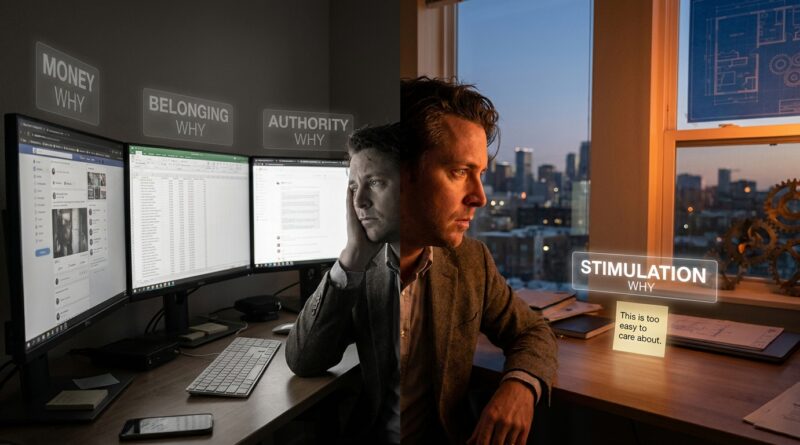
Why Your 5 Whys Keep Missing Boredom: The Simple ‘Stimulation Why’ Behind Doomscrolling, Drifting Teams and Quiet Quitting
You ask why you keep procrastinating, doomscrolling, missing small deadlines, or feeling weirdly checked out at work. Then the answers show up fast and familiar. “I’m lazy.” “I’m tired.” “I just need more discipline.” That is frustrating, because those answers rarely help for more than a day or two. A lot of people are not dealing with a character flaw. They are dealing with something flatter and harder to name. They are under-stimulated. Their work is too chopped up, too easy, too vague, or too interrupted to hold attention. Their free time is filled with tiny jolts from feeds and notifications, which makes normal tasks feel even duller. Traditional root cause tools, including the classic 5 Whys, are good at finding process mistakes. They are much worse at spotting boredom. That missing question matters more than most people realize.
⚡ In a Hurry? Key Takeaways
- Your procrastination or quiet disengagement may not be laziness. It may be chronic under-stimulation that standard root cause analysis misses.
- Try a simple “Stimulation Why” in your next 5 Whys session. Ask, “Is this task too easy, too fragmented, too passive, or too low-stakes to hold my attention?”
- If boredom is the real issue, the fix is not always another app or stricter routine. It may be better task design, smarter difficulty, and fewer digital distractions.
Why the usual 5 Whys often miss the real problem
The 5 Whys is useful. It can uncover broken steps, unclear ownership, bad handoffs, and missing training. If a report was late, you can trace the chain. If a project drifted, you can find the gap.
But here is the catch. The method only works as well as the kinds of questions you are willing to ask. Most people ask about time, tools, process, priorities, and communication. Fair enough. Those are visible. They fit neatly in a meeting note.
What they often do not ask is this. Was the person so mentally underfed by the task that their brain started hunting for stimulation somewhere else?
That is where psychological root cause analysis boredom and stimulation why becomes useful. It adds one more lens. Not a replacement for serious diagnosis. Just a better question set for modern work and modern tech habits.
What a “Stimulation Why” actually means
A Stimulation Why is a simple follow-up question inside your root cause analysis. It asks whether a behavior that looks like laziness, poor discipline, fatigue, or mild anxiety is really a response to low cognitive engagement.
In plain English, it means asking:
- Is this task too repetitive to keep my attention?
- Is it so easy that my brain keeps looking for novelty?
- Is it so fragmented that I never get into it?
- Is it so vague that it feels mentally slippery?
- Am I calling myself tired when I am really bored?
That is not the same as saying boredom is harmless. Boredom can quietly wreck focus, mood, and motivation. It can also push you straight toward your phone.
How boredom disguises itself
This is the sneaky part. Boredom rarely introduces itself politely.
It shows up wearing other labels.
“I’m too tired”
Sometimes you are tired. Of course. But sometimes your energy mysteriously returns the moment something difficult, social, competitive, or urgent appears. That is a clue. The problem may not be low energy. It may be low stimulation.
“I can’t focus anymore”
If you can focus for an hour on travel plans, hobby research, gaming, or a heated group chat, but not on a routine work task, your attention system may be rejecting dead air, not failing completely.
“I must need a better productivity system”
Sometimes yes. But many people are stacking planners on top of a task that is still painfully dull, too passive, or broken into tiny pieces by constant pings.
“Work is just like this now”
This one is especially common in teams. AI summaries, templates, auto-complete, and process tools remove friction, which is great up to a point. But they can also shave off challenge, craft, and ownership. The work gets smoother. People get flatter.
Doomscrolling is often a stimulation mismatch
Doomscrolling is not only about bad habits or weak willpower. It is often your brain choosing the richer stream of stimulation on offer. Your inbox asks for dull compliance. Your phone offers novelty every two seconds. Guess which one wins when your mental tank is already low.
That does not let the platforms off the hook. They are designed to keep you there. If this part hits home, it pairs well with Why Your 5 Whys Keep Ignoring Digital Exhaustion: The Simple ‘Screen Why’ That Explains Why You Can’t Switch Off, which gets into the way screens turn tiredness into compulsive checking.
The point here is slightly different. Sometimes you are not scrolling because the feed is irresistible. You are scrolling because the alternative feels psychologically dead.
Why teams drift even when the workflow looks fine
This shows up at work all the time.
A manager runs a retro. The team is shipping slower, meetings feel flat, initiative is down, and nobody seems fully awake. The obvious suspects get reviewed. Too many meetings. Unclear priorities. Tool sprawl. Slow approvals. Those may all be true.
But if every task is now half-automated, heavily templated, low-autonomy, and interrupted by chat all day, then the team may also be under-stimulated.
That creates a strange pattern:
- People look busy but do the minimum.
- They delay simple tasks for no clear reason.
- They seek side conversations and low-value notifications.
- They lose the thread during meetings.
- They describe themselves as exhausted by work that is not actually very demanding.
That can look like disengagement because it is disengagement. But the root cause is not always low morale. Sometimes the work has become too cognitively thin to care about.
The 10-minute Stimulation Why check
You can run this on your own in under ten minutes. No fancy worksheet needed.
Step 1: Pick one stuck behavior
Choose one. Doomscrolling before bed. Putting off admin. Zoning out in meetings. Quietly doing less than you know you could.
Step 2: Do a normal 5 Whys first
Ask why five times, quickly.
Example:
- I keep putting off this weekly report.
- Why? Because I dread starting it.
- Why? Because it feels annoying.
- Why? Because it is repetitive and takes forever.
- Why? Because I have to pull the same numbers from three places.
- Why? Because nobody redesigned the process.
That is useful. But do not stop there.
Step 3: Add the Stimulation Why
Now ask:
- Is the task boring in a specific way?
- Does it lack challenge, novelty, urgency, ownership, or visible progress?
- Am I avoiding it because it is hard, or because it is deadening?
- Would this feel easier if it were shorter, more social, more skill-based, or more clearly scored?
If the honest answer is yes, you have found something important.
Step 4: Score the task fast
Give it a quick 1 to 5 score on these:
- Challenge
- Novelty
- Autonomy
- Visible progress
- Interruption level
If challenge, novelty, autonomy, and progress are low while interruptions are high, boredom is probably not a side issue. It is the issue.
What to do if boredom is the root cause
This is where people usually go wrong. They think the fix is “try harder.” That rarely works for long.
Raise difficulty intelligently
If a task is too easy, add a target. Can you finish in 25 focused minutes? Can you improve quality by 10 percent? Can you batch three similar tasks and do them as a sprint?
You are not trying to make life harder for the sake of it. You are giving your brain a reason to engage.
Redesign the task shape
Some work is dull because of how it is packaged. Break vague work into visible steps. Turn passive reading into note-taking. Pair routine tasks with a checklist that creates momentum. Add a decision point every few minutes so you are not just dragging a file from one place to another.
Reduce fragmentation
A boring task becomes unbearable when it is constantly interrupted. Shut chat for 20 minutes. Put the phone in another room. Close the five tabs that are offering an easier dopamine option.
Use social friction
Bodies and brains wake up around other people. Co-working sessions, quick check-ins, and simple accountability can make dead tasks feel more alive.
Rebuild your tech defaults
If every idle second gets filled by feeds, your tolerance for ordinary effort drops. That is not a moral failure. It is conditioning. Reduce the easy hits. Fewer notifications. Fewer home screen temptations. Fewer “just checking” moments.
What this means for quiet quitting
Quiet quitting is often discussed as a values problem, a management problem, or a burnout problem. Sometimes it is all three. But there is another angle people miss.
When work loses challenge, meaning, growth, and ownership, people do not always explode. Sometimes they simply slide. They become professionally polite and psychologically absent.
That does not mean every disengaged worker needs a harder job. It means some need richer work. More skill use. More agency. More clear wins. Less flattened, machine-smoothed busywork.
Important caution
Not every attention problem is boredom. Real fatigue, depression, burnout, anxiety, ADHD, poor sleep, and overload are all real. This is not a medical diagnosis tool.
Think of the Stimulation Why as a missing everyday question, not a cure-all. If your struggle is severe, persistent, or affecting your health, it is worth talking to a qualified professional.
At a Glance: Comparison
| Feature/Aspect | Details | Verdict |
|---|---|---|
| Traditional 5 Whys | Great for finding process gaps, delays, unclear ownership, and obvious workflow problems. | Useful, but often blind to chronic under-stimulation. |
| Stimulation Why | Adds questions about challenge, novelty, autonomy, interruption, and boredom disguised as fatigue or laziness. | Best as an extra lens for modern work and tech habits. |
| Typical fix | People often reach for stricter routines, more apps, or self-criticism, even when the task itself is cognitively flat. | Redesigning tasks and reducing digital distraction is often more effective. |
Conclusion
If your 5 Whys keep ending with “I’m lazy,” you may not be at the root cause yet. A lot of modern problems are not just about bad habits, weak discipline, or the wrong tool. They come from lives and jobs that are cognitively flat. AI smooths off the hard parts. Notifications fill every empty second. People end up more checked out, not less. Adding a simple Stimulation Why gives you better language for what is really happening. It also gives you a quick diagnostic you can run in under ten minutes. Once boredom stops hiding behind fatigue, anxiety, or guilt, the fixes change. You can redesign the task, raise difficulty in a smart way, reduce interruptions, and rebuild how you use tech. That is a much better place to start than downloading another productivity app and blaming yourself again.