Why Your 5 Whys Keep Missing Feelings: The Simple ‘Emotion Why’ That Stops Endless Overthinking At The Source
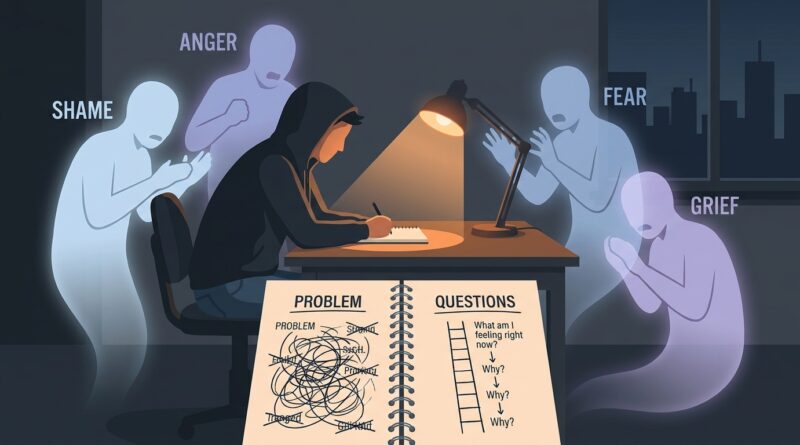
You ask why a problem happened. Then you ask why again. And again. On paper, that should help. In real life, you still end up wide awake at 2 a.m., replaying a text, a meeting, or one awkward sentence you wish you could take back. That is the part traditional root cause tools often miss. They are great at tracking events, but not so great at explaining why a small thing can hit you like a truck. If your 5 Whys keeps turning into a loop of overthinking, you probably do not need more logic. You need one extra question. The emotion why. Put simply, emotional root cause analysis 5 whys works better when you stop asking only, “Why did this happen?” and start asking, “Why did this feel so big to me?” That question often gets you to the real source faster than another hour of mental replay.
⚡ In a Hurry? Key Takeaways
- The 5 Whys often fails in personal life because it tracks facts but skips feelings, which is where many reactions actually start.
- Add one simple question, “Why did this feel so upsetting, threatening, or heavy?” and follow that answer 2 to 3 layers down.
- This is not about being dramatic. It is a practical way to reduce shame spirals, avoid blown-up arguments, and make clearer next steps.
Why the regular 5 Whys can fall short
The original 5 Whys is useful. It helps you find causes instead of blaming random symptoms. At work, that might look like this.
The report was late. Why? The data came in late. Why? One team missed the deadline. Why? The reminder system failed. Useful. Clean. Actionable.
But personal problems are rarely that tidy.
You snap at your partner because they forgot milk. If you use only a logic chain, you might land on, “I was stressed and they were careless.” That sounds reasonable. It also misses the real issue.
Maybe the forgotten milk made you feel unsupported. Maybe unsupported made you feel alone. Maybe alone touched an old fear that you have to carry everything yourself.
Now you are somewhere real.
What the “emotion why” actually is
The emotion why is one extra branch in your root cause process. Instead of staying only on the event side, you also trace the feeling side.
The standard chain
What happened? Why did it happen? What caused it?
The emotion chain
What did I feel? Why did I feel it so strongly? What did that feeling seem to mean about me, them, or the situation?
This is the missing piece in emotional root cause analysis 5 whys. Not because feelings are more important than facts, but because they often explain the size of your reaction.
Events matter. Meaning matters too.
A simple example
Let’s say your boss gives you brief feedback on a project. Nothing cruel. Just, “This needs more work.”
You cannot stop thinking about it all night.
Regular 5 Whys
Why am I upset? Because my boss criticized my work.
Why? Because the project was not complete.
Why? Because I rushed it.
Why? Because I had too many deadlines.
Why? Because I did not push back early enough.
That is useful. It tells you what to fix next time.
Emotion why chain
Why did this hit me so hard? Because it felt like I failed.
Why does that feel so intense? Because I tie good work to being respected.
Why does respect feel so fragile here? Because I am scared people will see me as not capable.
Why is that fear so loud? Because I already feel stretched thin and one comment confirms my worst story about myself.
That gets to the sticky part. The part keeping you awake.
The Three Whys approach that works better in real life
You do not always need five layers. In personal situations, three focused questions are often enough.
1. What happened?
Stick to facts. No speeches. No courtroom closing argument.
“My friend did not reply for two days.”
2. Why does it bother me?
Name the feeling plainly.
“I feel ignored and a little embarrassed.”
3. Why does that feeling have so much weight?
This is the emotion why.
“Because when people go quiet, I quickly assume I said something wrong or that I matter less than I thought.”
Now you have two paths forward. One practical, one emotional.
- Practical: Check in with your friend instead of guessing.
- Emotional: Notice that silence triggers an old story in you.
That is a far better result than spending four hours building theories.
How to do emotional root cause analysis 5 whys without turning it into therapy homework
Keep it short. You are not writing a memoir.
Step 1: Write the trigger in one sentence
Example: “My partner sighed when I asked for help.”
Step 2: Name the first emotion
Example: “I felt irritated.”
Step 3: Ask the emotion why
“Why did that irritation show up so fast?”
Answer: “Because it felt like they were annoyed by my needs.”
Step 4: Ask again
“Why is that especially hard for me?”
Answer: “Because I hate feeling like a burden.”
Step 5: Stop when you hit a belief, not just another event
Common beliefs sound like this.
- “I have to do everything myself.”
- “If I make a mistake, people lose respect for me.”
- “If someone is distant, I must have done something wrong.”
That is usually the root worth working on.
How this stops overthinking faster
Overthinking often looks like problem-solving, but a lot of it is actually emotion avoidance in nicer clothing.
Your brain says, “Let’s review the conversation 17 more times.”
What it often means is, “I do not want to sit with the feeling this brought up.”
Once you name the actual feeling and what it seems to mean, the loop often loses speed. Not always instantly. But noticeably.
You are no longer stuck asking, “What exactly did they mean by that comma in the text?”
You are asking the more honest question. “Why did that tiny thing make me feel rejected?”
When people get stuck anyway
Sometimes the first answer is too shallow.
“I am upset because they were rude.”
Maybe. But keep going.
What about their rudeness landed so hard? Did it make you feel dismissed? Powerless? Unimportant? Trapped?
Sometimes people also over-intellectualize the process. They stay in polished language because raw language feels uncomfortable.
Try simpler words.
- Mad
- Hurt
- Scared
- Ashamed
- Left out
Simple is usually better.
If you also tend to freeze when making decisions, the same pattern shows up there too. You can see that in Why Your 5 Whys Collapse Under Analysis Paralysis: The Simple ‘Choice Why’ That Gets You Unstuck Fast, which gets into how endless analysis can hide the real block.
What to do once you find the emotional root
This is the part people skip.
Insight is helpful. Action matters more.
If the root is practical
Take a practical step.
- Set a boundary
- Ask a direct question
- Fix the process
- Apologize clearly
If the root is emotional
Respond to the feeling instead of arguing with it.
- Name it
- Write the belief it triggered
- Ask whether that belief is current or old
- Choose one calmer next move
For example: “I feel dismissed. This is triggering my old fear that my needs are too much. Before I accuse anyone, I am going to ask for what I need clearly.”
That is grounded. Not dramatic. Just useful.
What this is not
This is not an excuse to over-focus on yourself.
It is not “My feelings are the facts.”
It is also not a replacement for serious mental health care if you are dealing with trauma, panic, depression, or constant emotional flooding.
Think of it as a better home tool. Like finally using the right screwdriver instead of a butter knife.
At a Glance: Comparison
| Feature/Aspect | Details | Verdict |
|---|---|---|
| Traditional 5 Whys | Good at finding process failures, missed steps, and visible causes. | Useful for facts, but often incomplete for emotional reactions. |
| Emotion Why | Tracks why a situation felt so threatening, painful, or loaded. | Best for stopping spirals and finding the real personal trigger. |
| The Three Whys | Combines facts, feelings, and meaning in a short process. | The easiest everyday method for clearer decisions and calmer responses. |
Conclusion
A lot of smart, capable people use systems thinking all day at work, then get blindsided by their own emotions at home. That does not mean they are irrational. It usually means their root cause process is missing one key input. Feelings. When you add the emotion why to emotional root cause analysis 5 whys, you stop treating every spiral like a logic problem. You start seeing the human part underneath it. That can mean fewer blown-up arguments, fewer shame loops, and a much clearer idea of what to do next. The nice part is that you do not need jargon, a color-coded journal, or a weekend retreat. Just ask what happened, what you felt, and why that feeling got so loud. That is often where the real answer has been waiting all along.