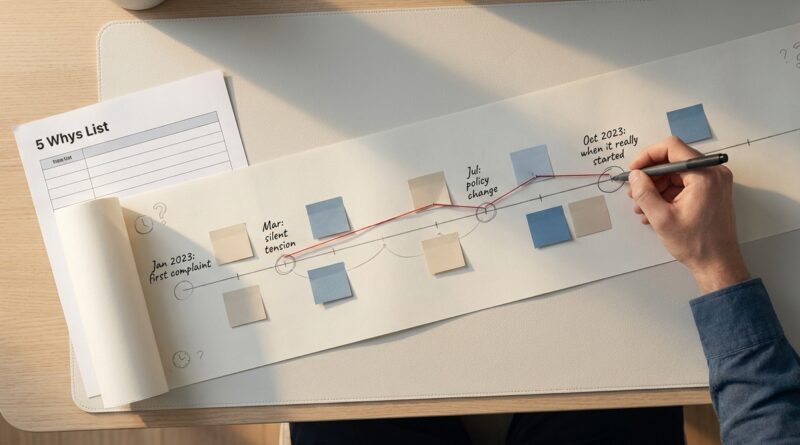
Why Your 5 Whys Keep Missing Context: The Simple ‘Timeline Why’ That Explains Why Problems Keep Coming Back Months Later
You know this one. A problem pops up, your team fixes it, everybody breathes out, and then six weeks later the same mess is back wearing a fake moustache. New symptom. Same damage. Slightly bigger bill. That is maddening, especially when you already did a proper 5 Whys and thought you had the root cause nailed down. The trouble is, regular 5 Whys often gives you a neat chain of reasons, but not a story across time. And time is usually where repeat problems hide. A bug starts after a release, gets worse after a staffing change, stays invisible during a busy month, then blows up when one more small thing shifts. If you do not ask when each cause began, when it was noticed, and what changed around it, your fix may only calm the symptom for a while. That is where a simple root cause analysis timeline why approach helps.
⚡ In a Hurry? Key Takeaways
- A Timeline Why adds dates and change points to your 5 Whys, so you can see why a “fixed” problem keeps returning later.
- Write down when the issue started, when each contributing cause switched on, how long it was ignored, and what else changed nearby.
- This is useful for work, products, and relationships because recurring problems often come from timing, buildup, and missed warning signs, not one single bad moment.
Why regular 5 Whys often feels right, but still fails later
The classic 5 Whys is good at one thing. It forces you to keep asking what sits underneath the obvious symptom.
That matters. A server outage might not really be about the server. A team conflict might not really be about one rude comment. A missed deadline might not really be about laziness.
But 5 Whys has a blind spot. It tends to flatten time.
It gives you a clean ladder:
Problem happened. Why? Because of X. Why did X happen? Because of Y. Why did Y happen? Because of Z.
Nice and tidy. Real life is rarely tidy.
Many repeat problems are not caused by one straight line. They are caused by layers that switched on at different times. One condition started three months ago. Another appeared last week. A third had been tolerated for ages. Then all three lined up.
That is why the issue “comes back” even after a sincere fix. You solved the latest trigger, not the timeline that made the trigger dangerous.
What a Timeline Why actually is
A Timeline Why is just a small upgrade to root cause analysis. Nothing fancy. You still ask why. You just pin each answer to time.
Instead of only asking, “Why did this happen?” you also ask:
- When did this cause first become true?
- When did we first notice it?
- When did it start mattering?
- What changed right before it became a real problem?
- How long did it sit there without action?
That changes everything.
Now you are no longer building a neat explanation. You are building a sequence. And sequences are often what recurring problems are made of.
A simple example
Let’s say customers keep complaining that orders are delayed.
Regular 5 Whys
Why were orders delayed? Because packing fell behind.
Why did packing fall behind? Because too few people were scheduled.
Why were too few people scheduled? Because demand forecasts were wrong.
Why were forecasts wrong? Because the new promotion was not included.
Why was the promotion not included? Because marketing and operations use separate planning tools.
That is useful. But it still misses why this keeps happening every few weeks.
Timeline Why
Now add time.
- Separate planning tools have been in place for 18 months.
- The new promotion process changed 4 months ago.
- Forecast checks were skipped during a staffing shortage 6 weeks ago.
- Customer demand spiked after payday cycles, which was predictable from past data.
- The backlog became visible 3 days before complaints, but nobody escalated it because similar spikes had settled on their own before.
See the difference?
The root issue is not just “marketing and operations use separate tools.” The real story is that an old weakness became dangerous after a newer process change, then was left alone long enough to turn into a customer problem.
That is a much better fix target.
The hidden question most teams forget to ask
Here it is:
Why did this cause matter now, instead of earlier?
That one question can save you weeks.
A lot of causes sit harmlessly in the background for a long time. Then conditions change, and suddenly they bite. If you do not ask why now, you may mistake a long-standing condition for the whole cause, when it is really only part of the setup.
This also helps you avoid blame. Instead of saying, “This person caused the problem,” you can see that the system had been drifting for months and finally crossed a line.
If your 5 Whys sessions also get skewed by assumptions and hindsight, it is worth reading Why Your 5 Whys Keep Missing Cognitive Bias: The Simple ‘Question Why’ That Stops You Chasing Fake Root Causes. Bias and timing often team up.
How to do a root cause analysis timeline why in 15 minutes
You do not need software. A notes app, whiteboard, or sheet of paper works fine.
Step 1: Write the problem in plain language
Keep it boring and specific.
Good: “Support tickets doubled in the last two weeks.”
Bad: “Our support process is broken.”
Step 2: Mark the date the pain became real
Ask when the issue stopped being background noise and became a problem people felt.
This is your anchor point.
Step 3: List the likely causes, then add dates
For each cause, add:
- When it started
- When it was first noticed
- When someone could have acted
- When it became expensive
This is where patterns show up fast.
Step 4: Note what else changed nearby
Think in terms of surrounding conditions:
- New release
- Team change
- Holiday period
- Budget cut
- Higher stress
- Supplier issue
- Shift in customer behavior
These are often the “amplifiers” that turn a manageable issue into a repeat crisis.
Step 5: Ask three Timeline Why questions
- Why did this become visible when it did?
- Why was it ignored for that long?
- Why did our earlier fix only work temporarily?
Those three questions usually uncover the missing context.
Step 6: Build fixes at three levels
Do not stop at one fix.
- Immediate fix: What stops the current pain?
- Timing fix: What helps us catch it earlier next time?
- System fix: What change removes the repeating setup?
That is how you move from reaction to prevention.
What Timeline Why looks like outside the office
This is not just for software teams and ops managers.
In relationships
You keep having the same argument. Traditional why questions may land on “poor communication.” True, maybe. But a Timeline Why might show something more useful:
- Tension started after sleep got worse.
- Short replies increased during a stressful work cycle.
- The first signs were shrugged off for two weeks.
- A family event added pressure right before the blowup.
Now the pattern is clearer. You are not dealing with one random argument. You are dealing with a buildup.
In personal habits
You “fix” your spending, then overspend again a month later.
A Timeline Why might reveal:
- The budget worked during calm weeks.
- Overspending returned after social events increased.
- Stress purchases happened near payday.
- You stopped checking your account after one bad week.
Again, time tells the story.
Early-warning signals you can actually track
The best part of this method is not the post-mortem. It is the preview.
Once you see how the problem formed across time, you can watch for the same pattern early.
Useful warning signals include:
- A metric drifting for two weeks in a row
- Repeated “temporary” workarounds
- A known issue surviving one full planning cycle
- Silence after a process change
- Customer complaints arriving after predictable calendar events
- Mood dips or conflict spikes around the same monthly pressure points
If you can put it on a calendar, you can often catch it sooner.
Common mistakes when using Timeline Why
1. Treating dates like trivia
Dates are not decoration. They show sequence, delay, and buildup.
2. Confusing first notice with first cause
The moment you saw the issue is often much later than the moment it began.
3. Stopping at one turning point
There are usually several. Start, drift, trigger, escalation, damage.
4. Hunting for one villain
Repeat problems usually come from conditions mixing together over time.
5. Writing a timeline with no prevention step
If the timeline does not lead to an earlier checkpoint, you will probably repeat the same dance.
Why this works better than another “better framework”
A lot of root cause advice tries to improve the logic of the analysis. That is fine. But many people do not need a more elegant model. They need a way to handle the thing that makes recurring issues so slippery.
Time.
Time is what turns a harmless weakness into a costly event. Time is what hides drift. Time is what makes an old cause look like a new surprise. Time is why your fix seems to work, until the same chain quietly reforms.
A root cause analysis timeline why approach is helpful because it is simple enough to use in real life. No workshop language needed. No consultant voice. Just a better question set.
At a Glance: Comparison
| Feature/Aspect | Details | Verdict |
|---|---|---|
| Regular 5 Whys | Good for finding a logical chain behind one incident, but often weak at showing buildup and recurrence over weeks or months. | Useful starting point, but incomplete for repeat problems. |
| Timeline Why | Adds dates, delays, nearby changes, and missed action windows to each cause. | Best for issues that keep returning in slightly different forms. |
| Best outcome | Not just a fix for today’s symptom, but an earlier warning sign you can track in calendars, releases, staffing, or emotional cycles. | Turns firefighting into prevention. |
Conclusion
If you are tired of fixing the same thing with a slightly different name every month, you are not bad at problem-solving. You are probably missing the time dimension. In the last day, most of the energy around root cause work has gone into better frameworks and models, but almost none of that helps a normal person handle the real killer, which is time. Problems in teams, products, and relationships boomerang back because nobody tracks when each cause switched on, how long it stayed ignored, and what else changed around it. The Timeline Why pattern fills that gap. It turns an abstract 5 Whys exercise into a concrete story across weeks and months. And once you can see the story, you can start spotting the warning signs earlier, in your calendar, release schedule, workload, or emotional rhythm, instead of waiting for the next expensive rerun.