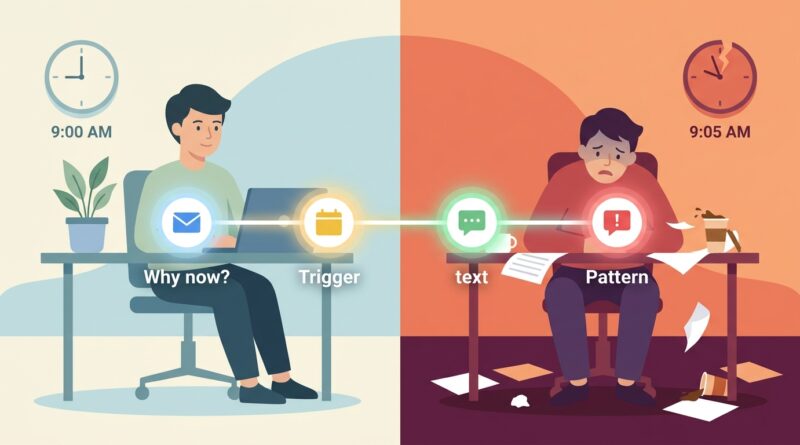
Why Your 5 Whys Keep Missing Patterns: The Simple ‘Trigger Why’ Behind Problems That Only Show Up After Something Sets You Off
You fix the argument. You apologize after the sharp email. You promise yourself you will stay calm next time. Then one specific thing happens. A certain subject line lands in your inbox. A certain person says that one sentence. A deadline gets tight. And suddenly you are right back in the same mess. That is maddening, especially when you are already trying to be thoughtful about it. The problem is not that root cause analysis is useless. It is that most people start too late. They ask why the blow-up happened, but they skip the tiny moment that lit the fuse. If you want better psychological trigger root cause analysis, you need one extra question before the usual 5 Whys. Ask, “What set me off right before this?” That is the Trigger Why. It sounds simple. It is. And it often shows you more than the post-mortem ever did.
⚡ In a Hurry? Key Takeaways
- Your 5 Whys may miss the real pattern if you only analyze the explosion and not the trigger that happened seconds or minutes before it.
- Start with a Trigger Why. Ask what email, tone, face, memory, deadline, or feeling flipped the switch, then run your usual Whys from there.
- This is about spotting patterns, not blaming yourself. If your reactions involve trauma, panic, or safety concerns, getting support from a therapist can help.
Why classic root cause analysis can miss emotional patterns
The usual 5 Whys works well on many practical problems. The server went down. Why? A part failed. Why? Maintenance was skipped. Why? The schedule was bad. You get the idea.
But people are not machines. We do not react only to the visible event. We react to meaning. To memory. To threat. To old stories our brain thinks are still current.
So if you only ask, “Why did I snap during the meeting?” you may get a neat answer that is also incomplete.
Maybe you say, “Because my coworker challenged me.” True enough. But why did that challenge hit so hard this time and not last Thursday? That is where the hidden pattern usually lives.
The missing piece: the Trigger Why
The Trigger Why is the question that comes before the first Why.
Ask this first. “What happened immediately before I changed state?”
Changed state is the key phrase here. Not just what happened before the event on the calendar. What happened before your body tightened, your chest sank, your jaw clenched, or your thoughts turned sharp.
Think of it like a light switch
The big problem you notice is the room getting bright. The trigger is the finger on the switch.
When people skip that step, they keep analyzing the bright room.
That is why the same issue keeps “coming out of nowhere.” It is not nowhere. It is just fast.
What a trigger actually looks like
A trigger is not always dramatic. Sometimes it is obvious. Sometimes it is almost boring.
It might be:
- An email from one specific person
- A phrase like “Just circling back”
- A deadline moving up by one day
- Someone sounding disappointed
- Being ignored in a group chat
- Your partner using the same tone your parent used
- Feeling trapped, judged, rushed, or dismissed
Notice that some of these are events, and some are interpretations. Both matter. In psychological trigger root cause analysis, you are studying the outer cue and the inner meaning it wakes up.
A simple example
Let’s say you keep blowing up whenever your boss asks for an update.
Your normal 5 Whys might go like this:
- Why did I get defensive? Because my boss asked for an update.
- Why did that upset me? Because it felt like pressure.
- Why does pressure upset me? Because I already had too much to do.
- Why did I have too much to do? Because I did not set boundaries.
- Why did I not set boundaries? Because I did not want to disappoint anyone.
That is not bad. It gives you useful information.
But now add the Trigger Why first:
- What set me off right before I got defensive? My boss wrote, “Need this ASAP.”
- Why did “ASAP” hit me so hard? It made me feel I had already failed.
- Why does that word feel like failure? Because I associate urgency with criticism.
- Why do I associate urgency with criticism? In past jobs, urgent messages usually meant blame was coming.
- Why is that still active now? I have not separated this boss from those past experiences.
Now you have something much more precise. The issue is not just workload or boundaries. It is the trigger word, the feeling it creates, and the old pattern attached to it.
How to do a trigger-focused 5 Whys
You do not need a giant worksheet. A notes app is enough.
Step 1: Capture the trigger fast
Right after the moment, write down the very first thing that changed your internal state.
Use plain language:
- “Saw her name in my inbox”
- “He laughed when I was talking”
- “Calendar alert popped up”
- “They said, ‘We need to talk’”
Do this before your brain starts rewriting history.
Step 2: Name the first feeling, not the polished one
Most of us skip right to the respectable explanation.
Try the less polished version first:
- Not “I was frustrated”
- Try “I felt cornered”
- Not “I was annoyed”
- Try “I felt dismissed”
The more accurate the feeling, the clearer the pattern.
Step 3: Run the Whys from the trigger
Now ask why that trigger hit so hard.
Keep going until you move from event to meaning. That is usually where the useful answer sits.
Step 4: Look for repeatable cues
After a few entries, circle what repeats.
Maybe it is not “conflict” in general. Maybe it is being surprised. Or being rushed. Or feeling watched. Or being asked for proof.
That is your real pattern.
The mistake people make
They analyze the explosion as if it were the start of the story.
It usually is not.
The visible problem is often the second or third step in the chain. By then, your nervous system is already in charge, and your smart explanations are trying to catch up.
This is also why you can swear you solved the issue and still repeat it. You fixed the argument strategy, not the ignition point.
Trigger Why vs root cause. You need both.
This is not a replacement for root cause analysis. It is a better starting point when people are involved.
Classic root cause methods ask, “Why did the problem occur?”
The Trigger Why asks, “What activated the problem pathway?”
Those are different questions.
One studies the breakdown. The other studies the switch.
Use both, and you get a fuller map.
What to do once you spot your trigger
Build a pause between trigger and reaction
You do not need perfect calm. You need a few extra seconds.
That might mean:
- Not replying to that email for 10 minutes
- Standing up and getting water
- Drafting a response in notes first
- Asking, “What story am I telling myself right now?”
Make the trigger less sharp
If one person’s emails set you off, change how you view them. Read them later. Turn off previews. Create a rule that moves them to a folder you check at a set time.
If deadlines trigger panic, break them into mini-deadlines you control. The point is not avoidance. It is reducing surprise and threat.
Separate present from past
This part matters. Ask yourself, “What does this remind me of?”
Sometimes the trigger is powerful because it is old. The current event is small, but it hooks into a much larger memory.
If that sounds familiar, you may also connect with Why Your 5 Whys Keep Ignoring Hidden Commitments: The Simple ‘Loyalty Why’ Behind Self‑Sabotage You Secretly Defend, which looks at the hidden promises and loyalties that keep people stuck even when they know better.
Questions that help when you are stuck
If your mind keeps saying, “Nothing triggered me, I just overreacted,” try these:
- What happened in the 30 seconds before I changed?
- What did I notice first, words, tone, face, timing, silence?
- What did I feel in my body first?
- What did this moment seem to mean about me?
- What older situation does this feel like?
- Does this happen with everyone, or only certain people and conditions?
That last one is especially useful. If it only happens with certain people or settings, you are not dealing with a general flaw. You are dealing with a pattern.
When this helps at work
A lot of people are learning 5 Whys and fishbone diagrams for work, then wondering why those same tools do not clean up their personal and career patterns.
The reason is simple. Work problems often live in process. Human blow-ups often live in activation.
Once you add the Trigger Why, those methods become much more human-friendly.
You can use it after:
- Performance review stress
- Repeated conflict with one teammate
- Procrastination before certain tasks
- Shutdown during meetings
- Career decisions that somehow always stall
When to get more support
If your triggers are intense, tied to trauma, or leave you feeling unsafe, frozen, panicked, or out of control, self-analysis may not be enough on its own.
That is not failure. It is just a sign that the pattern runs deep enough to deserve support.
A therapist can help you spot triggers, understand what they connect to, and build safer ways to respond.
At a Glance: Comparison
| Feature/Aspect | Details | Verdict |
|---|---|---|
| Classic 5 Whys | Starts with the visible problem and works backward through causes. | Useful, but can miss the exact cue that activated the reaction. |
| Trigger Why | Starts with the moment, signal, or meaning that flipped your internal switch. | Best for finding repeat emotional patterns you can predict and interrupt. |
| Best combined approach | Use Trigger Why first, then run the normal Whys on that trigger and the behavior that followed. | Most practical method for psychological trigger root cause analysis. |
Conclusion
The next time you find yourself doing another post-mortem on the same old blow-up, move your starting line. Do not begin with the argument, the email, or the bad decision. Begin with the switch getting flipped. Right now a lot of people are learning tools like 5 Whys and fishbone diagrams for work, but they are still stuck in the same emotional cycles at home and in their careers because they never analyze what actually sets them off. A practical Trigger Why helps connect classic root cause methods with real psychology. That means you can start predicting your patterns, soften them before they take over, and finally stop acting surprised by loops you now know how to see.