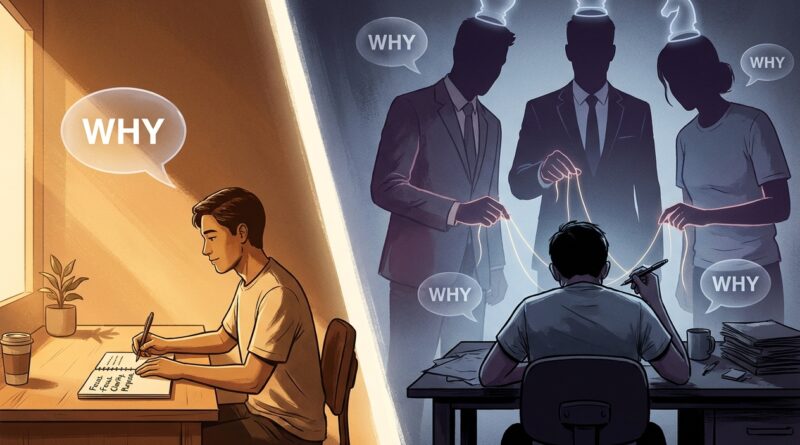
Why Your 5 Whys Keep Missing Power Dynamics: The Simple ‘Power Why’ That Explains Why You Self‑Sabotage Around Certain People
You are not imagining it. You can sit alone with a notebook, calmly sort out a problem, and come up with a solid plan. Then one specific person shows up, a boss, parent, partner, client, or even that loud person in the group chat, and suddenly your thinking gets fuzzy. You say yes when you mean no. You drop your own priorities. Later, when the pressure is gone, you replay the moment and wonder, “Why did I do that again?” That is deeply frustrating because it makes you feel weak or irrational when you are often reacting to something real. The missing piece is usually not logic. It is power. If your usual 5 Whys keeps acting like everyone in the situation has equal freedom, it will miss the real cause. A simple “Power Why” can make your root cause work far more honest, and far more useful.
⚡ In a Hurry? Key Takeaways
- Your 5 Whys may fail because it ignores who had more power, status, money, authority, or social safety in the moment.
- Add one question after each “why”: “What power gap was present here, and how did it change my choices?”
- This is not about blaming yourself. It helps you spot risk, protect your boundaries, and make better plans for the next conversation.
Why smart people still fold around certain people
Most root cause tools assume a clean, fair setup. Person A wants something. Person B responds. Everyone is making open choices based on facts. Real life is messier than that.
Sometimes the real answer is not “I am bad at boundaries” or “I need more discipline.” Sometimes the answer is, “I was dealing with someone who had more authority, more emotional force, more social protection, or more ability to punish me.”
That changes everything.
Your nervous system knows this before your conscious mind does. It notices who can embarrass you, fire you, freeze you out, shame you, withdraw love, tank your review, or turn a room against you. Then it starts making survival choices. Fast.
That is why the same person who is clear and capable in one setting can become hesitant and agreeable in another.
What the “Power Why” is
The Power Why is a simple add-on to regular root cause analysis. After each “why,” you ask:
“What power dynamic was present here, and how did it shape what I felt safe doing?”
That one question changes the quality of your answers.
Without it, your 5 Whys can turn into self-criticism. With it, you start seeing the environment, not just your behavior.
Standard 5 Whys example
Problem: I agreed to take on extra work I did not want.
Why? I did not speak up.
Why? I did not want to seem difficult.
Why? I worry people will think I am not a team player.
Why? I want approval.
Why? I have people-pleasing tendencies.
That may be partly true. But it is incomplete.
Now add the Power Why
Problem: I agreed to take on extra work I did not want.
Why? I did not speak up.
Power Why: My manager asked in front of the team, and controls my workload and review.
Why? I did not want to seem difficult.
Power Why: In this company, people who push back get labeled “negative” faster than leaders who over-assign work.
Why? I worry people will think I am not a team player.
Power Why: There have been layoffs, so the cost of being seen as “not committed” feels high.
See the difference? You are no longer pretending this happened in a vacuum.
Why this matters for self-sabotage
We call a lot of things self-sabotage that are actually threat responses mixed with unequal power.
You ghost the draft email. You over-explain. You agree too quickly. You freeze in meetings. You suddenly forget your talking points. Then later, away from the power source, your clarity comes back.
That is the clue.
If your intelligence returns when the person leaves, the issue may not be a lack of insight. It may be that your access to your own insight gets distorted in certain power setups.
Common signs power is the missing variable
- You are clear about your needs until one specific person is involved.
- You are more compliant in public than in private.
- You keep blaming your personality instead of naming the other person’s influence.
- You journal well after the fact but cannot think clearly in the moment.
- You use words like “I just caved” without asking what made resisting feel costly.
The four power gaps that most often distort your answers
1. Formal power
This is the obvious one. Bosses, clients, teachers, parents, officials, moderators, and anyone who can make a decision that affects your money, access, grade, housing, or reputation.
If they can punish you, even softly, your choices are not fully free.
2. Social power
This person may not outrank you on paper, but they control the room. They are popular, loud, well-connected, admired, feared, or very skilled at getting allies.
People often cave to social power because exclusion feels dangerous.
3. Emotional power
This person can trigger guilt, fear, longing, obligation, or old family roles. They know your buttons, or they remind you of someone who did.
This is why grown adults can turn into nervous teenagers around a parent or a certain partner.
4. Scarcity power
When jobs are shaky, housing is tight, money is thin, or your relationship feels fragile, the person linked to that scarce resource has more influence over you.
The tighter your margin, the harder it is to “just set a boundary.”
How to do a better 5 Whys with the Power Why built in
Use your normal 5 Whys. Just add one extra line each round.
Step 1: Name the visible problem
Keep it concrete.
Examples:
- I agreed to something I did not want.
- I stayed silent in the meeting.
- I picked a fight online and regretted it.
- I dropped my own plan after talking to my partner.
Step 2: Ask why, as usual
Get the basic chain going. Do not overthink it at first.
Step 3: After each why, add the Power Why
Ask:
- Who had more power in that moment?
- What kind of power was it?
- What did my body think could happen if I resisted?
- What felt unsafe to say or do?
- Was I trying to avoid punishment, shame, conflict, loss, or exclusion?
Step 4: Separate “my pattern” from “their power”
This is big. Some problems are 30 percent your habit and 70 percent the setup. Some are the reverse. You need both numbers, loosely speaking, before you decide what to fix.
Otherwise you will keep trying to improve your confidence while staying in the same skewed situation.
Step 5: Build a plan that fits reality
If power is part of the cause, your solution cannot be “be more assertive” and stop there.
You may need:
- A script prepared in advance
- A slower response window
- A witness or ally in the room
- A written follow-up instead of a live reply
- Stronger documentation
- A different setting for the conversation
- Distance from the person, if possible
A quick real-world example
Let’s say you keep abandoning your weekend plans to help your sibling with last-minute crises.
The usual analysis might say:
- I have poor boundaries.
- I hate disappointing people.
- I need to be more disciplined.
Now try the Power Why.
Why do I keep saying yes? Because I feel guilty.
Power Why: My sibling has trained the family to treat their needs as urgent. If I say no, I become the selfish one.
Why does guilt work so fast? Because I fear family backlash.
Power Why: There is a social coalition here. This is not just one person asking. It is a whole role I get pushed back into.
Why do I drop my plans? Because I panic that conflict will spiral.
Power Why: Growing up, saying no led to punishment or emotional chaos.
Now the solution changes. It is not just “grow a spine.” It may be “stop answering same-minute,” “reply by text,” “give a smaller yes,” or “expect guilt without obeying it.”
Where people get tripped up
They think naming power means making excuses
It does not. You are not saying, “I had no agency.” You are saying, “My agency was affected by the setup.” That is a much more accurate starting point.
They only look at official hierarchy
Some of the strongest power dynamics do not come with a title. They come with charm, volatility, group loyalty, or the ability to create drama on cue.
They do the analysis too late
After the fact, your brain smooths things over. It says, “It was not a big deal.” Try writing down details quickly. Who was there? What tone did they use? What did you fear would happen if you pushed back?
Use this with journaling, therapy, and team problem-solving
This is where the idea gets really useful. The Power Why is not a replacement for the 5 Whys. It is a correction.
If you already use root cause tools, this can sharpen them fast. If you want a related angle on how hidden influence can warp problem-solving, Why Your 5 Whys Keep Ignoring Power: The Simple ‘Control Why’ That Explains Hidden Resistance To Change is worth a read too. It pairs well with this idea because control and power often travel together.
In journaling
Add a column labeled “power in the moment.” You will start seeing patterns very quickly.
In therapy
Bring one recent example and ask, “What made this person feel bigger than me in that moment?” That question can open more than another round of “why do I do this?”
At work
Teams use the 5 Whys to fix process issues all the time. But if nobody can safely tell the truth upward, the process map will be fake. Psychological safety is not a side issue. It affects the data.
Three simple scripts that help when power is in the room
For pressure in the moment
“I do better when I check my calendar first. I’ll get back to you this afternoon.”
For public asks that corner you
“I want to answer carefully, not quickly. Can we follow up after the meeting?”
For repeat boundary tests
“I can help with X, but not in the way we did last time.”
These are not magic lines. They are speed bumps. And sometimes a speed bump is enough to get your thinking back online.
At a Glance: Comparison
| Feature/Aspect | Details | Verdict |
|---|---|---|
| Standard 5 Whys | Good for habits, process errors, and obvious decision chains, but often assumes everyone had equal freedom. | Useful, but incomplete when people, fear, or status are involved. |
| 5 Whys plus Power Why | Adds a check for authority, social pressure, emotional triggers, and scarcity before blaming character. | Best choice for relationship stress, workplace tension, and “why did I cave?” moments. |
| Action plan quality | Without power analysis, plans are often vague, like “be stronger.” With it, plans become specific, like changing timing, format, witnesses, or scripts. | More realistic and easier to use in real life. |
Conclusion
Power and status are baked into far more problems than most people want to admit, from workplace burnout to online conflict to family tension at dinner. Yet many root cause tools still treat people like equal rational actors moving across a level playing field. That is why your answers can look smart on paper and still fail in real life. The Power Why gives you a dead-simple way to map the hidden gap. Once you ask how power changed what felt safe, your 5 Whys becomes more honest. So do your therapy notes, your journal entries, and your next move. In a time of layoffs, polarized debates, and strained relationships, that kind of honesty matters. It helps you stop calling everything self-sabotage and start seeing the system around the behavior. That is not weakness. That is clarity, and clarity is where better choices begin.