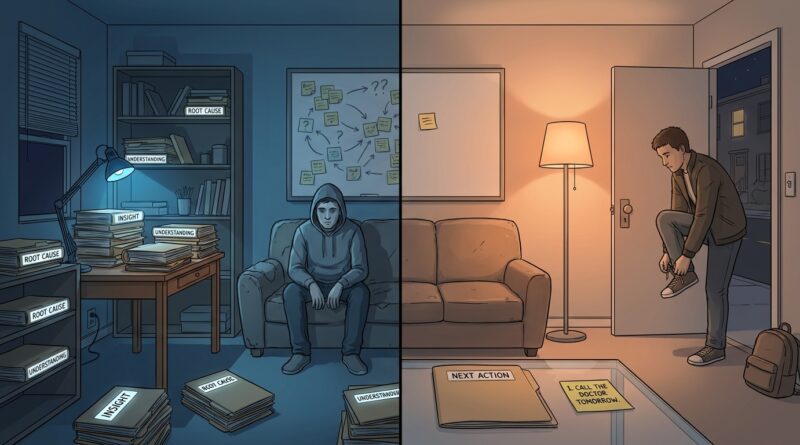
Why Your 5 Whys Keep Surfacing Insight But Not Change: The Simple ‘Action Why’ That Turns Aha-Moments Into Different Behavior Tomorrow
You are probably not missing insight. You are drowning in it. You know why the argument keeps happening, why the project slips, why you stay up too late, why your mornings feel rushed. You may even have a neat chain of five whys written in a notebook, a therapy app, or a retro board at work. And still, the same pattern shows up again on Monday morning like nothing was learned. That is maddening. It can make you feel lazy, broken, or strangely immune to your own self-awareness. Usually, though, the problem is simpler. The classic 5 Whys is good at finding meaning. It is not always good at changing behavior. Insight answers, “Why does this keep happening?” Change needs a different question. It asks, “Given what I now know, what is the next tiny move I will actually do?” That is where the Action Why comes in.
⚡ In a Hurry? Key Takeaways
- The gap in root cause analysis insight vs action is usually not understanding. It is the lack of one clear, small behavior tied to tomorrow.
- After your usual “why” chain, add one more question: “What is the smallest action that makes this pattern a little harder to repeat?”
- Keep the action safe, specific, and measurable. If it feels huge or vague, you are still in reflection mode, not change mode.
Why insight so often stalls out
The 5 Whys method came from problem-solving work. It is useful because it helps you dig past the first obvious answer. “I missed the deadline” becomes “I started late,” then “I avoided the task,” then “I felt unclear,” then “I did not want to ask for help,” and so on.
That is valuable. It can reveal fear, confusion, bad systems, missing support, or old habits. But there is a catch. The method tends to stop when the explanation feels satisfying.
And satisfying explanations can trick your brain into feeling finished.
You get the little burst of relief that comes with naming the problem. It feels like progress because, in one sense, it is progress. But behavior has not changed yet. Tomorrow still arrives with the same phone, same inbox, same tired brain, same defaults.
That is the heart of the root cause analysis insight vs action problem. Insight describes the machine. Action changes one gear.
The missing piece: the Action Why
Here is the simple shift. Do your normal why chain if it helps. Then add one final question.
Ask this:
“Why, specifically, do I keep doing this tomorrow, even after I understand it today?”
That is the Action Why.
It is not asking for a deeper childhood theory or a smarter systems map. It is asking what keeps the pattern alive in real life. Friction. Convenience. Timing. People. Environment. Energy. Cues.
Then ask one follow-up.
Follow with this:
“What is one tiny action that interrupts that exact reason?”
Now you are no longer trying to solve your whole personality by bedtime. You are trying to make one pattern slightly harder to repeat.
A quick example
Let’s say your usual 5 Whys looks like this:
I keep doomscrolling at night.
Why? Because I feel too wired to sleep.
Why? Because I work late and need to come down.
Why? Because my day feels unfinished.
Why? Because I start the hardest task too late.
Why? Because I avoid it in the morning.
Great. That is real insight.
But tomorrow night, your thumb can still open the same app.
Now add the Action Why:
Why do I still doomscroll tomorrow, even knowing all this?
Because my phone is on the pillow, and scrolling is the easiest off-ramp when I feel restless.
Now the action:
What is one tiny action that interrupts that exact reason?
Charge the phone across the room for one night, and put a paperback on the pillow instead.
Notice what happened. You did not solve your work avoidance, your unfinished-day anxiety, and your nervous system in one move. You changed the next repeatable moment.
That is often how change starts.
The five-minute desk-or-bedside framework
You can run this in five minutes. No app required. A sticky note is enough.
Step 1: Name the pattern
Keep it plain. “I snap at my partner after work.” “I miss my workout.” “I keep putting off the email.”
Step 2: Do a short why chain
Three to five layers is enough. Stop when you hit something useful, not when it gets dramatic.
Step 3: Ask the Action Why
Why does this still happen in the moment, even though I understand it?
This usually points to a live trigger. Low energy. No reminder. Too much setup. Easy distraction. Fear of a reply. Bad timing.
Step 4: Pick one tiny interruption
Make it so small it feels almost boring.
- If you avoid a task because starting feels foggy, write the first two-minute step before ending the day.
- If you skip meds because mornings are chaotic, place the bottle by the toothbrush tonight.
- If meetings run long because nobody closes them, decide on one sentence you will say at minute 25.
Step 5: Define what “done” means
Not “be more mindful.” Not “communicate better.” Try this instead:
- “Tomorrow, before I open Slack, I will write the first sentence of the proposal.”
- “Tonight, I will put my charger in the kitchen.”
- “After lunch, I will send the calendar invite before doing anything else.”
Step 6: Check once, not all day
Did you do it, yes or no? If not, do not write a sad essay about your lack of discipline. Ask a better question.
What made the action too hard, too vague, too late, or too easy to ignore?
Then shrink it again.
What the Action Why is really doing
It moves you from interpretation to design.
That sounds technical, but it is simple in practice. Instead of trying to feel different first, you change the setup around the behavior. You reduce the number of decisions required in the moment. You make the better move easier to start and easier to notice.
Think of it like fixing a printer jam. Knowing that the paper tray is misaligned is insight. Moving the paper guides so the jam stops happening is action.
Both matter. Only one changes tomorrow morning.
Common ways people accidentally stay stuck
1. They stop at the most elegant explanation
The smarter the explanation, the easier it is to admire it instead of use it. A clean theory can become a hiding place.
2. They choose actions that are too big
“I will set better boundaries” is not an action. “I will not answer work chat after 6 p.m. for one evening” is.
3. They pick actions that depend on feeling motivated
Motivation is nice. It is not reliable. Good actions survive low energy.
4. They confuse self-knowledge with self-trust
You may know yourself very well and still not trust yourself to follow through. Tiny completed actions rebuild that trust faster than long analysis does.
5. They try to fix the whole pattern at once
You do not need a full personal operating system redesign tonight. You need one better move than yesterday.
How to tell if your Action Why is good
A good Action Why points to something concrete and changeable.
Good: “I keep missing my workout because my clothes are still in the dryer, and by then I am already negotiating with myself.”
Too abstract: “I have a complex relationship with consistency.”
Good: “I avoid the report because I do not know the first chart to open.”
Too abstract: “I fear my potential.”
Abstract insights can be true. But if they do not point to a visible behavior or obstacle, they do not help much at 8:12 a.m.
Examples you can borrow
If you keep procrastinating
Action Why: The task is vague at the starting line.
Tiny action: Write the first ugly step before you close your laptop today.
If you keep having the same argument
Action Why: You try to talk when both of you are already flooded.
Tiny action: Use one pause phrase and revisit the issue at a set time.
If you keep overspending online
Action Why: Shopping apps are the fastest comfort when you feel flat.
Tiny action: Remove saved card details tonight, so impulse has one more step.
If you keep skipping a habit
Action Why: The setup is annoying enough to lose the moment.
Tiny action: Lay out the gear where you trip over it, politely, tomorrow morning.
What this looks like at work
This is not just for personal habits. Teams get stuck in insight loops too.
A retro says, “We had unclear ownership.” Everyone nods. The board gets exported. Nothing changes next sprint.
Try the Action Why instead.
Why does unclear ownership keep happening in live work, even though we all agree it is a problem?
Because tasks leave meetings without a named owner and a date.
One tiny action:
Before ending each meeting, ask, “Who owns this, and when is the next visible checkpoint?”
That is not glamorous. It is useful.
At a Glance: Comparison
| Feature/Aspect | Details | Verdict |
|---|---|---|
| Classic 5 Whys | Good for finding patterns, causes, and hidden assumptions behind a problem. | Useful for insight, but incomplete if you stop there. |
| Action Why | Asks why the behavior still happens in the real moment, then ties that answer to one tiny interruption. | Best bridge from understanding to follow-through. |
| Big self-improvement plan | Often ambitious, emotionally satisfying, and hard to keep up when energy drops. | Looks serious, but often fails faster than a small measurable action. |
Conclusion
If you keep asking why and getting smart answers but the same week keeps replaying, you are not failing at reflection. You are probably just stopping one step too soon. The internet has plenty of smarter and smarter tools for root cause analysis, and many of them are genuinely helpful. But people are tired. Attention is thin. Follow-through is the scarce resource now. That is why the counterweight matters. After the insight, ask the Action Why. Then choose one tiny behavior change that feels safe enough to try and real enough to measure. Five minutes is enough. At your desk. At your bedside. On the back of a receipt if needed. Do not aim for a new identity by tomorrow. Aim for one different move. Repeated often enough, that is how insight finally starts to look like change.