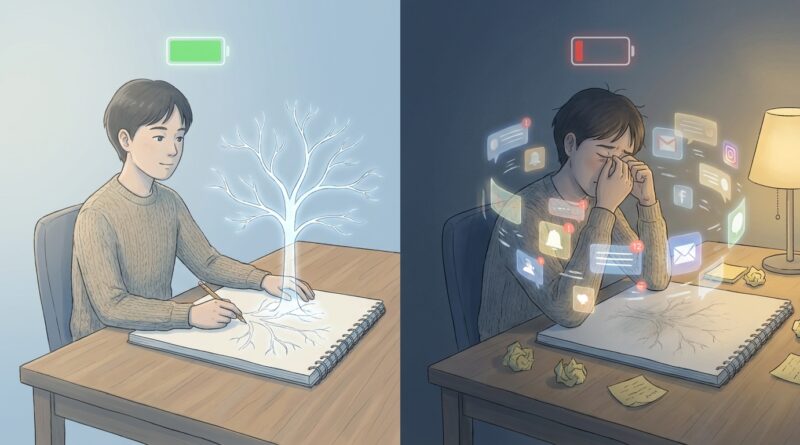
Why Your 5 Whys Collapse Under Decision Fatigue: The Simple ‘Energy Why’ Behind Choices You Keep Avoiding
You know the drill. Ask why five times, get to the root cause, fix the real problem. It sounds clean and smart. Then 3pm hits, your inbox is loud, your phone keeps buzzing, and even picking what to eat feels weirdly hard. That is when your 5 Whys can fall apart. Not because you got lazy. Not because you lack discipline. Because your brain is low on fuel.
When mental energy drops, you stop asking better questions and start grabbing faster answers. You say yes to things you should push back on. You treat symptoms like causes. You buy stuff to feel relief. You skip the walk, the budget check, the hard conversation. If you want a better decision fatigue root cause analysis, you need one extra question before the usual why chain starts. It is simple. “Do I have the mental energy to trust my answer right now?” That one check can save you from solving the wrong problem.
⚡ In a Hurry? Key Takeaways
- Decision fatigue can break root cause analysis. Sometimes the real problem is low mental energy, not bad character.
- Before asking “why” five times, ask one “energy why.” Check whether you are rested, fed, calm, and able to think clearly.
- If major money, health, or relationship choices keep going wrong late in the day, redesign when you decide. Do not just demand more willpower.
Why the 5 Whys stop working when your brain is tired
The 5 Whys method is useful because it slows you down and helps you dig into causes instead of blaming the first obvious thing. But it assumes something big. It assumes the person asking the questions is thinking clearly.
That is often not true.
By mid-afternoon, many people are running on low sleep, too many tabs open, shallow concentration, stress, and a pile of tiny choices already made. That matters. A tired brain wants closure, not truth. It wants the easiest answer that feels good enough.
So instead of asking, “Why do I keep overspending?” you land on, “I just need to be stricter.” Instead of, “Why do we keep having the same fight?” you land on, “My partner never listens.” Instead of, “Why am I not exercising?” you land on, “I am lazy.”
Those are fast answers. They are not always root causes.
The “Energy Why” that comes before every other why
Here is the missing question.
Ask this first
“Why does this choice feel so hard right now?”
Then test one possible answer before anything else.
“Is the difficulty coming from the problem itself, or from my current energy level?”
That is the Energy Why.
It sounds almost too simple, but it changes a lot. It separates a real issue from a low-power brain. If your mental battery is flat, your analysis gets warped. You become more reactive, more emotional, more avoidant, and more likely to confuse urgency with importance.
What low mental energy looks like in real life
You may be dealing with decision fatigue if you notice any of these:
- Small choices feel strangely heavy.
- You keep postponing one specific decision for days.
- You say yes to save mental effort, then regret it later.
- You buy convenience or comfort things you did not plan to buy.
- You keep changing your mind.
- You snap at people, then blame them for “bad timing.”
- You start researching instead of deciding.
None of that means you are broken. It means your brain may be protecting itself by avoiding effort.
A simple decision fatigue root cause analysis
If you want a practical way to use this, do not throw out the 5 Whys. Just add an energy check before it.
Step 1: Name the decision
Be specific. Not “my life is a mess.” Try “I keep avoiding opening my budget” or “I cannot decide whether to accept this extra project.”
Step 2: Run the Energy Why
Ask:
- Am I hungry?
- Am I tired?
- Have I already made too many decisions today?
- Am I stressed, rushed, or distracted?
- Would this choice feel easier at 9am than it does right now?
If the answer is yes to several of those, pause. You are not failing the process. You are improving it.
Step 3: Sort the problem into one of two buckets
Bucket A: Real problem. The issue is still hard even when you are rested and calm.
Bucket B: Energy problem. The issue mostly feels impossible when your brain is overloaded.
This matters because each bucket needs a different fix.
Step 4: Only then do the 5 Whys
If it is a real problem, go ahead and ask why repeatedly. But if it is mostly an energy problem, the root cause may be in the setup of your day, not in your morals or motivation.
Examples that make this easier to spot
Money
Problem: You keep ordering takeout and blowing the weekly food budget.
Fast answer: “I have no self-control.”
Energy Why answer: “At 7pm I am wiped out, so I pick the easiest option.”
Better root cause: You are making dinner decisions at the exact hour your brain is least able to make them.
Better fix: Decide meals earlier. Repeat a few default dinners. Keep two low-effort backup options at home.
Health
Problem: You keep skipping workouts.
Fast answer: “I am undisciplined.”
Energy Why answer: “By the time I am supposed to work out, I have used up my focus for the day.”
Better root cause: The decision point comes too late, after too many other choices.
Better fix: Move exercise earlier, or remove the choice by scheduling the same simple routine on the same days.
Relationships
Problem: You keep agreeing to plans you do not want.
Fast answer: “I am bad at boundaries.”
Energy Why answer: “When I am mentally drained, saying no feels harder than dealing with the consequences later.”
Better root cause: Boundary-setting requires energy you no longer have at the end of the day.
Better fix: Use a default response like, “Let me check and get back to you.” Give yourself time to decide when your brain is fresher.
Why people misread fatigue as a personality flaw
Because fatigue is boring. Character flaws feel dramatic and clear. “I lack discipline” sounds like an answer. “I made too many decisions before lunch” sounds less exciting.
But boring causes are often the real ones.
This is also why some advice feels useless. It tells you to trust your gut or use a better framework, but ignores that both guts and frameworks work worse when your brain is overloaded. A tired mind can use a smart method badly.
If you have ever traced a problem back to the wrong cause, time may be part of the issue too. That is where Why Your 5 Whys Keep Missing Time: The Simple ‘Timeline Why’ Behind Problems That Never Seem To End is worth reading. Sometimes the answer is not just what caused the problem, but when the problem reliably gets worse.
How to redesign your day so better choices happen with less effort
You do not need a heroic amount of willpower. You need fewer bad decision windows.
1. Put important choices earlier
If possible, make money, scheduling, and relationship decisions before your energy drops. For many people, that means morning or early afternoon.
2. Remove repeat decisions
Use defaults. Rotate the same lunches. Automate savings. Set fixed call times. Wear the same few reliable outfits. This is not dull. It is efficient.
3. Use “not now” on low-energy choices
Some decisions should not be made when you are fried. If the stakes are meaningful, delay the answer instead of forcing a low-quality one.
4. Notice your personal crash hour
Not everyone fades at 3pm. Some people hit the wall at 11am. Others at 8pm. Track when choices become slower, sloppier, or more emotional.
5. Protect fuel before hard decisions
Food, sleep, quiet, and breaks are not luxuries if you need to think clearly. They are part of the system.
6. Use scripts for common pressure points
When energy is low, words disappear. Prepare a few:
- “Let me think about it and reply tomorrow.”
- “That does not work for me.”
- “I am not deciding this tonight.”
- “I need to look at the numbers first.”
When the problem is not just energy
To be clear, decision fatigue does not explain everything. Some problems are still about habits, missing information, fear, conflict, or poor systems. The point is not to blame every mistake on being tired.
The point is to stop skipping a major variable.
If your choices reliably get worse when your mental energy is low, that is not a side note. That is part of the root cause analysis.
At a Glance: Comparison
| Feature/Aspect | Details | Verdict |
|---|---|---|
| Standard 5 Whys | Useful for digging into causes, but assumes clear thinking and enough mental energy to judge answers well. | Strong method, weak timing if used when exhausted. |
| 5 Whys plus Energy Why | Adds a quick check for fatigue, overload, hunger, stress, and decision volume before analysis starts. | Best choice for more accurate root cause analysis. |
| Willpower-only approach | Treats recurring bad decisions as a discipline problem and ignores timing, energy, and environment. | Usually leads to guilt, not better decisions. |
Conclusion
People are drowning in micro-decisions, and a lot of advice still acts like the answer is to trust your gut or stack on one more framework. But any why-based method can collapse when your brain is running on fumes. That does not make you weak. It makes you human. Once you connect bad outcomes to decision fatigue instead of character flaws, a lot starts to make sense. The overspending, the skipped workouts, the pointless arguments, the vague feeling that simple choices should not be this hard. Start using a better decision fatigue root cause analysis. Ask the Energy Why first. Then build your day around fewer, better-timed choices. You will likely need less willpower than you think, and get better results than shame ever gave you.