Why Your 5 Whys Keep Grabbing The Loudest Cause: The Simple ‘Salience Why’ That Stops You Ignoring Quiet Root Causes
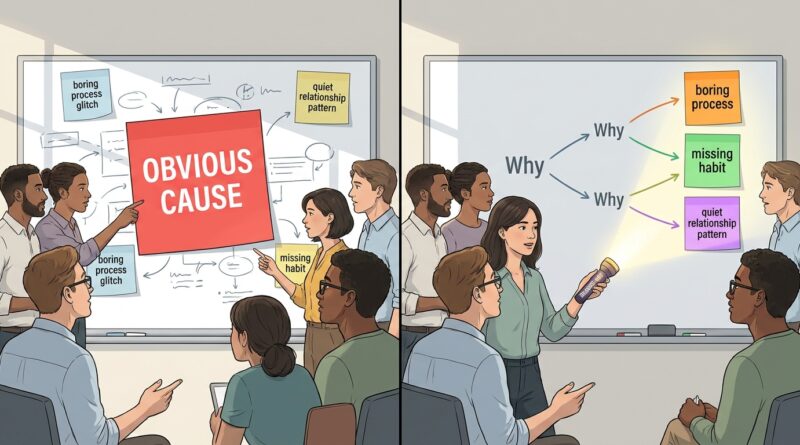
You know the meeting. Something goes wrong, everyone gathers round a whiteboard, and within five minutes the room has picked its favorite villain. The angry client email. The giant outage. The teammate who made the visible mistake. It feels satisfying because the loudest cause is easy to see, easy to say out loud, and easy to blame. It is also often incomplete. That is why so many 5 Whys sessions feel productive in the moment but lead to the same problem showing up again a few weeks later in a quieter form. If your root cause analysis keeps landing on whatever feels most dramatic, you are not really following the evidence. You are following salience. That is the simple bias where your attention sticks to what is vivid, recent, emotional, or embarrassing, while the boring system issue hiding underneath gets ignored. Once you know this pattern, you can start catching it before it hijacks your analysis.
⚡ In a Hurry? Key Takeaways
- The 5 Whys often fails when teams chase the most noticeable cause instead of the most supported one. That is salience bias in action.
- Slow the process down. Ask for at least one quiet, boring, system-level explanation before agreeing on any root cause.
- This small habit can cut blame, improve post-mortems, and lead to fixes that actually last.
Why the loudest cause keeps winning
Our brains are not neutral note-takers. They are spotlight operators.
In any incident, the spotlight swings toward what is emotionally charged or easy to picture. If a customer shouted, that becomes the story. If a server went down in a dramatic way, that becomes the story. If one person made a visible error, that person becomes the story.
Meanwhile, the quieter causes sit in the dark. Maybe the checklist was outdated. Maybe the team had no clear handoff. Maybe alerts were noisy for months, so people stopped trusting them. Those causes are less exciting, but they are often where the repeat problems live.
This is the heart of the 5 whys root cause analysis psychological bias salience problem. The method itself is not bad. The trouble starts when the people using it assume the first memorable answer must be the deepest one.
What “salience why” means in plain English
A “salience why” is a why-answer that feels convincing mainly because it stands out, not because it has been properly tested.
Common signs you have found a salience why
You may be dealing with one if the answer:
- focuses on the most recent dramatic event
- names a person before naming a process
- gets quick agreement because everybody already remembers it vividly
- sounds neat and complete after only one or two layers of questioning
- does not explain similar smaller failures that happened before
That last one matters a lot. A good root cause should explain the big incident and the little near-misses around it. If it only explains the dramatic version, you may have picked the story, not the cause.
Why 5 Whys and fishbone sessions are especially vulnerable
These tools are simple, and that is why people like them. But simple tools can still be bent by messy human habits.
5 Whys can become a fast blame ladder
If the facilitator is rushed, each “why” can quietly point back to the same obvious target.
For example:
Why was the release broken? Because Alex pushed the wrong config.
Why did Alex push the wrong config? Because Alex was in a hurry.
Why was Alex in a hurry? Because the client was angry.
See the pattern? The questions sound deeper, but the group is orbiting the same vivid event and the same visible person. It feels like analysis. It is really attention bias with extra steps.
Fishbone diagrams can still get crowded around the dramatic branch
A fishbone gives categories like People, Process, Tools, Environment, and so on. Helpful in theory. In practice, teams often spend most of their energy filling the branch that already has emotional heat.
If “People” gets ten sticky notes and “Process” gets one, that is not always because people are the main issue. Sometimes it is because personal mistakes are easier to remember than weak controls.
The quiet root causes teams miss most often
These are the kinds of causes that do not make for gripping retellings, but they often keep problems alive:
- unclear ownership
- missing or outdated documentation
- alert fatigue
- training gaps nobody noticed because workarounds existed
- approval steps that look official but are skipped in real life
- tools that are technically available but too awkward to use
- policies that conflict with how work actually gets done
None of these are flashy. That is exactly why they slip past people.
How to stop salience from hijacking your RCA
1. Separate “most visible” from “most likely”
Write the dramatic cause down. Do not ignore it. Just label it honestly as “most visible so far,” not “root cause.” That tiny wording change helps a group stay curious.
2. Force one boring explanation onto the board
Before the team can settle on an answer, ask this: “What is the dull system explanation we would regret ignoring?”
This works surprisingly well. It gives people permission to name process problems that sound less exciting but may matter more.
3. Ask for evidence at each why
After every answer, ask, “What tells us that is true?”
If the answer is “everybody remembers it” or “it was obvious in the room,” that is not much evidence. You want logs, timelines, repeat patterns, prior incidents, handoff records, and examples from normal days, not just crisis days.
4. Look for the problem in quiet corners
If the issue really is root-level, you should usually find smaller versions elsewhere.
Say the dramatic incident was a failed deployment during peak traffic. Check lower-stakes releases too. Were there similar misconfigurations in staging? Did another team nearly make the same mistake? Quiet repeats are gold. They often reveal the real pattern.
5. Run a “reverse fishbone”
Instead of starting with what went wrong, start with what would have prevented it.
Ask:
- What control should have caught this?
- What routine should have reduced the odds?
- What backup path should have softened the impact?
This shifts attention from the dramatic trigger to the missing safety net.
6. Invite the least dramatic witness
The loudest people in the room are not always the most useful. Sometimes the person with the clearest view is the quiet operator who says, “This has kind of been flaky for months.”
That sentence is often worth more than twenty excited theories.
A simple script you can use in your next post-mortem
If you want a practical way to reduce salience bias, try this short sequence:
- What happened that was most visible?
- What happened that was least visible but still relevant?
- Which explanation has evidence?
- Which explanation is just vivid?
- What quiet condition made the loud event possible?
- If the dramatic event had not happened, would the weakness still exist?
That last question is a keeper. If the weakness would still be sitting there, waiting for a different trigger, you have probably found something more useful than the headline event.
Personal life has this problem too
This is not just for IT teams and incident reviews.
People do this at home all the time. The big argument gets blamed on “that rude comment,” when the quieter cause was everyone being tired, rushed, and unclear about plans. A missed payment gets blamed on one bad day, when the real issue was a confusing reminder system that had failed quietly before.
Once you spot salience bias, you start seeing how often the flashy explanation wins over the steady one.
What good analysis feels like instead
It feels a bit less dramatic. That is usually a good sign.
Good analysis often ends with an answer that sounds almost boring: unclear change review, weak defaults, inconsistent onboarding, no single owner, alert thresholds that trained people to ignore alerts. These do not make for satisfying villains. They do make for better fixes.
And better fixes are the point.
At a Glance: Comparison
| Feature/Aspect | Details | Verdict |
|---|---|---|
| Loud cause | Vivid, emotional, easy to remember, often tied to a person or major event | Useful clue, but not enough on its own |
| Quiet root cause | Boring, repeated, system-level weakness that exists before and after the incident | Usually where lasting fixes come from |
| Best practice | Ask for evidence, look for quieter repeats, and require at least one non-dramatic explanation | Best way to reduce salience bias in RCA |
Conclusion
If your 5 Whys keeps landing on the loudest cause in the room, the fix is not to throw the method out. The fix is to notice the pull of salience before it turns your analysis into a blame story. That matters right now because root cause tools are everywhere again, from fresh 5 Whys templates to fishbone explainers and AI-driven RCA, but very few of them teach people to spot the psychological gravity of what feels important in the moment. Once you name that pull, you can tame it. The result is simple and valuable. More honest post-mortems. Fewer witch-hunts. Better fixes that hold up over time, both at work and in ordinary life. And honestly, that is the kind of boring result most teams need a lot more of.