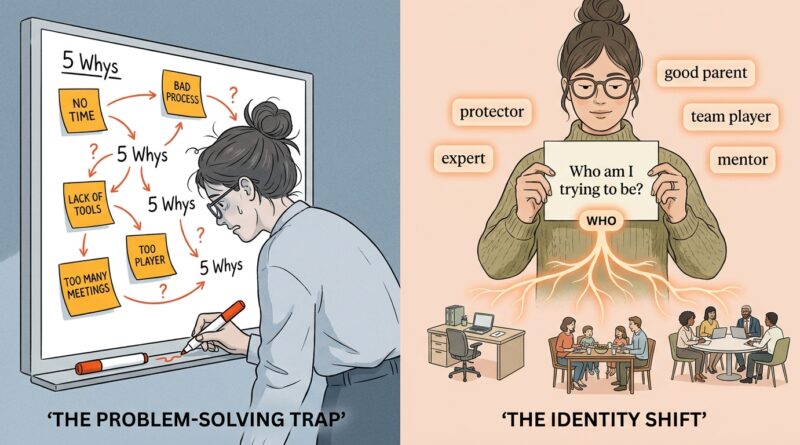
Why Your 5 Whys Keep Ignoring Identity: The Simple ‘Who Why’ Behind Behavior That Never Matches Your Goals
You ask “why” five times, and somehow still end up with the same bad result next week. That is maddening. The answer usually lands on the usual suspects. Not enough time. Wrong tool. Too much pressure. Poor communication. Those things can be real, but they are often not the deepest reason. The deeper reason is more personal and harder to spot. People usually act in ways that protect the identity they already have, even when that behavior clearly clashes with the goals they say they want. That is why a person can want to be healthy and still skip the workout, or a team can want innovation and still reject every risky idea. If your root cause analysis keeps circling the same surface explanations, it may be missing the “who” underneath the “why.” Ask a sharper question. Who does this behavior allow me, or us, to be?
⚡ In a Hurry? Key Takeaways
- Your 5 Whys may fail because behavior often follows identity, not stated goals.
- Add a “Who Why” question to your analysis: “Who does this behavior allow me or us to be?”
- This is not about blame. It is a practical way to spot hidden resistance before it turns into burnout, procrastination, or team gridlock.
Why the usual 5 Whys can miss the real cause
The classic 5 Whys is useful because it pushes past the first excuse. But it has a blind spot. It assumes the true cause is sitting in process, tools, timing, or training.
Sometimes it is. A broken workflow is still a broken workflow.
But human behavior is messy. A person can know the right process, have the right software, and still not do the thing. A team can agree on the goal in Monday’s meeting and quietly undermine it by Friday. When that happens, the missing piece is often identity.
In plain English, people do not just act from reasons. They act from self-story. “I’m the dependable one.” “I’m the rebel.” “We are the team that never makes mistakes.” “I’m bad at follow-through.” Those stories shape choices far more than most postmortems admit.
The simple “Who Why” behind behavior
Here is the question that changes the conversation:
Who does this behavior allow me to be, and why is that so hard to give up?
That sounds simple, but it gets under the hood fast.
Take procrastination. A standard why chain might say:
I delayed the work. Why? Because I was overwhelmed. Why? Because the task was big. Why? Because it was poorly scoped.
All fair. But the identity layer might say:
I delayed the work because starting would test whether I am actually competent. As long as I do not start, I get to keep being “someone who could do great work if I really tried.”
Ouch. But useful.
That kind of answer is what identity based root cause analysis is trying to uncover. Not just what blocked the action, but what the behavior protected.
What psychology keeps showing us
Across behavior-change research, one pattern keeps showing up. Change sticks better when it fits a person’s identity, and fails more often when it fights it.
If someone sees themselves as “not a runner,” getting them to run three times a week is not just a scheduling problem. It is a self-concept problem. If a manager sees themselves as “the person with the answers,” delegation feels like identity loss, not efficiency. If a team prides itself on being careful and mistake-free, experimentation can feel like betrayal.
This is why people really behave this way, even when it looks irrational from the outside. The behavior makes emotional sense inside the identity system.
Signs your team is dealing with an identity conflict, not a tool problem
Here are a few clues.
The fix is obvious, but nobody uses it
You brought in the new software. You simplified the workflow. Training happened. Still no change. That often means the barrier is not knowledge. It is self-protection.
People defend the old way with strange intensity
When the reaction feels bigger than the issue, identity may be involved. You are not just changing a process. You may be threatening what makes someone feel competent, needed, safe, or respected.
Everyone agrees in public, resists in private
This is common in teams that say they want speed, candor, or innovation, but unconsciously identify as cautious, agreeable, or perfectionist.
The same root causes keep returning
If every review ends with “communication” or “bandwidth,” chances are good you are naming symptoms, not the driver.
How to use identity based root cause analysis in real life
You do not need a whiteboard full of theory. You need a better sequence of questions.
Step 1: Start with the normal 5 Whys
Do not throw out the old method. Use it. Map the practical chain first. Tools, deadlines, decision rights, unclear scope, handoff problems. All of that matters.
Step 2: Then ask the “Who Why”
Once you reach the usual stopping point, ask:
Who does this behavior allow me to be?
Who does this behavior allow this team to be?
What identity would we risk if we stopped doing it?
Step 3: Listen for protective stories
You are listening for phrases like:
- “That’s just not me.”
- “We’ve always been the kind of team that…”
- “If I do that, people will think…”
- “I do my best work under pressure.”
- “I’m the one who keeps things from falling apart.”
Those are not random comments. They are clues.
Step 4: Design a bridge identity
The goal is not to rip away someone’s self-image. That usually backfires. The goal is to build a bridge.
For example, instead of asking a perfectionist to “care less,” frame the new identity as: “I am someone who ships solid work early enough to improve it.”
Instead of telling a burned-out helper to “set boundaries,” try: “I am someone who supports people consistently, which means I protect my energy.”
Small difference in wording. Huge difference in results.
Examples that make this click
Procrastination
Surface why: The task is big and annoying.
Who Why: Not starting lets me avoid finding out whether I am ordinary. I get to keep being “high potential.”
Better fix: Break the task into visible drafts and reward evidence of progress, not just brilliance.
Burnout
Surface why: Too much work.
Who Why: Overworking lets me be the reliable one, the rescuer, the person nobody can replace.
Better fix: Shift status away from self-sacrifice and toward sustainable performance.
Team resistance to change
Surface why: The rollout was too fast.
Who Why: Saying no lets us stay the team that is careful, smart, and hard to fool.
Better fix: Make adoption part of that same identity. “We are the team that tests new ideas carefully and improves them fast.”
What not to do
This method can help a lot, but only if you use it carefully.
Do not use identity analysis as a way to psychoanalyze people in public
No one wants to be told in a meeting, “You missed the deadline because you need to feel special.” That is not insight. That is a fast route to defensiveness.
Do not ignore real structural problems
Sometimes the problem really is workload, bad incentives, weak management, or poor tooling. Identity is not a magic answer to every issue.
Do not force a harsh label
The goal is clarity, not shame. You are trying to understand what a behavior is doing for someone, not make them feel cornered.
A practical script you can use today
If you want a simple version, try this:
1. What happened?
2. Why did it happen?
3. Why did that make sense at the time?
4. What did this behavior protect?
5. Who did it allow me, or us, to be?
6. What identity would support the goal better?
7. What is one small action that proves that new identity is real?
That last question matters. Identity shifts through evidence. Not slogans. Not posters. Not one inspiring meeting.
Why this works better than more pressure
Most failed change efforts add force. More reminders. More dashboards. More accountability. Sometimes that helps. Often it just creates cleaner reporting around the same old resistance.
When you ask the Who Why, you stop treating behavior like a broken machine and start treating it like a negotiation with self-concept. That is usually where the real friction lives.
Once you can see that, your fixes get smarter. You stop asking people to become strangers to themselves overnight. You start helping them build a version of themselves that can actually carry the goal.
At a Glance: Comparison
| Feature/Aspect | Details | Verdict |
|---|---|---|
| Traditional 5 Whys | Great for finding process, timing, tooling, and workflow issues. | Useful, but incomplete for behavior change. |
| Who Why lens | Looks at what identity the behavior protects or reinforces. | Best for repeated human problems that logic alone has not fixed. |
| Best overall approach | Use both. Start with systems, then check for identity conflict. | Most accurate and most practical. |
Conclusion
If your root cause analysis keeps producing smart-sounding answers and zero lasting change, you are not failing because you asked too few whys. You may be skipping the more uncomfortable question about identity. Across psychology and behavior-change research, the pattern is pretty clear. Frameworks that ignore identity hit a wall, because behavior change usually falls apart when it clashes with how someone explains who they are. That is why the Who Why matters. It connects root cause analysis with self-concept in a way that is actually useful. It helps you debug procrastination, burnout, resistance, and those team habits that never seem to match the goal on the slide deck. The next time behavior does not make sense, ask one sharper question. Who does this behavior allow me to be, and why is that so hard to give up?