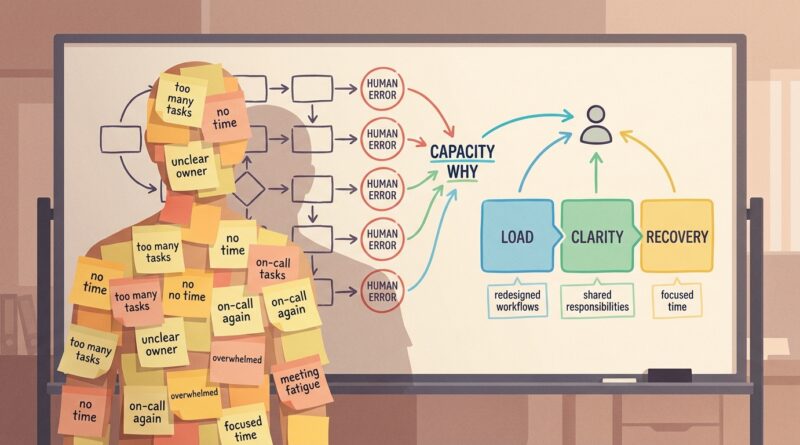
Why Your 5 Whys Keep Ignoring Human Limits: The Simple ‘Capacity Why’ Behind Burnout Fixes That Never Stick
You can feel the pattern, even if nobody says it out loud. Something breaks, the team runs a 5 Whys, and the trail somehow ends at “someone forgot,” “someone skipped a step,” or “someone needs more training.” Then come the fixes. Another checklist. Another reminder. Another meeting. The same tired people are asked to be even more careful while doing too much, too fast, with too little room to recover. It is frustrating because everyone can see the problem is bigger than one person, but the write-up keeps landing on “human error” anyway. That is why so many burnout fixes never stick. They treat people like faulty parts instead of people with attention limits, memory limits, and only so much mental bandwidth. If your root cause analysis human factors capacity limits never show up in the chain, your fixes will keep snapping back.
⚡ In a Hurry? Key Takeaways
- Most “human error” findings are incomplete. They miss workload, fatigue, context switching, and unclear priorities.
- Add a simple “capacity why” to every 5 Whys chain. Ask what the person was expected to hold, notice, remember, or switch between in that moment.
- This helps teams fix systems instead of blaming individuals, which lowers repeat incidents and burnout at the same time.
The missing question in most 5 Whys
The 5 Whys method is supposed to help you dig past the obvious. But in real workplaces, it often stops too early. It lands on the first human action that looks wrong and calls that the root cause.
Example.
Why was the customer sent the wrong quote? Because the rep used the old pricing sheet.
Why did they use the old sheet? Because they downloaded the wrong file.
Why did they download the wrong file? Because the folder had two versions with similar names.
Why didn’t they catch it? Because they were rushing.
Why were they rushing? Because it was month-end.
At this point, many teams still write down “rep needs more attention to detail” or “staff need refresher training.” That is the trap.
The better question is this. Why was success dependent on perfect attention from a rushed human in a messy system?
That is where capacity limits come in.
What a “capacity why” actually means
A capacity why is a simple extra question you add when the chain starts drifting toward blame.
Ask this:
What were the human limits in play here?
That can mean:
- Too many tasks at once
- Too many systems or tabs open
- Too many exceptions to remember
- Too much interruption
- Not enough recovery time
- Not enough sleep, staffing, or focus time
- Instructions that only make sense when you are already calm and fresh
People are not infinite. Attention is not infinite. Working memory is not infinite. A root cause analysis human factors capacity limits approach starts there, not as an excuse, but as a design fact.
Why training and checklists keep failing
Training is useful. Checklists are useful. Meetings can be useful. But they fail when they are piled onto the same overloaded setup that caused the problem in the first place.
If someone is already juggling 14 priorities, a new checklist can become priority number 15. If they are switching between Slack, email, ticketing, and customer calls every three minutes, a “please be more careful” memo changes nothing. If your process only works when everyone is fully rested and never interrupted, it is not a strong process.
That is why the fires die down for a week or two. People try harder. Then reality comes back. The queue grows. The context switching returns. The missed step returns too.
How blame sneaks in wearing an “accountability” badge
This part matters because the language sounds reasonable.
Leaders say they want accountability. Fair enough. But too often “accountability” becomes shorthand for “the person at the end of the chain should have compensated for every weakness upstream.” That is not accountability. That is wishful thinking.
Real accountability includes asking:
- Did we give people a workable load?
- Did we make the right action the easy action?
- Did we reduce ambiguity?
- Did we build in enough slack for normal human variation?
If the answer is no, then the system is also accountable.
A better 5 Whys example
Let’s rewrite that quote mistake.
Standard version
Wrong quote sent because employee used wrong file. Fix: retrain employee and remind team to double-check.
Capacity-aware version
Wrong quote sent because employee used wrong file.
Why? Two pricing files looked nearly identical.
Why? Old versions stayed in the shared folder and naming rules were inconsistent.
Why? No one owned version control.
Why? Sales ops support had been cut and the responsibility was spread informally across three busy managers.
Capacity why. Why did the employee not catch the mistake? They were handling live chat, email follow-ups, and month-end approvals at the same time, with no protected focus block.
Now your fixes look different:
- Archive outdated files automatically
- Use one approved pricing source
- Assign clear ownership for version control
- Reduce channel switching during high-risk work
- Protect focus time at month-end
That set of fixes has a much better shot at lasting.
Human factors are not soft. They are operational.
Some teams still hear “human factors” and think it sounds vague. It is not. It is deeply practical.
Human factors asks how real people interact with tools, timing, stress, interfaces, noise, fatigue, habits, and competing demands. It is the difference between saying “be careful” and saying “this screen makes the critical field easy to miss after the tenth repetition.”
That is not lowering standards. It is raising the quality of the investigation.
The four capacity limits most teams miss
1. Attention is selective
People do not notice everything. They notice what stands out, what they expect, and what they still have energy to process. If the warning is buried, repetitive, or visually weak, it will get missed.
2. Working memory is tiny
If success depends on remembering six exceptions, three policy changes, and one unwritten rule, people will drop something. That is normal.
3. Task switching is expensive
Every interruption has a cost. Not just time, but accuracy. The brain does not swap context for free.
4. Recovery debt is real
When teams run hot for too long, they do not just feel bad. They become more error-prone, more forgetful, and less able to spot weak signals. You cannot “mindset” your way out of that forever.
How to add the Capacity Why to your next incident review
You do not need a whole new framework. Just add one small step before finalizing the root cause.
Step 1: Stop at the first human action
When the chain reaches “they forgot,” “they missed it,” or “they skipped the step,” pause there.
Step 2: Ask three capacity questions
- What was this person carrying mentally at the time?
- What made the right choice hard to see or hard to do?
- What normal human limit was this process depending on them to overcome?
Step 3: Look for conditions, not character flaws
Replace “careless” with specifics. Fatigued after six straight days. Handling two systems with mismatched data. Working from a stale document library. Covering for an open headcount. Those are fixable conditions.
Step 4: Separate training gaps from load gaps
If people truly do not know how to do a task, training may help. If they know the task but keep failing under pressure, you have a load, design, or staffing issue.
Step 5: Make at least one fix that reduces cognitive demand
Not just reminders. Reduce the need to remember, search, compare, or guess.
Good fixes versus fake fixes
Fake fixes
- Send a reminder email
- Tell people to slow down
- Add a longer checklist without removing anything else
- Repeat annual training after every incident
- Call for more ownership without changing workload
Good fixes
- Remove duplicate sources of truth
- Cut unnecessary approvals and handoffs
- Use defaults, templates, and guardrails
- Schedule focused work away from interruption-heavy channels
- Staff peak periods based on real demand, not hope
- Build recovery time after sustained crunch periods
What leaders should say instead of “be more careful”
Words matter here.
Try this instead:
- “Walk me through what else was competing for your attention.”
- “Where did the process expect too much memory or guesswork?”
- “What would have made the right step easier in the moment?”
- “Which part of this depends on people being fresh when they are not?”
Those questions lower defensiveness and raise the odds of finding the real issue.
When human error is real, and what that still does not mean
Yes, sometimes a person makes a plain mistake. That happens. But even then, you still want to know why the system gave that mistake room to cause damage.
Airlines do this well. Hospitals are trying hard to do this more consistently. Good IT teams do it after outages too. The point is not to pretend people never slip. The point is to keep one slip from becoming a major incident.
That is the shift. Not “who failed?” but “why was one ordinary human miss enough to break the whole chain?”
At a Glance: Comparison
| Feature/Aspect | Details | Verdict |
|---|---|---|
| Traditional 5 Whys | Often stops at “human error,” then adds training, reminders, or more checks. | Fast, but often shallow and repeat-prone. |
| Capacity Why approach | Adds workload, fatigue, attention, ambiguity, and recovery debt to the analysis. | Better at finding durable fixes. |
| Typical corrective action | Either “try harder” or “reduce cognitive demand through better design, timing, and staffing.” | The second option is more likely to reduce both incidents and burnout. |
Conclusion
Teams are right to care about root cause. They are also right to care about human factors. The problem starts when those ideas are used without any honest view of capacity limits. People are not endlessly upgradeable machines. They get tired. They miss signals. They lose track when too much is stacked on them. If you start adding a simple capacity why to your incident reviews, you give yourself a real shot at fixing the conditions that keep producing the same mistakes. That means less finger-pointing, fewer repeat failures, and a healthier team. It also means “accountability” stops being a weapon and starts becoming what it should be, a shared commitment to remove overload, ambiguity, and recovery debt before the next incident, resignation, or quiet meltdown.