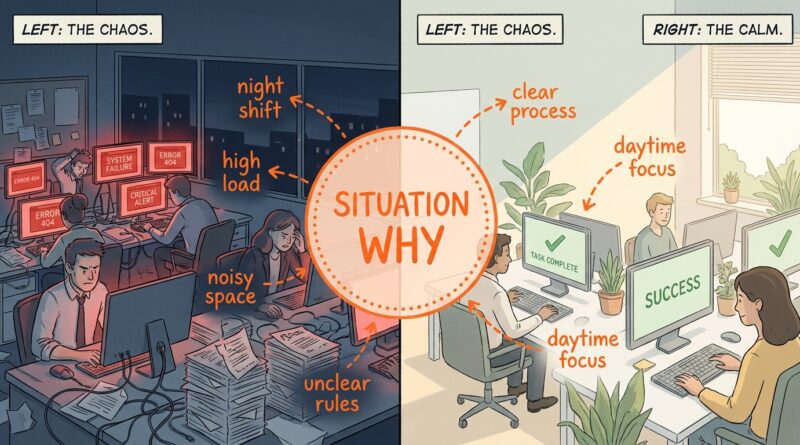
Why Your 5 Whys Keep Ignoring Context: The Simple ‘Situation Why’ Behind Problems That Only Exist In Certain Environments
You fix the bug. You update the process. You coach the team. Then the same problem comes back, but only on night shift, only in one region, or only when a certain tool is involved. That is maddening, and it can make smart people feel like they are missing something obvious. Usually, they are not. The issue is that classic root cause tools often focus on what happened and who touched it, but they do not force you to name the exact setting where the failure becomes likely. That missing piece is context in root cause analysis. I like to call it the Situation Why. It is the simple question after your usual why chain: why does this problem happen here, under these conditions, and not somewhere else that looks similar? Once you ask that, patterns show up fast. Load, timing, incentives, staffing, tools, handoffs, even the social mood of the room can stop looking like background noise and start looking like the real trigger.
⚡ In a Hurry? Key Takeaways
- The missing step in many investigations is asking why the problem appears in this specific environment and not in others.
- Add a “Situation Why” after your 5 Whys. Compare time, load, tools, staffing, incentives, and handoffs across places where the issue does and does not happen.
- This helps you avoid blaming people for problems that are really being created by conditions around them.
Why the usual 5 Whys can miss the real problem
The 5 Whys is useful because it gets teams past surface symptoms. But it also has a blind spot. It often assumes the cause travels the same way in every setting.
That is not how real life works.
A payment outage may happen only during peak traffic. A family fight may only flare up at holiday dinners. A support team may hit burnout only on the late shift. On paper, the process is the same. In practice, the environment is different enough to change the result.
When teams skip context in root cause analysis, they often land on fixes that sound right but do not hold. More training. Another reminder. A policy memo. A new checklist. Then the problem returns because the actual fuel source was never named.
What is the “Situation Why”?
The Situation Why is a plain-language question you add to your root cause work:
Why does this issue happen in this situation, under these conditions, with these constraints?
It sounds simple because it is simple. But it changes the conversation.
Instead of asking only, “Why did Sam make that mistake?” you ask, “Why did this mistake happen on the overnight shift when handoff notes are thinner and the approval tool runs slower?”
Instead of saying, “The AI summary was wrong,” you ask, “Why is the AI summary wrong mostly in one product line, with one type of messy source data, during one stage of the workflow?”
That shift matters. It moves you away from vague blame and toward conditions you can actually redesign.
Common signs your problem is really context-driven
If any of these sound familiar, you probably need a Situation Why step.
The issue only shows up in one place
One branch. One team. One market. One family event. One app environment.
The issue appears at certain times
Night shift. Month-end close. Holiday traffic. Monday mornings. During deployments.
The issue depends on a specific mix
It only happens when a new hire is paired with a legacy system. Or when AI output is reviewed by a rushed human. Or when sales incentives clash with service goals.
Your fix worked somewhere else, but not here
This is a huge clue. If the same fix gets two different results, the setting is probably carrying part of the cause.
How to add context in root cause analysis without making it complicated
You do not need a giant framework. You need one extra pass.
Step 1: Run your normal 5 Whys
Do your standard analysis first. Get the basic chain on the table.
Step 2: Ask where the chain breaks or bends
Now compare places where the issue happens and places where it does not.
Ask:
- What is different about the timing?
- What is different about workload or volume?
- What is different about tools, data, or automation?
- What is different about staffing, skill mix, or handoffs?
- What is different about incentives or pressure?
- What is different about the physical or social environment?
Step 3: Write a “situation statement”
Force the team to describe the context plainly.
For example:
“This failure happens mainly during peak load, when the approval queue exceeds 300 items, support is understaffed, and the AI assistant starts summarizing from incomplete records.”
That statement is often more useful than three pages of generic causes.
Step 4: Test the situation, not just the people
Change the environment in a small way and see what happens.
Reduce queue length. Add overlap between shifts. Change who reviews AI output. Delay a handoff. Remove one conflicting metric. If the issue drops, you have found something real.
A quick example
Say a team keeps seeing customer escalations. Their 5 Whys says the root cause is “agents are not following the script.” That sounds neat. It is also incomplete.
Then someone asks the Situation Why.
Why does this mostly happen on night shift?
Now the picture changes. Night agents handle more edge cases. Supervisors are less available. The script tool loads slowly on old terminals. Customers at that hour are often already upset because they have tried self-service first. Suddenly the problem is not just “people forgot the process.” It is a context stack.
The better fix might be faster tooling, a shorter night script, and a backup escalation lead. Training may still help, but it is no longer the whole answer.
Context is not an excuse. It is a design clue.
This is important. Looking at context does not mean nobody is accountable. It means you are trying to solve the whole problem, not the easiest version of it.
People make mistakes. Systems also set people up to make certain mistakes more often. Good root cause work looks at both.
In fact, context often explains why competent people keep stumbling in the same spot. That should be a relief, not a threat. It tells you the problem may be fixable without turning every incident into a character judgment.
When context is really about power
Sometimes the missing environmental factor is not load or tooling. It is control. Who can block a change? Who can quietly slow-roll it? Who has to absorb the risk?
That is where a related idea helps. If your investigation keeps producing obvious fixes that never get adopted, read Why Your 5 Whys Keep Ignoring Power: The Simple ‘Control Why’ Behind Confusing Conflicts And Silent Resistance. It pairs well with the Situation Why because a lot of “mystery failures” are really a mix of context and control.
Questions to ask in your next review
If you want a quick checklist, start here:
- Where does this problem happen most often?
- Where does it almost never happen?
- What is different in those two settings?
- What conditions make the task harder, slower, noisier, or riskier?
- What hidden tradeoff are people making in that environment?
- If we changed the setting, would the behavior likely change too?
Those questions are simple enough for incident reviews, project retros, management conflicts, and even personal patterns.
Why this matters now
We are all working in stranger mixes than before. Humans and AI are sharing tasks. Teams are stretched across time zones. Workloads spike harder and faster. Policies look consistent on paper while actual conditions vary wildly.
That means context in root cause analysis is not a nice extra. It is becoming basic hygiene.
Without it, you get whack-a-mole fixes. With it, you start making changes that survive real conditions.
At a Glance: Comparison
| Feature/Aspect | Details | Verdict |
|---|---|---|
| Classic 5 Whys | Good for tracing a cause chain, but it can flatten differences between environments. | Useful start, not the full picture. |
| Situation Why | Asks why the issue appears in this specific context, such as peak load, night shift, one market, or one tool stack. | Best add-on for recurring “only here” problems. |
| Resulting fixes | Moves teams from generic fixes like retraining to targeted changes like workload, schedule, tooling, and handoff redesign. | More likely to stick in the real world. |
Conclusion
If you keep solving the same problem over and over, there is a good chance the missing clue is not another why about the person. It is a why about the setting. Right now, people are drowning in incident reports, AI glitches and workplace conflicts where the obvious fix works in one context but fails in another. Classic 5 Whys and fishbones are great at listing causes, yet they rarely force you to name the exact environment that feeds the problem, which is why teams keep reliving the same outage during peak load, the same argument at family gatherings or the same burnout cycle in one specific role. A simple, teachable Situation Why step helps our community stop over-personalizing problems and start seeing the contextual root causes they can actually redesign, whether that is load, schedule, incentive structure or tech stack. The payoff is immediate. Fewer whack-a-mole fixes. More changes that hold up when life gets messy and constraints get tight.