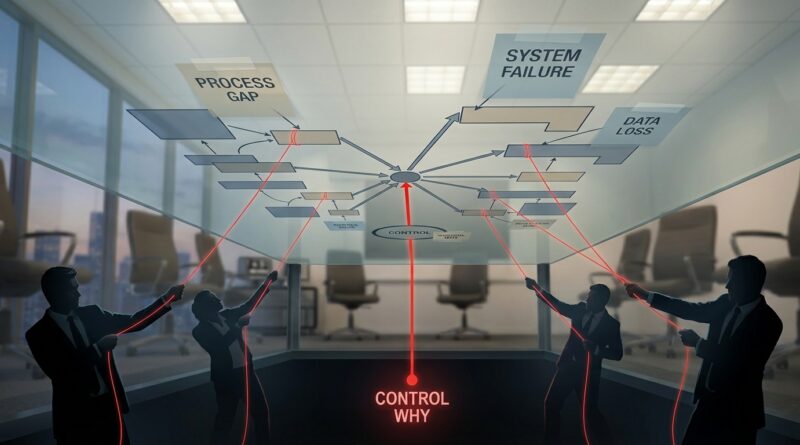
Why Your 5 Whys Keep Ignoring Power: The Simple ‘Control Why’ Behind Confusing Conflicts And Silent Resistance
You run the 5 Whys. Everyone nods. The root cause looks clear. Then nothing happens. A key manager gets vague. Another team “needs more review.” Someone forgets the action item three meetings in a row. It is maddening, because your analysis is not wrong. It is just incomplete. A lot of root cause analysis power dynamics never show up in the neat little chain on the whiteboard.
That is the missing piece. Some problems stay alive not because people cannot see the fix, but because the fix threatens control, status, budget, convenience, or blame. Once you start asking a simple extra question, “Who loses power if we solve this?”, the whole picture gets easier to read. You stop treating silent resistance like confusion. You start seeing it for what it often is: self-protection. And that gives you a much better shot at getting real change through instead of repeating the same postmortem every quarter.
⚡ In a Hurry? Key Takeaways
- Your 5 Whys may be missing the real blocker if it only tracks process and technology, not power, status, and hidden incentives.
- Add one extra step to each Why: ask who benefits from the current setup, and who feels threatened by the proposed fix.
- This is not about blaming people. It is about spotting the human friction early so your fix can survive contact with the real organization.
Why good root cause analysis still leads to bad outcomes
Most teams use 5 Whys as if the world is perfectly rational.
Server failed. Why? Bad deployment. Why? Weak review process. Why? No owner. Fine. That can all be true.
But then the fix stalls. Not because the chain is wrong. Because the chain assumes people will calmly support a better process once they see the evidence.
That is not how many workplaces work.
Sometimes a fix would move decision-making away from a senior person. Sometimes it would expose that one department has been skipping a control for years. Sometimes it would make a team look less essential. In those cases, resistance often arrives wearing a polite disguise. “We need more data.” “Now is not the right time.” “Let’s pilot this later.”
If that sounds familiar, you do not have a logic problem. You have a power problem.
The missing question: the “Control Why”
Here is the simple add-on.
After each Why in your chain, ask a second question:
Who gains or loses control at this step?
That is the Control Why.
It helps you spot the political and emotional reasons a problem stays in place even after the technical cause is known.
Think of it this way. The usual 5 Whys asks, “What caused this?” The Control Why asks, “What keeps this cause alive?” Those are not always the same thing.
A quick example
Problem: Incidents keep getting escalated too late.
Why 1: Frontline staff hesitate to escalate.
Why 2: They are unsure whether the issue is serious enough.
Why 3: The escalation rules are vague.
Why 4: The rules were never updated after the org change.
Why 5: No team owns the new workflow.
So far, that sounds tidy. Now add the Control Why.
Control Why: Who loses control if escalation becomes easier?
Possible answer: A middle manager who currently acts as the gatekeeper would lose visibility, influence, and approval power.
Now the “mystery” resistance makes more sense. The workflow update is not just an admin task. It changes status inside the org.
Why people resist fixes they say they want
This is the part teams often avoid because it feels awkward. Nobody wants to sound paranoid or cynical.
But you do not need to assume bad motives. You just need to accept that people protect what feels important to them.
Common forms of hidden resistance
Look for these patterns:
- Control protection. A fix removes approval power, ownership, or special access.
- Status protection. A fix makes a team seem less critical, or shows their past choices caused damage.
- Fear of exposure. A fix creates audit trails, metrics, or transparency someone would rather avoid.
- Budget defense. A fix shifts headcount, tools, or money to another group.
- Identity threat. A fix challenges how a team sees itself, such as “we are the final quality gate.”
Notice that none of these are technical. But they can stop technical fixes cold.
How to add power dynamics to your Why-chain without turning it into office gossip
This is where people get nervous. They worry that talking about power means finger-pointing.
It does not have to.
The trick is to write observations, not accusations.
Use this simple format
For each Why, add a small side note with three prompts:
- Who benefits from the current state?
- Who would lose control, status, or comfort if we fix it?
- What behavior might that create?
Example:
- Why: No shared dashboard exists.
- Control note: Reporting stays manual, which keeps interpretation in one team’s hands.
- Likely behavior: Delays, requests for custom views, concerns about “misreading the data.”
That is grounded. It is useful. And it is a lot safer than writing, “Team X is sabotaging this.”
A visual model that works in meetings
If you want to make this easy for non-specialists, use two columns.
Column 1: Causal Why
This is the standard 5 Whys chain. Keep it factual.
Column 2: Control Why
Next to each cause, note the power effect.
For example:
- Causal Why: Releases bypass review because deadlines are tight.
- Control Why: Senior product leaders get rewarded for ship dates, not review quality.
- Causal Why: Teams do not log near-misses.
- Control Why: Logging them creates evidence that could hurt local performance ratings.
- Causal Why: Access rights are never cleaned up.
- Control Why: No manager wants to be the one blamed if removal slows someone down.
This side-by-side layout is powerful because it shows two truths at once. The system has a mechanical failure. The organization also has an incentive structure that protects it.
Questions to ask when your RCA feels “right” but nothing moves
If you are stuck, these questions usually open things up fast:
- Whose job gets smaller if we fix this?
- Who approves the current workaround, and what does that approval give them?
- Who would face more measurement or oversight after the change?
- Who has learned to live with the problem because it serves them in some way?
- What polite objection keeps appearing, and what interest might sit behind it?
You do not need perfect certainty. You are looking for testable possibilities, not courtroom proof.
Be careful not to confuse power with villainy
This matters.
When you start looking at root cause analysis power dynamics, it is easy to slide into “those people are the problem.” Try not to do that. Most resistance is not cartoon evil. It is usually people reacting to incentives, fear, and pressure.
A manager may block a change because they think losing control will increase risk. A team may resist transparency because every visible defect gets used against them. Those are still problems, but they are more solvable when you name them accurately.
If your team also struggles to talk openly about danger, this pairs well with Why Your 5 Whys Keep Ignoring Safety: The Simple ‘Risk Why’ Behind Problems You’re Afraid To Write Down. Risk and control often travel together.
How to turn the insight into action
Finding the hidden power issue is only step one. Then you need to design the fix so it can survive.
1. Map the winners and losers early
Before you present the “obvious” solution, list who gains and who loses. If one group loses influence, expect drag. Plan for it.
2. Reduce the threat where you can
Sometimes the best move is not to fight resistance head-on. It is to lower the perceived loss.
For example, if a team fears losing control, give them a defined review role instead of removing them overnight. If a manager fears exposure, start with aggregate reporting before individual scorecards.
3. Change incentives, not just process docs
If leaders are rewarded for speed, they will keep cutting review corners no matter how pretty your new checklist looks. The process will fail until the incentive changes.
4. Put behavior into the RCA action plan
Do not stop at “update workflow” or “assign owner.” Add actions like:
- Get executive sponsor to back the ownership shift.
- Clarify how metrics will be used, and how they will not be used.
- Hold a transition period so gatekeepers do not feel bypassed without context.
5. Test your theory with small moves
If you think a fix is being blocked for political reasons, try a pilot. Or ask for one narrow change and watch where the friction appears. Resistance patterns often reveal more than meeting notes.
Why AI and automated RCA tools keep missing this
This is especially timely right now. There is a lot of excitement around AI agents and automated root cause analysis systems. They can be genuinely useful. They are good at tracing logs, correlating events, and finding technical links humans might miss.
But many tools still assume the world behaves like a flowchart.
They can tell you a queue backed up because retries spiked after a config change. Helpful. They usually cannot tell you that the config stayed messy because nobody wants to challenge the director who insisted on owning exceptions manually.
That is why root cause analysis power dynamics still need human judgment. The machine can map the failure path. People still need to map the social terrain around the fix.
Signs your team needs the Control Why badly
- You solve the same problem more than once.
- Action items die quietly instead of being openly rejected.
- Meetings sound supportive, but progress keeps slipping.
- The technical diagnosis is clear, but ownership stays fuzzy.
- People keep debating process details that do not seem central.
If you see those signs, your RCA may be missing the hidden incentive layer.
At a Glance: Comparison
| Feature/Aspect | Details | Verdict |
|---|---|---|
| Standard 5 Whys | Good at tracing process, system, and ownership failures, but often ignores status, fear, and incentive conflicts. | Useful starting point, but incomplete in political environments. |
| 5 Whys plus Control Why | Adds a clear check for who benefits from the current setup and who may resist the fix. | Best option for real-world change, especially across teams. |
| Automated RCA tools alone | Fast at spotting technical chains and correlations, but weak at reading hidden organizational motives. | Helpful assistant, not a replacement for human judgment about power dynamics. |
Conclusion
If your team keeps finding the cause but failing to land the fix, do not assume the analysis is useless. It may just be missing the part nobody likes to write down. Systems do not fail only for technical reasons. They also fail because proposed solutions threaten someone’s control, status, comfort, or protection. When you add a simple Control Why beside the usual Why-chain, root cause analysis power dynamics become easier to see and discuss without turning the room toxic. That matters even more now, as AI tools promise perfectly rational diagnostics while teams keep hitting very human walls. Add the hidden incentive layer, make it visible, and you give your team a much better chance of shipping change instead of debating it forever.