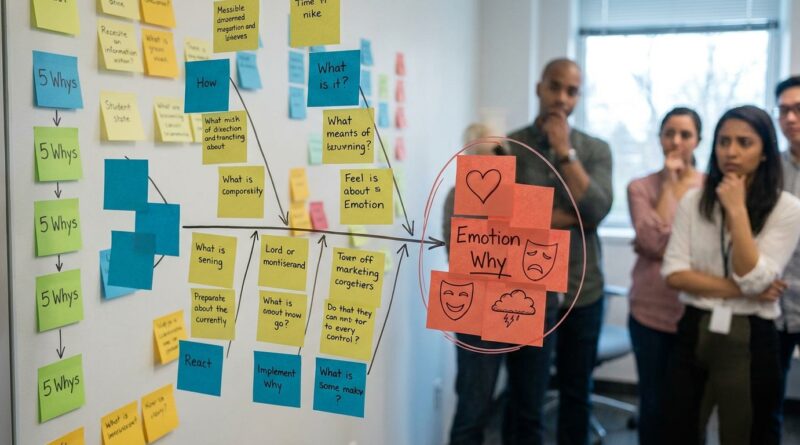
Why Your 5 Whys Keep Ignoring Feelings: The Simple ‘Emotion Why’ Behind Stalled Fixes And Repeating Drama
You did the responsible thing. You mapped the process, asked the 5 Whys, found a clean root cause, and got nods all around. Then the same mess came back a few weeks later, just dressed up as a new issue. That is maddening. It also makes smart teams doubt themselves for the wrong reason. Usually the logic is not the problem. The missing piece is that people are not machines. A fix can be technically correct and still fail because it pokes fear, shame, embarrassment, or status anxiety that nobody wants to name out loud. That is where a simple 5 whys emotional root cause analysis helps. It adds one more lane to the conversation. Not instead of process, but alongside it. When you ask what people were feeling, and what they were trying to avoid, stalled fixes start making a lot more sense. So do the strange little acts of delay, silence, and half-hearted follow-through.
⚡ In a Hurry? Key Takeaways
- Your 5 Whys may miss the real blocker if it only tracks process and never asks what people felt threatened by.
- Add an “Emotion Why” such as “What felt risky, embarrassing, unfair, or unsafe here?” after your normal root cause steps.
- This is not group therapy or blame hunting. It is a practical way to spot hidden resistance before it turns into repeat failures.
Why good root cause analysis still misses the real cause
Classic 5 Whys is useful because it forces teams to move past surface symptoms. A missed handoff becomes a training gap. A training gap becomes poor documentation. Poor documentation becomes unclear ownership. That is all good.
But here is the catch. People often do not resist a fix because they disagree with the logic. They resist because the fix feels dangerous in some human way.
Maybe the new checklist makes a senior person look sloppy for not using it earlier. Maybe the change removes a shortcut the team quietly depends on to survive an unrealistic workload. Maybe speaking up about the real issue would embarrass a manager in front of peers.
None of that appears on the swim lane diagram.
What an “Emotion Why” actually is
An Emotion Why is a simple question added to your analysis once you have the process story in front of you.
Ask it like this
After a normal “why did this happen?” ask:
- What emotion was in the room at this step?
- What felt risky to admit or change?
- What was someone trying to avoid feeling?
- What would have felt embarrassing, threatening, or unfair here?
You are not trying to read minds. You are trying to uncover pressures that shape behavior.
Common emotional root causes
- Fear of blame
- Shame about not understanding a tool or process
- Status anxiety, especially for senior staff
- Resentment after a change was forced through
- Burnout that makes “one more improvement” feel insulting
- Learned helplessness from years of ignored feedback
A quick example
Say a customer support team keeps skipping a required note in the CRM. Your normal 5 Whys might find this:
- Why was the note missing? Because agents closed tickets before adding it.
- Why did they close early? Because the close button is easier to reach than the note field.
- Why does the layout allow that? Because the form was designed for speed.
- Why was speed favored? Because managers were measured on ticket volume.
- Why were they measured that way? Because leadership wanted faster queue clearance.
That is a solid process answer. But it still may not explain why the fix fails.
Now add the Emotion Why.
- What did agents feel? Pressured and watched.
- What felt risky? Looking slow on the dashboard.
- What were managers trying to avoid? Being blamed for backlog numbers.
Now the repeated failure makes sense. The team did not ignore the fix because they are careless. They ignored it because the reporting system made compliance feel personally costly.
Your real fix is no longer just “move the note field.” It may also include changing the metric, adjusting queue targets, and giving managers cover to trade a little speed for quality.
Why teams leave this part out
Because feelings sound soft, messy, and hard to prove. Process maps feel safer. They look objective. They fit in slides.
Also, many workplaces still treat emotion like a personal weakness instead of a normal signal. So people talk about workflow friction when they really mean fear. They talk about “misalignment” when they mean resentment. They say “resource constraints” when they mean burnout.
This is also why emotional root cause analysis often connects with power. Sometimes people are not just afraid. They are afraid of someone. If that sounds familiar, this piece on Why Your 5 Whys Keep Ignoring Power: The Simple ‘Control Why’ Behind Confusing Conflicts And Silent Resistance is worth reading too. Emotions and control often travel together.
How to run a 5 whys emotional root cause analysis without making it awkward
1. Start with the normal facts
Do not skip the process side. People feel safer talking about emotions after they see that you are not abandoning the evidence.
2. Name the goal clearly
Say something like, “We have the workflow causes. Now I want to check for any human pressure we have missed, because fixes fail when they clash with what people feel is safe.”
3. Ask about the situation, not the person’s character
Good question: “What felt risky in this moment?”
Bad question: “Why were you so defensive?”
4. Offer examples so people do not have to guess
Try, “Sometimes the hidden blocker is fear of blame, looking incompetent, losing control, or making someone powerful unhappy. Did any of that show up here?”
5. Listen for coded language
When someone says:
- “People were not ready.”
- “It was bad timing.”
- “There were concerns.”
- “The team did not buy in.”
There is often an emotion under that sentence. Ask one more gentle question.
6. Protect honesty
If people think honesty will get them punished, you will get theater instead of truth. That means no public shaming, no gotcha quotes, and no treating emotional data as gossip.
Useful Emotion Why questions
- What felt hardest to say out loud at the time?
- What were people worried would happen if they followed the new process exactly?
- Did anyone feel exposed, judged, slowed down, or ignored?
- What made the old way feel safer, even if it was worse on paper?
- Who had something emotional to lose if this changed?
- What part of the fix sounded reasonable but felt unrealistic or insulting?
What this changes in the fix
Once you spot the emotional root cause, your action plan gets more realistic.
Instead of this
“Retrain staff and send a reminder.”
You do this
- Remove metrics that punish the desired behavior
- Give managers language to support the change without losing face
- Create a low-risk way for people to admit confusion
- Acknowledge workload honestly if burnout is part of the problem
- Make early adoption socially safe, not just technically possible
That is the difference between a fix people agree with in a meeting and a fix they will actually live with on a Tuesday afternoon.
What an Emotion Why is not
It is not therapy
You do not need childhood backstory. You need enough truth to understand behavior.
It is not an excuse
Fear and shame explain resistance. They do not make harmful behavior okay. They simply show you where the design is colliding with reality.
It is not anti-data
You are adding missing data. Human data.
Signs your team needs this right now
- The same problem returns in slightly different forms
- Everyone agrees in meetings, but follow-through is weak
- People say the fix is fine, yet quietly work around it
- Dashboards look healthy, but frontline frustration keeps rising
- No one can explain the resistance without using vague phrases
At a Glance: Comparison
| Feature/Aspect | Details | Verdict |
|---|---|---|
| Standard 5 Whys | Great for tracing process breakdowns, handoffs, missing tools, and unclear ownership. | Useful, but incomplete when people quietly resist the fix. |
| Emotion Why | Surfaces fear, shame, status anxiety, resentment, and burnout that shape behavior. | Often reveals why a correct fix still fails in real life. |
| Best overall approach | Use both process and emotional analysis, then adjust systems, metrics, and communication together. | Most likely to produce fixes people will support instead of quietly undermining. |
Conclusion
If your root cause analysis keeps producing smart fixes that somehow do not stick, do not assume your team is irrational or your method is useless. You may just be missing the human layer. Teams everywhere are dealing with burnout, quiet resistance, and strange repeat failures that no dashboard can fully explain. Big RCA tools are very good at metrics, incidents, and automation. They are much worse at naming fear, shame, and status anxiety. A simple Emotion Why fills that gap fast. It helps you see the hidden reason people stall, nod without meaning it, or protect the old way. Once you can see that, you can design fixes people actually feel safe supporting. And that is usually when the repeating drama finally starts to fade.