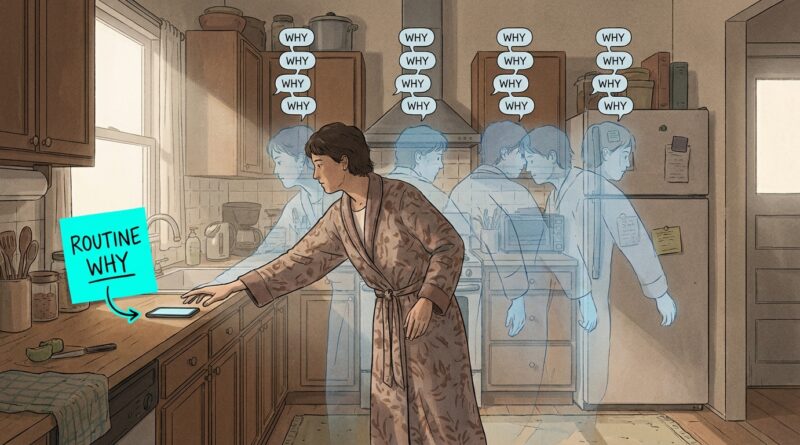
Why Your 5 Whys Keep Missing Habits: The Simple ‘Routine Why’ Behind Problems You Keep Repeating On Autopilot
You already know this feeling. You ask “why” five times, you get a smart, honest answer, and for a few hours it feels like you finally cracked it. Then the next morning you do the exact same thing again. Same missed workout. Same late-night doomscrolling. Same snapping at people when you are stressed. It is maddening, because the problem is not that you are clueless. The problem is that your brain is often running a routine before your thinking mind even shows up. That is why 5 whys root cause analysis habits routine issues can feel so slippery. The logic is fine. The map is incomplete. If your problem repeats on autopilot, you need one more question after the usual chain of whys. You need the Routine Why. That means asking what cue starts the behavior, what setting keeps it easy, and what action your brain has learned to run automatically.
⚡ In a Hurry? Key Takeaways
- Your 5 Whys may miss the real blocker if the problem is driven by an automatic habit loop, not a conscious decision.
- Add a “Routine Why” by identifying the cue, the environment, and the default behavior that fires on autopilot.
- This is not about blaming yourself. It is about making hidden routines visible so you can change the setup, not just your intentions.
Why normal 5 Whys can still leave you stuck
The classic 5 Whys is useful because it pushes you past the first obvious answer. Instead of stopping at “I was late,” you keep going.
I was late because I left late. I left late because I overslept. I overslept because I stayed up too long. I stayed up too long because I was watching videos to unwind. I was watching videos to unwind because work has been draining.
That is not wrong. It may even be deeply true.
But it still may not change tomorrow morning.
Why? Because the final answer often explains your state of mind, not the exact routine that keeps replaying. “Work is draining” tells you why you are vulnerable. It does not tell you what your hands do at 11:07 p.m. when you sit on the couch, phone in reach, TV on, charger plugged in, and your brain has learned a one-tap path into a two-hour scroll.
That gap matters. A lot.
The missing layer: the Routine Why
The Routine Why is simple. After your normal why chain, ask this:
What routine actually runs when this problem happens?
Not what you believe. Not what you meant to do. What happens, step by step, in real life?
Habits are usually tied to context. A place. A time. A feeling. A device. A person. A sequence.
The routine might look like this:
- Finish work feeling fried
- Walk into kitchen
- Grab snack
- Sit on couch
- Open phone “for a minute”
- Lose 90 minutes
That is the engine. That is the repeatable part. That is what your 5 Whys often misses.
Think of it like a computer shortcut
If you are not a tech person, here is the easiest way to picture it.
Your brain loves shortcuts. If it sees the same input often enough, it builds a fast path. Just like your phone auto-connects to known Wi-Fi, your brain auto-connects to known behaviors.
Same cue, same action, same reward.
You do not debate it each time. You just run it.
That is why repeating problems can feel weirdly impersonal. You are not always making a fresh choice. Sometimes you are just pressing a mental hotkey your environment has trained into you.
How to add a Routine Why to your root cause analysis
Here is the practical version. Run your normal 5 Whys. Then add three more questions.
1. What is the trigger?
Look for the thing that happens right before the repeated behavior.
Common triggers include:
- A time of day
- A location
- A feeling, like boredom or stress
- A person entering or leaving
- A notification or sound
- Finishing one task and drifting into another
If you keep saying “it just happens,” that usually means the trigger is very consistent and very easy to miss.
2. What in the environment makes the routine easy?
This is the part people skip.
Your environment is often the silent co-author of your bad habit. Open tabs. Snacks on the counter. Phone by the bed. No shoes by the door. Email pinned on your taskbar. Laptop on the kitchen table so work bleeds into dinner.
Willpower gets far too much credit. Friction matters more than most people think.
3. What behavior is preloaded?
When the trigger hits, what is your default move?
Not your ideal move. Your real one.
Maybe stress leads to snacks. Maybe awkward silence leads to checking your phone. Maybe finishing one meeting leads straight to opening messages instead of the project you meant to start.
That preloaded behavior is the routine.
A real-world example
Let’s say your problem is, “I keep putting off writing important reports.”
Your 5 Whys might go like this:
- Why am I procrastinating? Because the report feels hard.
- Why does it feel hard? Because I am not sure where to start.
- Why am I not sure where to start? Because the task is vague.
- Why is it vague? Because I did not break it into steps.
- Why did I not break it into steps? Because I rushed into the week without planning.
Good insight. But now add the Routine Why.
- Trigger: I open the document and feel uncertainty.
- Environment: My email is open, chat is open, phone is on desk.
- Preloaded behavior: I click into inbox for a “quick check” and never come back.
Now you have something you can test tonight.
Close email before opening the report. Put the phone across the room. Start with one tiny template line at the top: “This report answers three questions.”
Same person. Same job. Different routine path.
Why this matters more in 2026 than it used to
People are swimming in advice right now. Root cause frameworks. productivity systems. mental health content. self-awareness prompts.
A lot of it is useful. A lot of it also lives at the level of beliefs, goals, and identity.
That is helpful, but it is not always enough for repeating behaviors that are context-linked and automatic.
In 2026, our routines are constantly shaped by devices, alerts, work apps, algorithmic feeds, and hybrid schedules. Many bad loops are not dramatic. They are tiny. Frictionless. Rehearsed hundreds of times. That is exactly why they are powerful.
The Routine Why gives you a bridge between “I understand myself” and “I changed what actually happens at 9:40 p.m. in my kitchen.”
Routine Why versus deeper emotional causes
This is important. The Routine Why does not replace emotional insight. It adds to it.
Sometimes the repeated problem comes from stress, loneliness, fear, grief, or burnout. You should not ignore that. But if the behavior repeats in a near-identical pattern, there is probably a habit loop riding on top of the deeper issue.
You can work on both.
In fact, that is often the winning combo. Understand the pain. Then interrupt the routine that keeps turning that pain into the same outcome.
If you have also noticed that some repeated problems are driven by silent obligations you never meant to carry, this pairs well with Why Your 5 Whys Keep Missing Hidden Commitments: The Simple ‘Promise Why’ Behind Problems You Secretly Agreed To. Sometimes the loop is not just a habit. Sometimes it is a habit protecting an old promise.
How to spot a routine problem fast
Here are the signs you are dealing with a Routine Why issue.
- You keep repeating the same behavior in the same place or at the same time.
- You say “I did it before I even thought about it.”
- You understand the problem clearly, but insight alone changes nothing.
- The behavior is tied to a transition, like getting home, ending work, waking up, or going to bed.
- Small changes in setup make a surprisingly big difference.
If that sounds familiar, do not ask only “Why do I feel this way?” Also ask, “What routine is getting launched here?”
A simple Routine Why worksheet
You can do this in five minutes.
Step 1: Name the repeated problem
Example: “I keep staying up too late on my phone.”
Step 2: Run your usual 5 Whys
Get the deeper logic and context.
Step 3: Add the Routine Why layer
- Trigger: What happens right before it?
- Environment: What around me makes it easy?
- Routine: What do I do automatically?
- Reward: What quick relief or payoff do I get?
Step 4: Change one thing, not ten
Examples:
- Charge phone outside bedroom
- Block one distracting site during work sprint
- Put workout clothes on the chair, not in the drawer
- Pre-write the first sentence of tomorrow’s task
- Move snacks off the counter
Step 5: Test for three days
Do not ask, “Did I become a new person?”
Ask, “Did the routine fire less often?”
Common mistake: trying to win with motivation
This is where many people get stuck. They keep trying to out-motivate an automated routine.
That is like trying to stop your laptop from opening a default app by giving yourself a pep talk. Wrong tool.
If the behavior is loaded by context, change the context.
If the routine starts with a trigger, interrupt the trigger or place a speed bump between trigger and action.
If the environment keeps feeding the loop, edit the environment first.
At a Glance: Comparison
| Feature/Aspect | Details | Verdict |
|---|---|---|
| Classic 5 Whys | Great for finding logical and emotional root causes behind a problem. | Useful, but often incomplete for autopilot behaviors. |
| Routine Why layer | Maps the cue, environment, and automatic action that recreates the issue. | Best add-on when the same problem keeps repeating despite insight. |
| Best first fix | Change one part of the setup, such as device placement, timing, or task sequence. | More effective than relying on motivation alone. |
Conclusion
If your problem keeps coming back, that does not mean you are lazy, broken, or bad at self-reflection. It may simply mean your analysis stopped one layer too soon. People are overloaded with advice on root cause analysis, mental health, and productivity tricks, yet they stay trapped in the same loops because most frameworks do not directly target the automatic, context-linked habits running below awareness. That is where the Routine Why helps. It ties root cause analysis to habit science in a way that is concrete and observable. You stop guessing about your character and start watching the trigger, the setup, and the routine that keeps replaying. That is especially useful in 2026, when so much “why” advice stays up in the clouds of beliefs and systems. This brings it back to the ground. You can test it tonight. Change one cue. Add one bit of friction. Replace one default move. Sometimes that is the moment the loop finally starts to break.