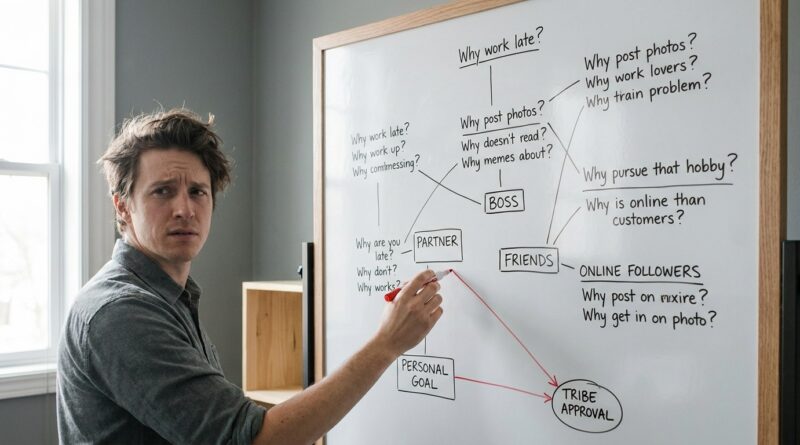
Why Your 5 Whys Keep Ignoring Social Pressure: The Simple ‘Tribe Why’ That Reveals Who You’re Really Solving Problems For
You are not imagining it. Few things are more frustrating than finally figuring out why a problem keeps happening, only to watch it come right back the second other people are involved. You do the usual root cause exercise. You ask why five times. You get a neat answer on paper. Then your team joins the meeting, your family makes a comment, your friends raise an eyebrow, and somehow you make the same choice again. That is not stupidity or weak will. It is often social pressure hiding in plain sight. A lot of what looks irrational from the outside is really a safety move inside a group. If your root cause analysis never asks who you are trying to stay safe with, it can miss the real driver. That is where a simple Tribe Why helps. It adds one extra question that often explains why good intentions collapse the moment the room fills up.
⚡ In a Hurry? Key Takeaways
- Your 5 Whys may fail because they focus on process and logic, while ignoring the group approval you are quietly protecting.
- Add one question to your root cause analysis tribe why method: “Whose reaction am I trying to avoid or win?”
- This is not about blaming friends, family, or coworkers. It is about spotting the social pressure loop so you can make choices that actually stick.
Why the usual 5 Whys can miss the real problem
The classic 5 Whys is useful. It helps you move past surface symptoms and find a deeper cause. If a project misses deadlines, it can show that the real issue was unclear ownership, bad handoffs, or too many last-minute changes.
But there is a blind spot. The method assumes people are mainly acting from logic, systems, and individual intent. Real life is messier. Humans are group creatures. We read the room. We adjust. We protect our place. We avoid being the difficult one, the selfish one, the outsider, the disappointment, the buzzkill.
So you may think the issue is poor planning. In reality, poor planning keeps happening because nobody wants to challenge the loudest person in the room. Or because you do not want your family to think you are lazy if you rest. Or because you keep saying yes to friends because saying no feels like risking your place in the group.
That is why a standard root cause analysis can feel correct and still not change anything. It identified the mechanical cause, but not the social one.
What “Tribe Why” means
The Tribe Why is simple. After you ask your normal why questions, ask one more:
The Tribe Why question
Who am I trying to stay safe with by doing this?
You can also phrase it a few different ways:
- Whose approval matters most in this moment?
- Whose reaction am I trying to avoid?
- What group rule am I obeying, even if nobody said it out loud?
- If I stopped doing this, who might judge me, exclude me, or disappoint me?
That is the missing layer in social pressure root cause analysis tribe why. It moves the problem from “Why do I keep doing this?” to “For whom does this behavior make sense?”
That question can be uncomfortable. It can also be wildly clarifying.
A quick example from work
Let’s say your team keeps agreeing to unrealistic deadlines.
The normal 5 Whys
Why are deadlines missed? Because the timeline was too aggressive.
Why was the timeline too aggressive? Because estimates were too low.
Why were estimates too low? Because people did not speak up.
Why did they not speak up? Because the meeting was rushed.
Why was the meeting rushed? Because leadership wanted a fast answer.
That all sounds fair. But it still might not fix the problem.
Add the Tribe Why
Who were people trying to stay safe with? Leadership. The team did not want to look negative, slow, or “not solutions-focused.”
Now the root cause looks different. The problem is not just rushed planning. It is a social norm where honesty feels risky.
That changes the fix. You do not just add more planning time. You also make it safe to tell the truth. You reward realistic estimates. You ask the quiet people first. You make “I need more time” a respected answer, not a career risk.
A personal example that hits even harder
Imagine you keep blowing your budget.
You ask why. You spent too much eating out. Why? You were tired. Why? You did not meal prep. Why? Your weekends are overloaded. Why? You keep saying yes to plans.
That sounds like a time-management issue. Maybe. But now ask the Tribe Why.
Who am I trying to stay safe with by saying yes? Maybe your friends. Maybe your partner. Maybe your family’s idea of what a “good” person always does. Maybe an old fear that if you are less available, people will drift away.
Suddenly the spending problem is not really about food. It is about belonging.
And that is why budget apps, calendars, and productivity hacks sometimes fail. They treat the symptom. The real driver is social pressure.
Why people ignore this layer
Because it is subtle. Social pressure does not always feel like pressure.
Often it feels like common sense. Manners. Loyalty. Professionalism. Being easy to work with. Being a good parent, partner, sibling, boss, or friend.
That is what makes it so powerful. You are not usually thinking, “I will betray my own priorities now so the tribe keeps me.” You are thinking, “This is just what people like me do.”
That is why social cognition and group dynamics matter so much. We do not make choices in a vacuum. We make them in a room full of real or imagined witnesses.
How to run a simple Tribe Why on any recurring issue
You do not need a workshop or a whiteboard full of arrows. Try this five-minute version.
Step 1: Name the repeating problem
Keep it concrete. “I keep overcommitting.” “Our team keeps avoiding honest updates.” “I keep changing my mind after talking to my family.”
Step 2: Do a normal why chain
Ask why three to five times. Get the obvious causes out of your head first.
Step 3: Add the social question
Ask, Who benefits if I keep doing this, and whose discomfort am I preventing?
Step 4: Find the feared consequence
What feels dangerous about stopping? Be specific.
- They will think I am selfish.
- I will look incompetent.
- I will lose influence.
- I will disappoint them.
- I will no longer feel like one of them.
Step 5: Test a tiny act of disobedience
Do not blow up your life. Run a small experiment.
- Say, “I need until tomorrow to answer.”
- Offer a realistic deadline instead of the pleasing one.
- Skip one event you usually attend out of guilt.
- State one preference without overexplaining it.
Then watch what actually happens. Many people discover the social threat was exaggerated. Others discover it was real, which is also useful. At least now the real problem is visible.
What the Tribe Why often reveals
When people use this method, they usually land in one of a few patterns.
1. You are solving for approval
You keep making choices that earn a nod, not choices that solve the problem.
2. You are solving for conflict avoidance
The behavior stays because it prevents friction in the short term, even while making life worse in the long term.
3. You are solving for identity
You are attached to a role. The reliable one. The chill one. The ambitious one. The good child. The helper. The peacemaker.
4. You are solving for belonging
This is the big one. Many recurring problems make perfect sense once you see they are really membership fees for a group.
How to use this without becoming cynical
This matters. The point is not to start seeing every relationship as manipulation. Groups are not bad. We need them. Families, teams, friend circles, and communities help us survive and make sense of life.
The point is to notice when group safety is quietly steering the car while your conscious mind thinks it is driving.
That helps you respond more honestly. Sometimes you will still choose the group. Fine. But now it is a decision, not an invisible reflex.
Three questions to ask before you “fix” the issue again
If you are about to make another plan, have another hard conversation, or start another self-improvement push, pause and ask:
- Will this fix still hold when the people I care about are watching?
- What social reward keeps the old pattern alive?
- What would I choose if nobody’s opinion could lower my safety or status?
Those questions get closer to the truth than most neat diagrams do.
At a Glance: Comparison
| Feature/Aspect | Details | Verdict |
|---|---|---|
| Standard 5 Whys | Good for finding process flaws, system gaps, and obvious behavioral patterns. | Useful, but incomplete when group pressure is driving behavior. |
| Tribe Why addition | Adds the missing social layer by asking whose approval, acceptance, or comfort you are protecting. | Often reveals the real day-to-day root cause. |
| Best use in real life | Works well for recurring issues in teams, habits, money, boundaries, health, and family decisions. | Best when paired with one small behavior test, not just more analysis. |
Conclusion
If you keep fixing the same issue and watching it return when other people step back into the picture, your logic is probably not broken. Your analysis may just be missing the social layer. That is why there is so much growing interest in social cognition, group dynamics, and perceived expectations. They shape daily choices far more than most advice admits. People are flooded with tips about thinking clearly, but much less is said about tracing behavior back to the tribe that makes it feel safe, risky, admirable, or unacceptable. A tiny Tribe Why can change that. It gives you a practical way to spot the real root cause behind choices that seem irrational from the outside. Once you see who you are really solving the problem for, you finally have a shot at making a fix that survives contact with the room.