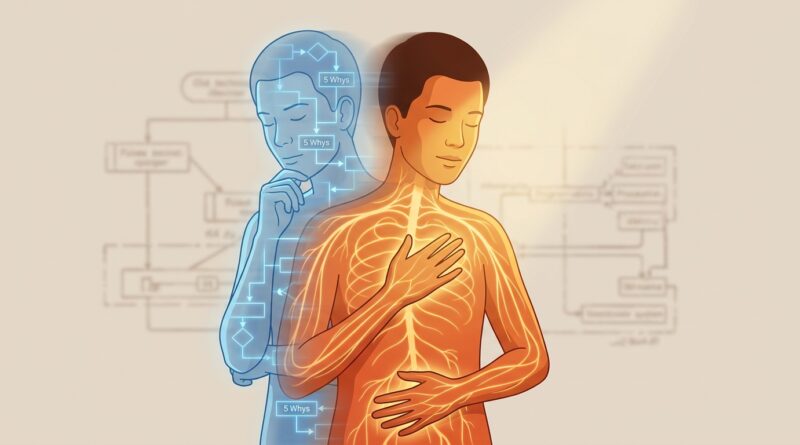
Why Your 5 Whys Keep Missing the Body: The Simple ‘Somatic Why’ That Reveals the Root Cause Your Nervous System Is Hiding
You know the pattern. You have already done the smart-person thing. You journaled. You read the books. You asked “why” five times. You can explain your triggers better than anyone. And yet a small email still makes your chest tighten. A tiny bit of criticism still feels huge. A partner’s tone still flips your whole mood before your brain can catch up. That is maddening, because it feels like you understand the issue, but your body did not get the memo. The missing piece is often not another insight. It is a better question. A somatic root cause why framework starts with what your nervous system is doing, not just what your thoughts are saying. In plain English, it helps you stop asking only, “Why do I think this?” and start asking, “What is my body protecting me from right now?” That shift is small, but it can reveal the real root cause your usual 5 Whys keeps skating past.
⚡ In a Hurry? Key Takeaways
- A somatic root cause why framework asks what your body is sensing, bracing for, or protecting against, not just what your mind believes.
- Try this tonight: notice a trigger, name the body sensation, ask what feels unsafe, then ask what response your body learned would help you survive.
- This is a self-awareness tool, not a replacement for trauma therapy. If you get flooded, disoriented, or panicky, pause and get support from a qualified professional.
Why the usual 5 Whys often misses the real problem
The classic 5 Whys is useful for broken processes. A machine fails. You ask why. Then why again. Eventually you find the broken part.
Humans are not machines.
When the problem is emotional reactivity, shutdown, people-pleasing, perfectionism, or panic, the surface answer is usually too neat. Your thinking brain gives you a story. Your nervous system is running a survival pattern.
That is why you can say something like, “I know my boss is not my parent,” while your body still reacts like you are about to be punished. Insight is real. It just may not be reaching the part of you that is slamming the alarm button.
What “somatic” actually means, in normal-person language
Somatic simply means “of the body.”
Not mystical. Not fancy. Just body-based.
Your body is constantly scanning for cues of safety and danger. Tone of voice. Facial expressions. Pace. Silence. Distance. Conflict. Even your own thoughts can become cues.
If your system learned long ago that certain cues meant pain, rejection, chaos, embarrassment, or being ignored, it may still react before you can reason your way through it.
That reaction is not proof you are broken. It is proof your nervous system is trying to protect you with old information.
The simple “Somatic Why”
Here is the question that changes everything:
“What is my body trying to prevent, get, or protect right now?”
That is the Somatic Why.
Instead of stopping at a thought like “I hate being ignored,” you go one layer lower.
- What is happening in my body right now?
- What does this sensation seem to predict?
- What feels at risk?
- What did my system learn it had to do in moments like this?
You are not replacing logic. You are adding the missing data source.
The somatic root cause why framework
Here is a simple version you can use without turning it into homework.
Step 1: Catch the moment, not the autobiography
Pick one live reaction. Not your whole life story. Just one moment.
Example: your coworker says, “Can we talk?” and your stomach drops.
Step 2: Name the body signal
Keep it concrete.
- Chest tight
- Jaw clenched
- Stomach dropped
- Throat closed
- Face hot
- Went numb
This matters because your body often tells the truth faster than your explanation does.
Step 3: Ask the first Why
Why am I upset?
Maybe the answer is, “I think I did something wrong.” Fine. Keep going.
Step 4: Ask the Somatic Why
What is my body protecting me from right now?
Now the answers get more useful:
- Being blamed
- Being shamed
- Being trapped
- Being rejected
- Losing control
- Being seen as incompetent
Step 5: Ask what your system learned to do
When my body sensed this kind of risk before, what response did it learn?
- Over-explain
- Get perfect
- Stay quiet
- Fight back
- Freeze
- Please people fast
Step 6: Find the root belief under the reaction
Complete the sentence:
“If I do not do this, then ______.”
Examples:
- If I do not explain myself perfectly, I will get attacked.
- If I do not keep everyone happy, I will lose connection.
- If I do not shut down, I will get overwhelmed.
Now you are much closer to the real root cause.
Step 7: Give your body a new cue, not just a new idea
This is where change starts.
Before you reason with yourself, give your system a little evidence that the current moment is not the old moment.
- Put both feet on the floor
- Look around the room slowly
- Lengthen your exhale
- Press your hands together
- Name five things you can see
- Say quietly, “This is discomfort, not danger”
The goal is not to force calm. It is to reduce the body’s certainty that you are under threat.
A real-life example
Let’s say you keep getting defensive in meetings.
The standard 5 Whys might look like this:
- Why did I snap? Because I felt criticized.
- Why did criticism bother me? Because I care about doing well.
- Why do I care so much? Because I want respect.
- Why do I need respect? Because I do not want people to think I am bad at my job.
- Why? Because that would hurt my confidence.
That is not wrong. It is just incomplete.
Now try the somatic root cause why framework:
- Trigger: My manager questioned my slide.
- Body: Face hot. Heart racing. Shoulders hard.
- Somatic Why: What is my body protecting me from? Humiliation. Being cornered in public.
- Learned response: Get sharp fast. Defend before anyone can pile on.
- Root belief: If I do not protect myself immediately, I will get exposed and powerless.
See the difference?
The issue is not just “I care a lot.” The issue is that your nervous system may read feedback as a threat to safety, status, or belonging. Once you see that, your next step changes. You stop trying to think your way out and start helping your body feel less under attack.
Why insight alone has not changed your reactions
Because reactions are often state-dependent.
When you are calm, you can access your best logic. When you are activated, your body pulls from older, faster survival code.
This is why smart people can repeat the same pattern for years. Not because they are lazy. Not because they “do not want it badly enough.” Because information and regulation are not the same thing.
You can know the stove is off and still check it again if your body does not believe the signal.
How to use this tonight in under 10 minutes
You do not need a retreat. You do not need the perfect notebook. Try this after your next emotional spike.
The 4-line Somatic Why check-in
- What happened? “My partner got quiet after I asked a question.”
- What did my body do? “My chest tightened and I felt a rush to fix it.”
- What is my body protecting me from? “Disconnection. Being shut out.”
- What did my system learn to do? “Over-talk and chase reassurance.”
Then add one regulating action:
- Take three slower exhales
- Unclench your hands
- Lean back into the chair
- Wait 30 seconds before responding
That is enough for one round.
What this framework is not
It is not a magic trick. It is not a way to blame every bad mood on “trauma.” It is not proof that every body sensation has deep meaning.
Sometimes you are just tired, hungry, overloaded, or having a rough day.
But when the same reaction keeps hijacking your work, your relationships, and your quiet moments alone, the somatic root cause why framework can help you notice the pattern under the pattern.
When to get extra support
If body awareness makes you feel more flooded, dissociated, panicky, or confused, slow down. This work can bring up a lot.
A trauma-informed therapist, somatic practitioner, or psychologist can help you do this more safely and with more support.
Self-awareness is good. Feeling like you have to excavate your whole nervous system alone at 11:30 p.m. is not.
At a Glance: Comparison
| Feature/Aspect | Details | Verdict |
|---|---|---|
| Classic 5 Whys | Good for thoughts, decisions, and clear cause-and-effect problems. Often stops at mental explanations. | Useful, but limited for emotional loops. |
| Somatic Why | Adds body sensations, safety cues, and learned protective responses to the question of “why.” | Best bridge to deeper root causes. |
| What changes behavior | Insight plus nervous system regulation. New thoughts help more when your body is not in alarm mode. | Most practical path for real-life change. |
Conclusion
If you have been thinking your problems to death and still getting blindsided by the same reactions, you are not failing. You are probably trying to solve a body-led problem with mind-only tools. Right now there is a wave of interest in root cause healing, subconscious patterns, and body-based therapy. That is useful. But most people still reach for more analysis, more frameworks, and more perfectly worded insight. A Somatic Why gives you a practical bridge between classic root cause analysis and what trauma-informed psychologists keep showing about stored emotional patterns. It helps explain why insight alone has not changed your reactions. More importantly, it gives you something to do tonight. Notice the trigger. Name the body signal. Ask what your system is protecting. Then offer one cue of safety. Small step, yes. But often that is the step your nervous system has been waiting for.