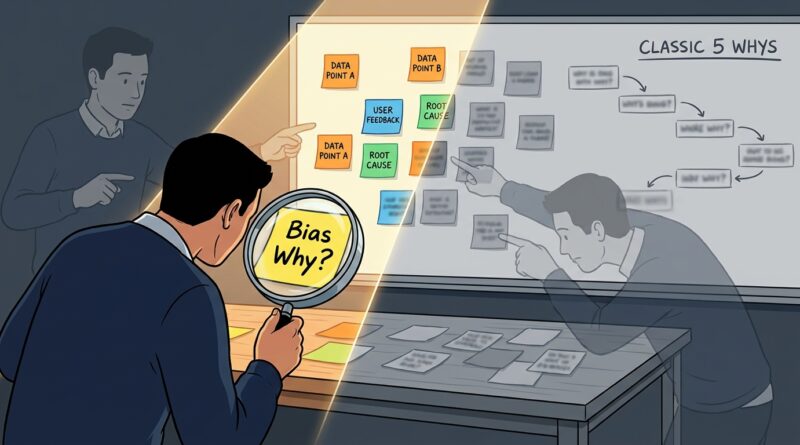
Why Your 5 Whys Keep Ignoring Conflicting Evidence: The Simple ‘Bias Why’ That Stops You Only Seeing What You Want To See
You know the feeling. You run the 5 Whys on a problem at work, at home, or in a relationship, and somehow the answer keeps pointing to the same familiar culprit. The lazy teammate. The bad process. The lack of communication. The difficult partner. It feels tidy, but also a little suspicious. Some facts do not fit. A few comments do not line up. Your gut says, “Hang on, that cannot be the whole story.” Still, the group nods, the chart gets filled in, and everyone moves on with the same fix that did not work last time. That is often confirmation bias in root cause analysis 5 whys. You are not really asking why anymore. You are asking for support for a story you already believe. The good news is you do not need a fancy new framework to fix that. You just need to add one simple question, the Bias Why.
⚡ In a Hurry? Key Takeaways
- Confirmation bias can quietly break the 5 Whys by steering you toward the answer you already wanted.
- Add a “Bias Why” after each why: “What evidence would make this explanation weaker or wrong?”
- This simple check helps you avoid fake fixes, blame games, and repeating the same problem with a prettier report.
Why the 5 Whys can go wrong so easily
The 5 Whys is popular because it is simple. That is also why it can get into trouble.
When a problem is mechanical, the method often works well. A machine stopped because a part failed. The part failed because maintenance was skipped. Fine. You can follow the chain.
But many real-world problems are not that clean. They are emotional, political, messy, and full of missing information. That is where people start filling the gaps with assumptions.
And once your brain likes one explanation, it starts collecting proof for that explanation while brushing aside awkward facts that do not match. That is confirmation bias in root cause analysis 5 whys in plain English.
You are not lying on purpose. Your brain is trying to make a messy situation feel simple and settled.
What confirmation bias looks like during a 5 Whys session
You keep landing on the same “safe” culprit
Maybe every issue becomes “poor communication.” Or “lack of training.” Or “management.” Or “they just do not care.”
These answers can be true. They can also be lazy placeholders that stop the real digging.
You explain away conflicting evidence
If one piece of data does not fit the story, you treat it like an exception instead of a clue.
For example, if three people missed a deadline but one person hit it despite the same process, that matters. If you ignore that, you may miss the actual cause.
You confuse the easiest answer with the deepest one
The first answer that sounds reasonable often wins. Especially if it protects the team, avoids conflict, or blames someone who is not in the room.
That is one reason 5 Whys can become a blame tool instead of a learning tool.
The simple fix: add a “Bias Why”
Here is the extra question to bolt onto any step in your 5 Whys:
Bias Why: What evidence would make this explanation weaker, incomplete, or wrong?
That is it.
You can ask it after every why, or at least after the group thinks it has found the root cause.
This one question does something powerful. It forces your brain to look for disconfirming evidence instead of only supporting evidence.
In other words, it interrupts the story your mind is trying to protect.
How to use the Bias Why in real life
Step 1: Write your current explanation clearly
Do not keep it vague. Write the actual claim.
Example: “The project failed because the team did not communicate clearly.”
Step 2: Ask the Bias Why
Now ask:
What evidence would make this explanation weaker, incomplete, or wrong?
Possible answers might be:
- There were clear written updates, but decisions still changed late.
- Some team members understood the plan, but priorities kept shifting from leadership.
- The real issue may not be communication at all. It may be role confusion or unrealistic deadlines.
Step 3: Look for missing facts, not just stronger opinions
This part matters. Do not answer the Bias Why with a louder guess.
Look for actual things you can check. Messages. Dates. Examples. Contradictions. Patterns.
Step 4: Rewrite the cause if needed
Maybe communication was part of the problem. But maybe the more honest version is:
“The project failed because decision rights were unclear, which made communication look bad.”
That is a much better target for action.
A quick example
Let us say a manager asks why a team member keeps missing deadlines.
Why 1: Because they are disorganized.
Why 2: Why are they disorganized? Because they do not plan well.
Why 3: Why do they not plan well? Because they are not taking ownership.
At this point, the story feels neat. Too neat.
Now add the Bias Why.
Bias Why: What evidence would make this explanation weaker or wrong?
- They meet deadlines on work from one specific client.
- Tasks often arrive with unclear priority labels.
- The manager changes the order of work three times a week.
- Two other team members are also slipping on the same kind of task.
Now the picture changes. The issue may not be personal disorganization. It may be unstable priorities and poor intake.
That leads to a fix that might actually help.
Why this matters outside work too
This is not just a business problem.
People use root cause thinking in relationships, family arguments, parenting, and personal habits all the time.
“We keep arguing because you never listen.”
“I am always tired because I have no discipline.”
“The friendship is strained because they are selfish.”
Maybe. But maybe not fully.
When you add a Bias Why, you give yourself a chance to notice the parts you would rather avoid. Your own tone. Your own mixed signals. Stress. Burnout. Fear. Old assumptions.
That does not mean every conflict is your fault. It means the truth is usually less flattering, and more useful, than the first version your brain serves up.
How to tell if your 5 Whys is being hijacked by bias
Watch for these red flags:
- You reach the same root cause no matter what problem you start with.
- The cause sounds broad and morally satisfying, but not testable.
- The group ignores people or facts that complicate the story.
- The conclusion conveniently avoids powerful people or touchy topics.
- Your action items are the same every time, and the problem keeps returning.
If that sounds familiar, you do not need a fancier diagram. You need a more honest process.
This is also why Why Your 5 Whys Keep Ignoring Cognitive Bias: The Simple ‘Bias Why’ That Stops You Lying To Yourself Without Knowing It hits such a nerve. People are often sincere during analysis. They are just not very good at noticing the story they are protecting.
Questions that make the Bias Why even stronger
If you want to get more out of it, pair the Bias Why with a few follow-up questions:
- What facts did we dismiss too quickly?
- Who would disagree with this explanation, and why?
- What are we assuming without proof?
- If our favorite explanation is wrong, what is the next most likely one?
- What would an outsider notice here that we are missing?
These questions slow the rush to certainty. That is usually a good thing.
What the Bias Why is not
It is not endless doubt
You are not trying to make every conclusion impossible. You are just stress-testing it before you act on it.
It is not a trick to avoid accountability
Sometimes the obvious culprit really is the cause. The Bias Why does not erase responsibility. It just checks whether you earned that conclusion.
It is not anti-5 Whys
The 5 Whys is still useful. It just works better when you remember that humans are not neutral investigators. We are story-making machines.
At a Glance: Comparison
| Feature/Aspect | Details | Verdict |
|---|---|---|
| Standard 5 Whys | Fast, simple, and useful for straightforward problems, but easy to steer with assumptions. | Good starting tool, not enough on its own for messy human problems. |
| 5 Whys plus Bias Why | Adds a check for conflicting evidence and weak spots in your favorite explanation. | Best option when bias, politics, or emotions may be shaping the answer. |
| AI-generated RCA templates | Can organize thoughts neatly, but often make shaky assumptions look polished and final. | Helpful for structure, risky if you let them replace human honesty and fact-checking. |
Conclusion
If your 5 Whys keeps leading to the same tidy answer and the same failed fix, the problem may not be the tool. It may be the story you keep protecting while you use it. That is why the Bias Why matters. It gives you a simple way to sanity-check your thinking before you turn a guess into a conclusion. Right now a lot of people are using root cause tools on complex workplace, emotional, and relationship problems soaked in bias and half-seen facts. Shiny templates and AI diagrams can make that look smarter than it is. A plain question like, “What evidence would make this explanation weaker or wrong?” is often more useful than another polished chart. Add it to your next 5 Whys. You will cherry-pick less, blame less, and notice the uncomfortable causes that actually need attention. That means fewer fake fixes, fewer pointless meetings, and more honest conversations that finally change something.