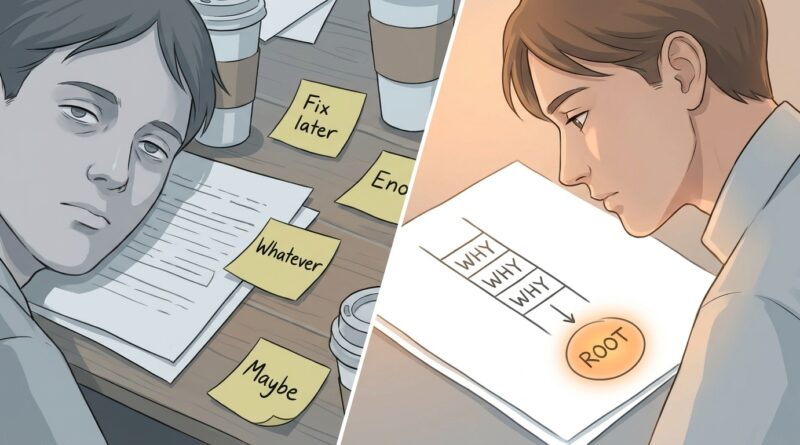
Why Your 5 Whys Keep Ignoring Quiet Apathy: The Simple ‘Apathy Why’ That Reveals When You’ve Secretly Stopped Caring
You know the feeling. You can explain the problem in perfect detail. You know what keeps going wrong. You may have even done the 5 Whys exercise three times already. And yet nothing changes. Not because the issue is confusing, but because a quieter problem has moved in. You do not feel much about it anymore. That flat, stalled feeling is easy to miss because it does not look dramatic. It looks like procrastination, low motivation, or “I’ll deal with it later.” But sometimes the real block is apathy. If that is true, classic problem-solving tools will keep giving you smart answers to a question your heart already left. A better form of root cause analysis for apathy starts by asking one extra question before all the others: “Why don’t I care enough to act?” That small shift can tell you whether you are burned out, overloaded, disconnected from your values, or simply finished with something that no longer fits.
⚡ In a Hurry? Key Takeaways
- The missing step in many 5 Whys sessions is asking whether apathy, not confusion, is the real root cause.
- Use an “Apathy Why” first: “Why don’t I care enough to fix this right now?” Then sort the answer into exhaustion, overload, misalignment, fear, or being truly done.
- Apathy is not always laziness. It can be a signal of burnout, emotional numbness, or a need for support. If the flatness is deep or persistent, talk to a mental health professional.
Why the usual 5 Whys can miss the real issue
The classic 5 Whys is useful because it helps you move past surface-level answers. Problem: I keep missing deadlines. Why? I start late. Why? I avoid the task. Why? It feels too big. Why? I did not break it down. Why? I rushed planning.
That can be true and still not be the whole truth.
Sometimes you can break the task down just fine. You can make a schedule. You can set reminders. You can even buy a nicer planner, a better app, or a standing desk. Still nothing. Why? Because the engine is off. You are trying to improve a system that no longer has motive behind it.
This is where root cause analysis for apathy matters. It does not replace the 5 Whys. It makes it honest.
The simple fix: add one “Apathy Why” before the rest
Before you ask the normal chain of why questions, start here:
The Apathy Why
“Why don’t I care enough to fix this?”
That question can feel uncomfortable because it strips away the tidy, productive language we usually hide behind. But it is also the question that often gets you unstuck fastest.
Your answer will usually land in one of a few buckets.
1. I am exhausted
You care in theory, but your body and brain are running on fumes. This is common after long stress, caregiving, bad sleep, work overload, or months of being “on” all the time.
In this case, apathy is less about attitude and more about depleted capacity.
2. I am overcommitted
You still care, but too many things are competing for your attention. When everything is urgent, your mind protects itself by going numb to some of it.
This is not failure. It is a traffic jam.
3. This no longer matches my values
You keep trying to solve the problem because you think you should care. But deep down, the goal may not fit who you are now. Maybe the promotion does not matter anymore. Maybe the side project has become dead weight. Maybe the friendship, habit, or routine belongs to an older version of you.
That is not laziness. That is misalignment.
4. I care, but I feel helpless
This one can look like apathy from the outside. Inside, it feels more like “What is the point?” If repeated efforts have failed, your brain may stop investing energy in trying. That is closer to discouragement than not caring.
5. I am done, and I have not admitted it yet
Sometimes the cleanest answer is the hardest one. You do not want to fix the issue because you no longer want the thing attached to it.
You do not want a better workflow for that job. You want out of the job.
You do not want a better budget for that hobby. You want to stop pretending you enjoy it.
That can be sad. It can also be clarifying.
How to do root cause analysis for apathy in real life
Here is a simple version you can use on paper or in a notes app.
Step 1: Name the repeating problem
Keep it concrete.
Examples:
- “I keep putting off job applications.”
- “I never follow through on fixing my sleep schedule.”
- “I keep saying I’ll organize my finances, but I don’t.”
Step 2: Ask the Apathy Why first
Write: Why don’t I care enough to fix this right now?
Do not force a noble answer. Write the blunt one.
Examples:
- “Because I’m too drained to think after work.”
- “Because I don’t believe this effort will change anything.”
- “Because I don’t actually want the outcome anymore.”
- “Because I’m embarrassed I let it get this bad.”
Step 3: Ask why again, but only on the emotional answer
If the answer is “I’m too drained,” ask why you are so drained.
If the answer is “I don’t want it anymore,” ask what changed.
If the answer is “I feel embarrassed,” ask what you think that says about you.
Now you are doing actual root cause analysis for apathy, not just circling the behavior.
Step 4: Sort the root cause into a response type
This part matters because different causes need different fixes.
- Exhaustion: rest, reduce demands, protect sleep, get help.
- Overcommitment: cut obligations, choose fewer priorities.
- Misalignment: rethink the goal, not just the process.
- Helplessness: shrink the task, get support, create a visible win.
- Being done: make a clean ending instead of endless dragging.
What this sounds like in practice
Example 1: “I never update my portfolio”
Why is this happening? Because I avoid it.
Why do I avoid it? Because it feels tiring.
Apathy Why. Why don’t I care enough to fix it? Because I do not even want jobs like the ones in my portfolio anymore.
That changes everything. The issue is not time management. The issue is that your old career story no longer fits.
Example 2: “I keep ignoring my health routine”
Why is this happening? Because I skip workouts and meal prep.
Why? Because I feel unmotivated.
Apathy Why. Why don’t I care enough to fix it? Because every day feels like survival already, and adding one more task makes me want to cry.
That points to overload or burnout, not lack of discipline.
Example 3: “I do not deal with my clutter”
Why is this happening? Because I keep walking past it.
Why? Because it feels overwhelming.
Apathy Why. Why don’t I care enough to fix it? Because I’m ashamed I let it pile up, and ignoring it feels easier than facing that.
Now the root problem is shame. A better first move is not buying bins. It is making the task small and safe enough to start.
Signs you are dealing with apathy, not just procrastination
Procrastination usually still has emotional charge. You care, maybe a lot, but you delay because of fear, perfectionism, or overwhelm.
Apathy feels flatter. Quieter. More like a low battery than a traffic jam.
Watch for these signs:
- You can describe the problem clearly but feel no real pull to act.
- You keep researching solutions and use none of them.
- You feel emotionally distant from goals you used to care about.
- You say “I should” more than “I want.”
- You are not confused. You are detached.
What not to do
Do not shame yourself into action
Calling yourself lazy can create a temporary spike of guilt. It rarely creates steady change. Shame makes honest analysis harder.
Do not solve the wrong problem really well
If your issue is burnout, a better productivity system will not save you. If your issue is misalignment, more discipline will just help you walk faster in the wrong direction.
Do not assume apathy means nothing matters
Sometimes apathy is very selective. You may be numb in one area and fully alive in another. That contrast is useful data. Pay attention to where your energy still appears naturally.
Small next steps that actually help
If you find a likely root cause, match it with a small response.
If you are exhausted
- Cancel one nonessential task this week.
- Pick one maintenance habit, not five.
- Ask what would make life 10 percent lighter.
If you are overcommitted
- Make a “not now” list.
- Choose one active priority for the next seven days.
- Stop calling everything equally important.
If you are misaligned
- Write what you think you should want.
- Write what you actually want.
- Notice the gap without trying to explain it away.
If you feel helpless
- Lower the bar until action feels almost silly.
- Get one other person involved.
- Track one visible sign of progress.
If you are done
- Say it plainly.
- Decide what ending well looks like.
- Let closure replace endless repair attempts.
When apathy may be a mental health signal
Sometimes apathy is situational. Sometimes it is a sign of depression, burnout, chronic stress, grief, or another health issue. If your flatness spreads across most of life, lasts for weeks, or comes with hopelessness, sleep changes, loss of pleasure, or trouble functioning, it is worth talking to a doctor or licensed therapist.
You do not need to wait until things are dramatic. Quiet struggles count too.
At a Glance: Comparison
| Feature/Aspect | Details | Verdict |
|---|---|---|
| Classic 5 Whys | Good at tracing process failures, habits, and system problems, but may skip emotional disengagement. | Useful, but incomplete when motivation has gone flat. |
| Apathy Why | Asks why you do not care enough to act, revealing exhaustion, overload, misalignment, helplessness, or being done. | Best first step when the same problem keeps returning without real effort to change it. |
| Best next action | Match the fix to the cause. Rest for burnout, reduce commitments for overload, rethink goals for misalignment, support for helplessness. | A targeted response works better than generic “try harder” advice. |
Conclusion
If your usual problem-solving tools have started to feel weirdly useless, that does not mean you are broken or bad at change. It may mean you are trying to do root cause analysis on behavior while ignoring the silent loss of caring underneath it. Apathy and emotional numbness are rising for a reason. Repeated stress, burnout, and information overload can make people look unmotivated when they are actually depleted, overfull, misaligned, or quietly done. The good news is that once you treat apathy as a signal instead of a character flaw, your analysis gets sharper and your next step gets kinder. Ask the Apathy Why first. Then follow the answer where it leads. When there is a real motive behind the work, the rest of the 5 Whys can finally do their job again.