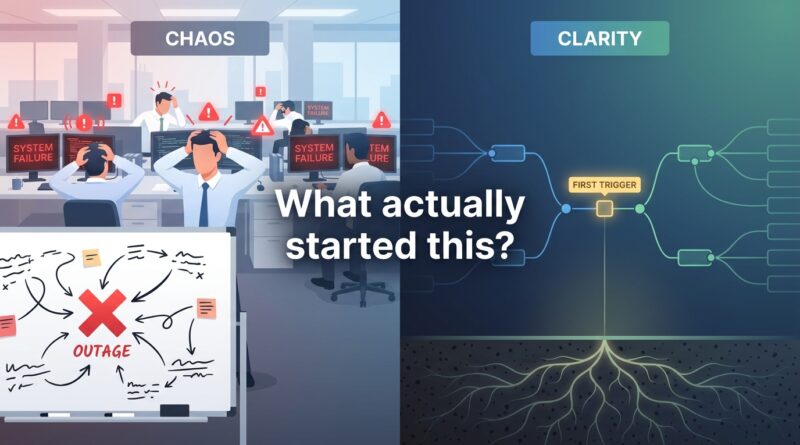
Why Your Root Cause Analysis Keeps Starting In The Wrong Place: The Simple ‘Trigger Why’ That Stops You Chasing The First Symptom You See
You know the feeling. Something breaks, tempers rise, alerts start pinging, and everyone wants a root cause analysis right now. So you grab the most obvious problem, the crashed app, the argument in the meeting, the sudden wave of panic, and start asking why. Five layers later, you have a neat-looking explanation that still somehow does not fix the real issue. That is frustrating, and it happens more often than most teams admit. The problem is not always your method. It is often your starting point. If your root cause analysis is starting from the wrong problem, even a solid framework will lead you down the wrong path. A simple fix is to ask one question before the usual Whys begin: “Why did this become visible now?” That small “Trigger Why” helps you separate the symptom from the actual starting event, so you stop spending hours analyzing the smoke instead of the fire.
⚡ In a Hurry? Key Takeaways
- The fastest fix for root cause analysis starting from the wrong problem is to ask, “Why did this become visible now?” before doing 5 Whys.
- Use the Trigger Why to identify the event that exposed the issue, then run your deeper analysis from that point instead of from the first symptom.
- This saves time, reduces blame, and works just as well for outages, team conflict, and personal stress patterns.
Why smart people keep starting in the wrong place
Most root cause analysis starts where the pain is loudest.
The server is down. The patient handoff failed. The team is arguing. You snapped at your partner. That visible moment feels like the problem because it is the moment everyone can see.
But visible is not the same as causal.
That is the trap behind a lot of root cause analysis starting from the wrong problem. The first symptom is often just the point where an older issue finally became impossible to ignore.
The simple “Trigger Why”
Before you start 5 Whys, ask this first:
“Why did this become visible now?”
That is the Trigger Why.
It does one very useful thing. It forces you to look for the event, condition, or change that turned a hidden problem into a visible one.
Sometimes that trigger is the real place your analysis should start. Sometimes it reveals that you are looking at an effect, not a cause.
What the Trigger Why changes
Without it, people say:
“Why did the service go down?”
With it, people first ask:
“Why did the service problem become visible at 2:17 p.m. today?”
That shift matters.
Maybe the service had been degraded for days, but traffic spiked after a marketing email. Maybe the conflict in your team did not start in the meeting. The meeting just exposed a decision nobody had clearly owned for weeks. Maybe your anxiety spike did not begin with the notification on your phone. That was only the last straw after bad sleep, skipped meals, and too many unresolved tasks.
A quick example from work
Let’s say a customer checkout fails.
The usual approach is:
Why did checkout fail?
Because the payment API timed out.
Why did it time out?
Because requests piled up.
Why did they pile up?
Because database reads slowed down.
That may be useful. But it may still start too late.
Try the Trigger Why first:
Why did the checkout issue become visible now?
Answer: because a new promo launched at noon and tripled order volume.
Now your analysis starts from the stress event that exposed the weakness, not just the symptom people saw on the screen.
The root cause may not be “the timeout.” It may be missing load testing for promo traffic, weak capacity planning, or a launch process that never includes engineering sign-off.
A quick example from real life
You have a blow-up at home over something tiny, like dishes.
If you start with, “Why did we argue about dishes?” you may get a shallow answer.
If you ask, “Why did this become visible now?” you may find the trigger was exhaustion, a missed expectation from earlier in the week, or stress from work that had been building quietly.
The dishes were real. They just were not the beginning of the story.
How to use the Trigger Why in one minute
Step 1: Name the visible problem
Keep it plain. “The app crashed.” “We missed the handoff.” “I froze during the presentation.”
Step 2: Ask what made it visible now
Look for timing, change, pressure, volume, fatigue, new inputs, missing buffers, or hidden buildup.
Step 3: Decide where the real analysis should begin
If the visible issue is just the final symptom, move your starting point back to the trigger event.
Step 4: Then use your usual method
Now do 5 Whys, fishbone, timeline review, or whatever process your team already trusts.
You are not replacing your framework. You are aiming it better.
Why this works better than just “doing more Whys”
More Whys do not always fix a bad starting point.
If your first question is off, the rest of the chain can still sound logical while missing the actual problem. That is one reason teams end up with tidy RCA documents and recurring incidents.
If that sounds familiar, it is worth reading Why Your 5 Whys Keep Feeding Analysis Paralysis: The Simple ‘Good-Enough Why’ That Gets You Unstuck And Moving Again. It pairs nicely with the Trigger Why idea. First make sure you are starting in the right place, then make sure you do not overthink your way into a dead end.
Common signs you are analyzing the wrong problem
- Your RCA keeps ending with “human error” or “communication issue” and nothing improves.
- The fix works briefly, then the same pattern returns.
- Your timeline starts exactly when the problem became visible, not when conditions started forming.
- Different teams disagree on what the problem even was.
- You feel like your explanation is neat, but oddly unsatisfying.
Where this matters most right now
This is showing up all over tech, healthcare, operations, and everyday life.
In tech, systems are so layered that the alert you see is often several hops away from the real weakness.
In healthcare, a visible incident may trace back to workflow design, staffing patterns, handoff timing, or tool friction, not just the final mistake.
In personal life, the breakdown you notice is often the point where accumulated strain finally leaks out.
That is why root cause analysis starting from the wrong problem keeps wasting so much energy. People are working hard. They are just starting too close to the smoke.
At a Glance: Comparison
| Feature/Aspect | Details | Verdict |
|---|---|---|
| Starting from the first visible symptom | Feels fast and obvious, but often builds the whole analysis on an effect instead of a cause. | Useful for triage, risky for true RCA |
| Using the Trigger Why first | Adds a one-minute pause to find what made the issue visible now, then shifts the starting point if needed. | Best upgrade for clearer analysis |
| Running your normal framework after that | Lets you keep 5 Whys or other tools, but with a stronger first question and less wasted effort. | Practical and easy to adopt |
Conclusion
If your root cause analysis keeps feeling careful but somehow incomplete, there is a good chance you are not bad at analysis. You may just be starting from the wrong problem. A lot of current RCA talk in tech and healthcare is quietly circling the same truth: the first visible issue is usually not where the real story begins. Yet many frameworks still nudge people to start there anyway. That is why teams keep burning hours on the wrong incident, families keep replaying the wrong fight, and individuals keep dissecting the wrong emotional spike. The Trigger Why gives you a practical fix in about a minute. Ask, “Why did this become visible now?” Then start from that answer. You do not need a whole new system. You just need a better first step. For anyone tired of constant fires and repeat problems, that small shift can make your next RCA far more honest, useful, and worth the time.