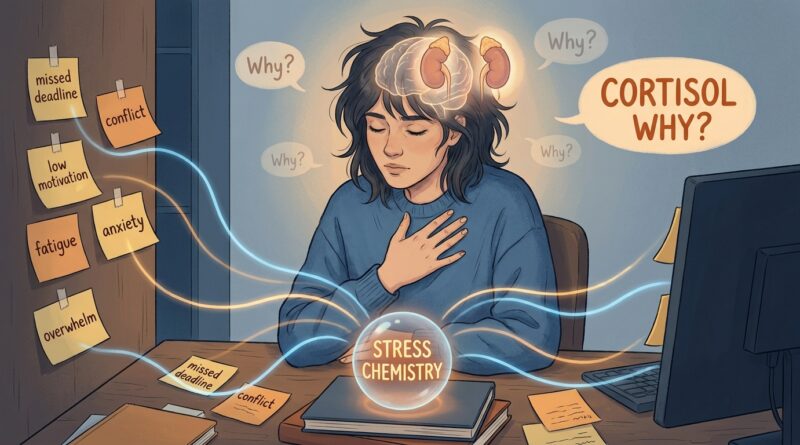
Why Your 5 Whys Keep Ignoring Stress: The Simple ‘Cortisol Why’ Behind Repeating Problems And Burnout
You fix the missed deadline. Then the next one slips too. You talk about communication, accountability, motivation, better planning. And still the same problem keeps coming back. That is maddening, especially when everyone involved is already trying hard. A lot of teams and families are not actually bad at solving problems. They are just solving the problem one layer too high. Under the surface, stress chemistry is quietly steering decisions, memory, patience, and follow-through. If someone has been running on cortisol for months, their brain may default to fight, flight, or freeze long before they make a “logical” choice. So the real issue is not always laziness, poor attitude, or weak discipline. Sometimes the missing step in your 5 Whys is much simpler. Ask what stress was doing in that moment, and what system kept it high in the first place.
⚡ In a Hurry? Key Takeaways
- Your root cause analysis may be missing stress and burnout. Repeating problems often come from an overloaded nervous system, not just bad habits or bad communication.
- Add one extra question to every Why chain: “What did stress make harder here?” Then look for workload, uncertainty, interruptions, sleep loss, or fear.
- This is not about excusing harmful behavior. It is about spotting the real conditions behind it so fixes actually last and people burn out less.
Why the usual 5 Whys can miss the real problem
The 5 Whys is useful because it pushes you past the obvious answer. But it also has a blind spot. It assumes people were operating from a fairly stable baseline.
Many people are not.
They are carrying job insecurity, nonstop notifications, family strain, AI-related pressure, and the general feeling that everything is changing faster than they can process. In that state, the brain does not make clean, careful choices. It cuts corners. It forgets. It shuts down. It gets snappy. It avoids.
Then we label the outcome instead of the state behind it.
We say “poor communication.” We say “they need more ownership.” We say “nobody is motivated anymore.” Those labels are not always wrong. They are just often incomplete.
The missing question: the Cortisol Why
Here is the simple add-on to your usual process.
After each Why, ask this too
What did stress make harder at this step?
That is the Cortisol Why.
You do not need a lab test. You are not trying to diagnose anyone. You are simply checking whether stress load changed attention, memory, judgment, patience, sleep, or energy enough to shape the outcome.
This turns root cause analysis stress and burnout why framework from a blame hunt into something much more useful. It helps you see the human operating conditions, not just the visible mistake.
A simple example at work
Problem: A project update was never sent, and a client got upset.
Why 1: The manager forgot to send it.
Cortisol Why: What did stress make harder? It made working memory worse, and they were switching between six urgent chats.
Why 2: They were juggling too many last-minute requests.
Cortisol Why: Stress made it harder to prioritize calmly, so everything felt equally urgent.
Why 3: The team had no clear rule for what counts as a true emergency.
Cortisol Why: Ongoing uncertainty kept everyone in reactive mode, so they created more interruptions for each other.
Why 4: Leadership changed timelines twice this month.
Cortisol Why: Repeated change raised baseline anxiety, so people stopped trusting plans and worked from panic instead.
Why 5: The organization rewards fast replies more than thoughtful work.
Cortisol Why: Chronic pressure trained people to protect themselves socially, not protect the quality of the process.
Notice what happened. The problem did not disappear into “stress.” It got clearer. Now you have real design issues to fix: interruptions, unclear urgency rules, unstable planning, and a culture of panic responses.
A simple example at home
Problem: You keep having the same argument about chores.
Why 1: One person did not do their part.
Cortisol Why: What did stress make harder? Task initiation. They looked at the mess and froze.
Why 2: They avoided starting.
Cortisol Why: Stress made the task feel bigger and more emotionally loaded than it really was.
Why 3: They were already drained from work and poor sleep.
Cortisol Why: Their tolerance for small frustrations was low before the conversation even began.
Why 4: Both people only talk about chores when they are angry.
Cortisol Why: A stressed nervous system tends to wait, avoid, then burst.
Why 5: There is no simple routine for resetting the house.
Cortisol Why: Without a low-effort default, every mess becomes a fresh negotiation.
This is where stress and habits overlap. If that sounds familiar, you may also like Why Your 5 Whys Keep Ignoring Hidden Habits: The Simple ‘Routine Why’ That Explains Problems You Swear You’ve Already Fixed. Stress often lights the fire, and missing routines keep it burning.
What stress actually changes in real life
When people hear “cortisol,” they sometimes picture a wellness podcast. Keep it practical instead. Chronic stress tends to affect a few very ordinary things.
Attention
People miss details they would normally catch.
Memory
They forget steps, follow-ups, or conversations.
Patience
Neutral feedback sounds like criticism. Small delays feel huge.
Decision-making
Short-term relief wins over long-term sense.
Initiation
People know what to do but cannot get themselves to start.
Social behavior
They become more defensive, withdrawn, or sharp.
That does not mean they do not care. It often means their system has been red-lining for too long.
How to use the Cortisol Why without turning every meeting into therapy
You do not need to ask people to share trauma histories. You do not need scented candles in the conference room. You just need better questions.
Ask about conditions, not character
Try: “What made this harder than it should have been?”
Not: “Why were you careless?”
Look for load, not just mistakes
Ask about interruptions, unclear priorities, fear of getting in trouble, sleep loss, understaffing, context switching, and timeline churn.
Separate acute stress from chronic stress
A bad day causes one kind of error. Six bad months cause another. The second one is where burnout grows.
Fix the environment where you can
People cannot breathe their way out of a broken system. If the same problem shows up across multiple people, it is probably not a personality issue.
A tiny framework you can start using today
Here is a practical version.
The 5 Whys plus 1
For each Why, add these prompts:
- What did stress make harder here?
- What signs tell us stress was part of the chain?
- What in the system kept stress high?
- What one change would lower the load next time?
You can use this in a postmortem, a one-on-one, a family talk, or even your own journaling after a rough week.
Signs you are misdiagnosing burnout as a personal flaw
- The same “careless” error is happening across several capable people.
- People say they are busy all day but finish little meaningful work.
- Everyone sounds more reactive, avoidant, or numb than usual.
- Small tasks are piling up because starting feels weirdly hard.
- You keep trying training, reminders, and pep talks, but nothing sticks.
When that happens, your analysis probably needs a stress lens.
What better fixes look like
The point is not to stop expecting responsibility. The point is to design for actual humans.
Instead of “communicate better”
Set one channel for urgent issues and define what urgent means.
Instead of “be more organized”
Cut active projects, reduce context switching, and use checklists for tired brains.
Instead of “people need resilience”
Stabilize deadlines where possible and stop changing priorities without explaining why.
Instead of “try harder at home”
Create tiny defaults. Ten-minute resets. Visible task lists. Fewer decisions at the end of the day.
These are not glamorous fixes. They work because they respect the fact that stressed brains need less friction, not more lectures.
At a Glance: Comparison
| Feature/Aspect | Details | Verdict |
|---|---|---|
| Standard 5 Whys | Good at tracing process failure, but can stop at labels like communication, motivation, or discipline. | Useful, but often incomplete during high-stress periods. |
| 5 Whys plus the Cortisol Why | Adds a check for stress load, burnout, uncertainty, and nervous system overload at each step. | Best for finding causes that actually match real life right now. |
| Typical fixes that follow | Without the stress lens, fixes become reminders and blame. With it, fixes become clearer priorities, fewer interruptions, better routines, and kinder systems. | System changes usually stick longer than motivational speeches. |
Conclusion
If your team, household, or even your own brain keeps tripping over the same problem, it does not automatically mean people are lazy, flaky, or bad at communicating. Right now, a lot of us are doing root cause analysis while already sitting on top of a constant stress baseline. That changes everything. Adding one small question, “What did stress make harder here?”, can make hidden pressure visible inside your Why chain. That helps you stop misreading burnout as a character flaw and start building systems that are more honest, more humane, and much more likely to work. In a year full of AI change, job worries, and information overload, that is not soft thinking. It is practical thinking. And frankly, it is the kind of fix more tech advice should talk about.