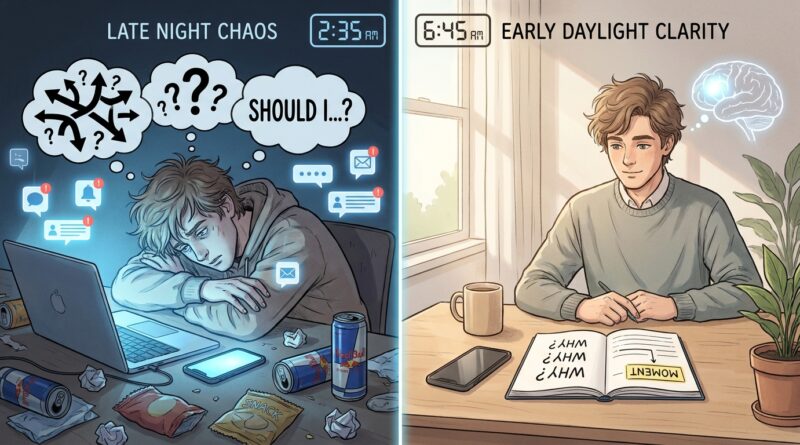
Why Your 5 Whys Keep Ignoring Timing: The Simple ‘Moment Why’ Behind Regrettable Decisions And Fake Willpower Guilt
You make a bad call at 11:47 p.m., then spend the next day acting like you uncovered some deep character flaw. That is exhausting, and honestly, unfair. Maybe you rage-texted someone, bought something dumb, skipped the workout, or agreed to work you should have said no to. Then out comes the usual post-game review. Why did I do that? Because I lack discipline. Because I self-sabotage. Because I need better habits. Sometimes those answers are partly true. But a lot of the time, they miss the biggest factor. The moment itself. Your brain at 11:47 p.m. is not your brain at 10:00 a.m. A root cause analysis of bad decisions timing often shows something simple and humbling. You did not fail because you are weak. You made a very human choice in a bad decision window, while tired, overloaded, stressed, rushed, lonely, or digitally fried.
⚡ In a Hurry? Key Takeaways
- Most regrettable decisions are not just about character. They are often about timing, fatigue, stress, and context.
- After a blow-up or impulse buy, ask “Why this moment?” before you ask “What is wrong with me?”
- This shift can cut fake guilt and help you design better guardrails instead of relying on shaky willpower.
The mistake most “5 Whys” make
The 5 Whys can be useful. Keep asking why, and you can often get past the surface story. But when people use it on themselves, it can turn into a courtroom.
Why did I snap at my partner?
Because I was irritated.
Why?
Because I am stressed.
Why?
Because I do not manage my emotions well.
See where this goes? Pretty quickly, the answer becomes identity. You are the problem. Your discipline is the problem. Your mindset is the problem.
But there is a missing question sitting in plain sight.
Ask “when,” not just “why”
Before you dig into motives, ask this.
Why did this make sense to my brain at that exact moment?
That is the Moment Why.
It sounds small. It is not. It changes the whole investigation.
Instead of treating every bad decision like a moral failure, you start treating it like a timing event. You look at sleep, hunger, cognitive load, notification overload, alcohol, social pressure, deadline pressure, and the simple fact that some hours of the day produce worse judgment than others.
What fake willpower guilt looks like
Fake willpower guilt is what happens when you blame a decision on weak character, even though the conditions were stacked against you.
A few common examples:
The late-night purchase
You buy something expensive after scrolling for an hour. The next morning, you call yourself impulsive. But the real picture is usually more boring. You were tired, reward-seeking, and one-click payment made the decision friction-free.
The food decision that “proves” you have no discipline
You eat whatever is fastest at 3:00 p.m. after back-to-back meetings and no lunch. Then you build a whole story about self-control. But your brain was running low, and convenience won.
The yes you should have made a no
You agree to help, cover, attend, or volunteer when you are already overloaded. Later you resent it. That was not always people-pleasing as a personality trait. Sometimes it was decision fatigue and social pressure hitting at the same time.
The angry message
You send the text, post the comment, or fire off the email because you are emotionally hot and digitally close to the send button. Timing matters here more than people like to admit.
Why timing quietly dominates bad decisions
Your brain does not make choices in a vacuum. It makes them inside a moment. And moments have conditions.
Those conditions include:
- Sleep debt
- Stress load
- Hunger or low blood sugar
- Too many open loops
- Too much screen time
- Emotional conflict
- Time pressure
- Alcohol or other impairing factors
- Social exposure and pressure
- Easy digital access to the bad option
That does not remove personal responsibility. It just makes it more accurate.
Think of it like troubleshooting a laptop that keeps crashing. You would not only ask, “What is wrong with the machine?” You would also ask, “What was running when it crashed?” Timing and load matter. People are not machines, but the point still holds. A brain under strain makes different choices than a rested one.
The “Moment Why” framework
Here is a simple way to run a root cause analysis of bad decisions timing without turning yourself into the villain.
Step 1: Name the decision clearly
Keep it factual.
“I bought the gadget.”
“I picked a fight.”
“I said yes when I meant no.”
Step 2: Freeze the moment
Ask what the moment looked like right before the choice.
- What time was it?
- How much had you slept?
- Had you eaten?
- How many decisions had you already made that day?
- Were you alone, rushed, angry, embarrassed, or bored?
- What app, site, or person was in front of you?
Step 3: Ask the key question
Why did this choice feel reasonable to my brain in that moment?
Notice the wording. Not correct. Not wise. Reasonable.
That matters because most regrettable decisions do feel reasonable for about ten seconds.
Step 4: Spot the pressure mix
Usually it is not one thing. It is a mix.
For example:
Tired + annoyed + easy access + no pause.
Or:
Lonely + targeted ad + payday + frictionless checkout.
Or:
Back-to-back meetings + low blood sugar + guilt + someone asking in real time.
Step 5: Build a guardrail for that moment
Do not promise to “be better.” Change the moment.
Examples:
- No purchases after 9:00 p.m.
- Draft angry messages, do not send for 30 minutes.
- Never answer commitment requests on the spot.
- Remove saved cards from shopping apps.
- Set a food plan for the hour you usually crash.
- Put hard conversations earlier in the day, not late at night.
Bad decisions often come from bad decision windows
This is the part many people find strangely comforting. You may not have a “discipline problem” nearly as often as you have a decision-window problem.
Some windows are predictable. Late at night. Right after work. During a commute. After conflict. When scrolling in bed. When hungry and in a rush. When a boss Slacks you at 5:28 p.m.
If you track these windows for even two weeks, patterns show up fast.
A simple log that actually helps
After a regrettable choice, write down:
- What happened
- What time it happened
- Your sleep, hunger, stress, and mood level
- What triggered it
- What the decision gave you in the short term
That last one is important. Every bad decision usually solves something for a minute. Relief. Stimulation. Escape. Comfort. Approval. Speed.
When you see the short-term reward, the choice stops looking random.
This is still root cause analysis, just done honestly
People sometimes hear this and think it sounds like making excuses. It is not. It is better diagnosis.
If a team investigated a failure but ignored when the failure happened, what load the system was under, and what conditions were present, you would call that incomplete. The same goes for personal decisions.
In fact, if you like structured post-mortems, you might also appreciate Why Your 5 Whys Keep Ignoring Safety: The Simple ‘Risk Why’ Behind Problems You’re Afraid To Write Down. It makes a similar point from a different angle. What people leave out of an analysis is often the thing driving the outcome.
How to use Moment Why in real life
For impulse spending
Look at time of day, emotional state, and checkout friction. If most bad buys happen when you are tired and on your phone, the fix is not a lecture about values. The fix is a spending pause, removed payment info, and no shopping when depleted.
For conflict
If arguments keep blowing up after 10:00 p.m., stop trying to become a perfectly calm night person. Make a rule that tense topics get parked until tomorrow morning.
For overcommitting
If you say yes under live pressure, create a default line. “Let me check and get back to you.” That one sentence can save hours of resentment.
For doomscrolling and procrastination
If you drift into low-value screen time when your brain is cooked, reduce the temptation in the hour you usually fade. Change the home screen. Log out. Put the charger in another room. Small friction matters.
What this changes emotionally
The biggest benefit is not just better decisions. It is less pointless shame.
Shame loves vague stories. “I always do this.” “I have no self-control.” “I am the kind of person who messes things up.”
Moment Why forces specificity.
“I made this choice after six hours of meetings, no lunch, and an upsetting message, while a very easy option was sitting in front of me.”
That is a very different sentence.
Specificity gives you something to work with. Shame does not.
At a Glance: Comparison
| Feature/Aspect | Details | Verdict |
|---|---|---|
| Traditional self-blame analysis | Focuses on discipline, motivation, and personality traits after the fact | Often too harsh and too vague to prevent the next mistake |
| Moment Why analysis | Looks at timing, fatigue, stress, context, and what made the choice feel reasonable then | More accurate, more useful, and easier to turn into guardrails |
| Best next step | Track your bad decision windows and add one friction point where you usually slip | Small changes to the moment usually beat big promises about willpower |
Conclusion
A lot of so-called irrational choices are not mysterious at all. They are rational for a tired, overloaded brain in the wrong moment. That is the big idea worth keeping. People are drowning in advice about habits, trauma, mindset, and motivation, but not enough of it helps them see timing as the root cause. The Moment Why does. After an impulse buy, a blow-up, or a weak yes, stop asking only what this says about your character. Ask when it happened, what load you were under, and why that choice fit that moment. Once you start mapping behavior instead of moralizing it, better decisions get easier to build. That matters even more now, when always-on phones, fast apps, and constant context switching keep pushing us into bad decision windows. You may not need more guilt. You may just need better timing data.