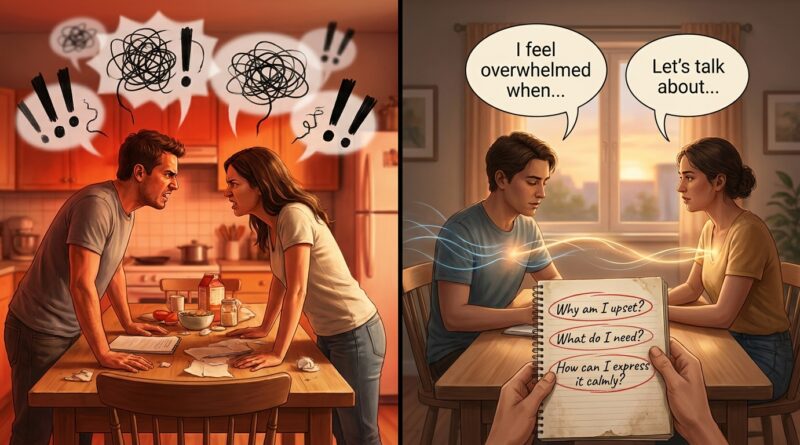
Why Your 5 Whys Keep Missing Communication Meltdowns: The Simple ‘Emotion Why’ That Explains Blow‑Ups You Never Meant To Start
You walk away from a conversation thinking, “How did that turn into a fight?” That feeling is maddening, especially when you truly did not mean to sound harsh, dismissive or cold. So you replay the whole thing. You look for the bad sentence, the wrong word, the better script. But the same blow-up keeps happening. At home. At work. In group chats. That is usually because you are asking a logic question about what was really an emotion problem. The root cause of communication breakdown emotional regulation often is not the sentence itself. It is the feeling underneath the sentence, and the feeling underneath their reaction. If you only ask the usual “why did this happen?” five times, you can still miss the live wire. Add one more question, the Emotion Why, and a messy argument often starts making a lot more sense, fast.
⚡ In a Hurry? Key Takeaways
- The missing root cause in many arguments is not poor wording alone. It is the untracked emotion driving tone, timing and interpretation.
- Use a quick Emotion Why sequence: What happened, what did I feel, what did I fear, what did I need, what can I say now.
- This is not about blaming yourself for every conflict. It is about spotting triggers early so you can respond with more control and less damage.
Why the usual 5 Whys often stalls out
The classic 5 Whys is great for fixing systems. A server failed. A deadline slipped. A process broke. You keep asking why until you find the source.
But people are not servers.
In a hard conversation, the visible problem is often just the last domino. “They snapped.” “I got defensive.” “The meeting got tense.” “My partner shut down.” If you only stay on the level of words and actions, you get shallow answers.
They are too sensitive.
I need better phrasing.
We were both tired.
Sometimes those are true. But they are rarely the full story.
The root cause of communication breakdown emotional regulation usually sits one layer lower. Not in the script, but in the nervous system. One person feels dismissed. The other feels accused. One hears control. The other hears rejection. Then both start protecting themselves instead of listening.
The missing step: the Emotion Why
Here is the simple add-on.
After you ask what happened and why it escalated, ask this.
What emotion got activated right before the conversation went bad?
That is the Emotion Why.
It sounds almost too simple, but it changes the whole map. You stop treating the blow-up like a word-choice failure and start seeing it as a trigger chain.
A trigger chain often looks like this:
Event. Meaning. Emotion. Protection. Reaction.
For example:
Your manager says, “Can we talk about your draft?”
You hear, “I messed up again.”
You feel shame.
Your brain moves to self-protection.
You become clipped, defensive or overly detailed.
Same with a partner:
They say, “You never listen.”
You hear, “I am failing you.”
You feel guilt mixed with anger.
You protect yourself by arguing facts.
Now they feel even less heard.
That is how “not what I meant at all” turns into a repeat fight.
The 5-step Emotion Why sequence you can use in real time
You do not need a therapy session in the middle of a tense talk. You need a tiny checklist you can run quickly.
1. What just happened?
Stick to the observable event. One sentence.
“They questioned my idea in front of the team.”
“She said I was distracted again.”
2. What did I feel, exactly?
Use plain words. Not polished ones.
Embarrassed. Ignored. Cornered. Scared. Ashamed. Disrespected.
If your first answer is “annoyed,” keep going. Annoyed is often a cover emotion. What is under it?
3. What did that feeling seem to mean?
This is where the story appears.
“They think I am incompetent.”
“I am not important here.”
“I am about to lose control.”
The meaning may not be objectively true. But it is often what your body reacted to.
4. What was I trying to protect?
This is the core.
Your competence. Your dignity. Your freedom. Your belonging. Your safety. Your time. Your hope of being understood.
Most communication meltdowns are protection moves.
5. What can I say now that names the issue without throwing a grenade?
This is the repair step.
Try:
“I think I got defensive because I heard that as criticism.”
“Give me a second. I am feeling cornered, and I do want to answer clearly.”
“When that came up in front of everyone, I felt embarrassed. Can we talk about the substance without making it personal?”
That is emotional regulation in practice. Not suppression. Not fake calm. Just enough awareness to choose your next sentence.
Why scripts alone often fail
People love communication scripts because they are neat. Say this, not that. Use this phrase. Avoid that tone.
Scripts can help. But if your body is already in fight, flight or freeze, the script may never make it out of your mouth. Or it comes out sounding robotic, sarcastic or flat.
That is why so much advice feels useless in the moment. It starts too late.
If you want to improve the root cause of communication breakdown emotional regulation, you have to catch the emotional surge before it fully grabs the wheel. Once you notice, “Oh, I feel dismissed,” you have a chance. Before that, you are mostly acting on autopilot.
Common hidden emotions behind “bad communication”
Not every conflict is about the same thing. But these are common patterns.
Defensiveness is often fear
Fear of blame. Fear of looking foolish. Fear of losing status.
Shutting down is often overwhelm
Not indifference. Too much input, too fast, with no sense of safety.
Anger is often a bodyguard
It rushes in to cover hurt, shame or helplessness.
Passive-aggression is often blocked honesty
Someone does not feel safe enough to say the thing directly.
Over-explaining is often panic
The person is trying to regain control or avoid being misunderstood.
Once you can spot these, people start making more sense. Including you.
How to use the Emotion Why with other people
You cannot force another person to self-reflect. But you can make it easier.
Ask softer, more useful questions
Instead of “Why are you overreacting?” try:
“What felt bad about that?”
“What did you hear me saying?”
“What part landed wrong?”
Those questions get closer to the trigger chain.
Reflect the emotion before debating the facts
“It sounds like that came across as dismissive.”
“I can see that felt pretty public and embarrassing.”
You are not admitting guilt for everything. You are showing that you understand impact, which usually lowers the temperature.
Name your own state early
“I want to talk about this, but I can feel myself getting defensive.”
That one sentence can save ten minutes of damage.
What this looks like in everyday life
At work
Your teammate interrupts you. You snap back. Later you think the issue was the interruption. Maybe. But the Emotion Why may be that you felt erased in a room where you already worry people overlook you.
Better repair: “When I got cut off, I felt dismissed, and I reacted sharply. I want to finish the point and hear your pushback after.”
With a partner
They ask why the dishes are still there. You hear criticism, not a household question. Now you are arguing about tone, history and who does more.
Better repair: “I heard that as ‘you failed again,’ and I got defensive. Can we restart?”
Online
A comment reads hostile. You fire off a reply. Hours later you regret it. The Emotion Why may be that you felt exposed, mocked or misread in public.
Better move: pause, identify the feeling, then decide whether this needs a response at all.
What the Emotion Why is not
It is not a magic trick.
It is not an excuse for bad behavior.
It is not saying every conflict is your fault.
Sometimes the other person really is rude. Sometimes a boundary really was crossed. Sometimes the healthiest move is to step back, not to explain yourself better.
The point is simpler than that. If you understand the emotion in the chain, you get more choice in what happens next.
At a Glance: Comparison
| Feature/Aspect | Details | Verdict |
|---|---|---|
| Standard 5 Whys | Good for processes and visible causes, but can stop at surface explanations in human conflict. | Useful, but incomplete for emotional conversations. |
| Emotion Why | Asks which feeling got activated, what meaning it created and what you were trying to protect. | Best for finding the real trigger behind repeat blow-ups. |
| Scripts and hacks | Helpful when calm, but often fail once shame, fear or anger is already running the show. | Good support tool, not the root fix. |
Conclusion
Emotional control and regulation are suddenly everywhere in the feeds for a reason. They sit under bad decisions, broken conversations and a lot of everyday stress. But most advice still treats the smoke, not the fire. It offers better lines, smarter tactics and cleaner scripts without mapping the emotional trigger chain that blew the interaction off course in the first place. The Emotion Why is tiny, but that is its strength. You can use it in a meeting, in the kitchen, over text or before posting online. What happened. What did I feel. What did it seem to mean. What was I trying to protect. What can I say now. That simple sequence turns an abstract self-help idea into something practical you can actually use in the next hard moment. And that is how you get closer to the real motive underneath the behavior, which is where better conversations usually start.