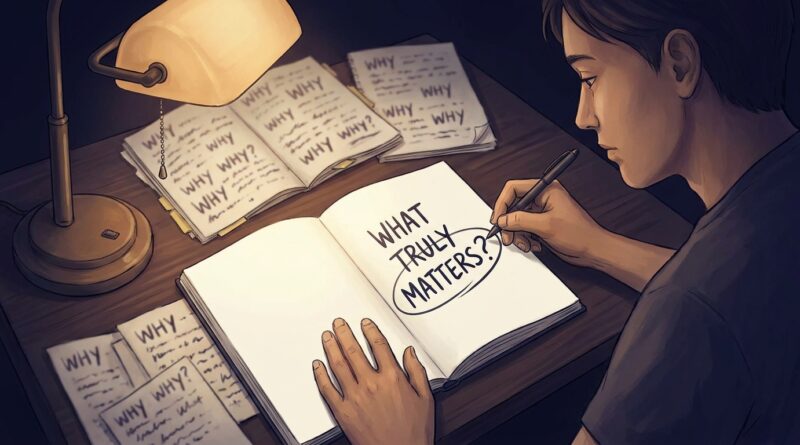
Why Your Self‑Reflection Makes You More Anxious: The Simple ‘Question Why’ That Turns Rumination Into Real Insight
You sit there replaying a text, a meeting, a breakup, a weird look from a friend, and your brain keeps asking the same thing. Why did I do that? Why am I like this? Why can’t I just get over it? It feels like self-reflection, but a lot of the time it is just rumination wearing smarter clothes. That is why you end up more drained than clear. More emotional than informed. If that sounds familiar, you are not broken, and you are not bad at thinking. You are probably using a useful tool in the wrong way. The difference between rumination and self reflection why questions is simple once you see it. One kind of why-question keeps you circling your pain. The other moves you toward something you can understand, test, or change. The trick is learning to spot the switch point before your own mind turns into a hamster wheel.
⚡ In a Hurry? Key Takeaways
- Rumination asks “why” in a way that chases certainty and self-blame. Real self-reflection asks “why” in a way that leads to a next step.
- If your why-question makes you feel more stuck, switch to this one: “Why does this make sense, given what I know, felt, or needed at the time?”
- This is not about excusing harmful behavior. It is about getting enough clarity to respond usefully instead of spiraling.
When “Why?” stops being helpful
Most people think rumination and self-reflection are the same thing because they can sound the same.
Both involve looking back. Both involve asking questions. Both can even happen in a journal or in therapy language.
But they do very different jobs.
Rumination tries to solve distress by going over it again and again. It promises relief, but usually gives you more agitation. Self-reflection tries to understand what happened well enough to respond better next time. It may feel uncomfortable for a minute, but it tends to lower confusion.
That is the core difference between rumination and self reflection why questions. One loops. One moves.
The sneaky part
Rumination often sounds intelligent. It uses words like patterns, triggers, attachment, root cause, and processing. None of those words are bad. The problem is that your mind can use them to keep the loop going.
You think you are digging into the issue. Really, you are just reopening the wound with better vocabulary.
How to tell which kind of “why” you are asking
Here is a simple test.
After five minutes of asking yourself why, do you have one of these?
- A clearer understanding of what happened
- A more balanced view of your part and other people’s part
- A specific next action
- More self-respect, even if you still feel regret
If yes, that is probably self-reflection.
If instead you have:
- More shame
- More urgency
- More mental replay
- Less ability to decide what to do next
That is probably rumination.
Rumination usually asks “why” like this
Why am I like this?
Why do I always ruin things?
Why can’t I stop thinking about this?
Why did they do that to me?
These questions are huge, vague, and loaded. They push your brain toward identity, blame, and certainty. They do not create traction.
Self-reflection asks “why” like this
Why did this hit me so hard?
Why did that choice make sense to me at the time?
Why did I miss that signal?
Why do I keep making this mistake in this specific situation?
These questions are narrower. They make it easier to find context, not just fault.
If you want a practical companion to this, How to Use Micro-Whys to Stop Repeating the Same Mistakes Every Week is useful because it keeps your thinking small enough to stay honest and actionable.
The one Question Why that changes the whole process
When you catch yourself spiraling, switch to this:
Why does this make sense, given what I knew, felt, feared, or needed at the time?
That question does three important things at once.
1. It replaces self-attack with context
Context is not the same as excuse.
If you snapped at someone because you were overwhelmed, that does not make it okay. But it does make it understandable. And once something is understandable, it becomes easier to fix.
Self-attack sounds like insight, but it usually blocks insight. People learn more when they feel safe enough to be honest.
2. It turns the past into usable information
Instead of asking why you are like this in general, you ask what made your reaction make sense in that moment.
Maybe you were exhausted. Maybe you felt trapped. Maybe the situation reminded you of an old fear. Maybe you were trying to avoid conflict. Maybe you genuinely did not know a better option.
Now you have data.
3. It gives you a bridge to a next step
Once you know what made your behavior or reaction make sense, you can ask better follow-ups.
- What would have helped me then?
- What signal did I miss?
- What boundary was I afraid to set?
- What can I put in place next time?
That is the shift from spiraling to problem-solving.
A quick example
Say you cannot stop replaying a conversation where you froze and said nothing.
Rumination says: “Why am I so weak? Why do I always do this?”
That leads to shame. Shame leads to more replay. More replay leads to more shame.
Now try the other question.
“Why does it make sense that I froze, given what I felt or needed at the time?”
Maybe the answer is: “Because I hate conflict, I was caught off guard, and part of me wanted to keep the peace.”
That answer is not flattering. But it is useful.
From there, you can ask:
- What is one sentence I can use next time when I need a pause?
- What situations make me most likely to freeze?
- Who do I become around this person, and why?
Now you are actually learning something.
Why anxiety loves endless why-questions
Anxiety hates uncertainty. So it tries to think its way into total safety.
That is why anxious rumination often feels urgent. Your brain is not trying to waste your time. It is trying to protect you by finding the perfect explanation, the perfect lesson, or the perfect replay that will stop bad things from happening again.
But that kind of certainty rarely arrives.
Instead, anxious thinking starts treating every emotion like a puzzle that must be solved before you can rest. That is exhausting.
Signs your “why” has become an anxiety trap
- You ask the same question with slightly different wording
- You keep searching for the one missing insight that will finally calm you down
- You feel more activated the longer you think
- You cannot stop at “good enough” understanding
- You confuse emotional intensity with depth
If that is happening, the problem is not that you have not thought enough. The problem is that thinking is no longer the right tool for this moment.
What real self-reflection feels like
It does not always feel good. But it does feel cleaner.
Real self-reflection often brings a sense of, “Oh. That fits.”
Not, “I have finally solved myself forever.”
Just enough clarity to reduce friction. Enough truth to help you make a better move.
A good why-question has three features
- It is specific. It points to a moment, reaction, or pattern, not your whole identity.
- It includes context. It asks what made sense, not just what went wrong.
- It leads somewhere. It helps you decide what to try, say, stop, or watch for next time.
What to do when you catch yourself spiraling
You do not need a ten-step system. Try this simple reset.
Step 1: Name the loop
Say, “I am not solving right now. I am circling.”
That small bit of distance matters.
Step 2: Ask the better why
“Why does this make sense, given what I knew, felt, feared, or needed at the time?”
Write down the first honest answer. Keep it short.
Step 3: Pull out one useful lesson
Ask, “What does this point to?”
Maybe it points to poor sleep, unclear boundaries, people-pleasing, decision fatigue, loneliness, or old fear getting triggered.
Step 4: End with one next move
Examples:
- I will draft the text tomorrow instead of tonight
- I will ask for 24 hours before deciding
- I will write down the signs I ignored
- I will apologize without turning it into a self-hate speech
If there is no next move, your brain will often keep spinning because it thinks the job is unfinished.
What this is not
This is not a trick for talking yourself out of accountability.
If you hurt someone, made a bad call, or ignored something important, you still own that. The goal is not to feel innocent. The goal is to become accurate.
Accuracy helps more than punishment.
Punishment feels serious, but it rarely teaches much. Understanding what made your reaction make sense gives you the best shot at changing it.
At a Glance: Comparison
| Feature/Aspect | Details | Verdict |
|---|---|---|
| Type of why-question | “Why am I like this?” is broad and shame-heavy. “Why did this make sense at the time?” is specific and grounded in context. | Context-based why wins |
| Emotional effect | Rumination raises urgency and exhaustion. Self-reflection may sting, but usually reduces confusion. | Choose the question that lowers fog, not the one that raises heat |
| Outcome | Rumination loops without a clear next step. Self-reflection ends with one lesson, one adjustment, or one decision. | If it does not lead to action, it is probably a loop |
Conclusion
A lot of people right now are using root-cause tools, journaling prompts, and therapy language on themselves with good intentions, but they accidentally turn it into endless rumination, especially when anxiety or hard decisions are involved. That is why it helps to know the difference between rumination and self reflection why questions. If your why-question leaves you more stuck, more emotional, and less able to act, it is not giving you insight. It is feeding the loop. The fix is surprisingly simple. Stop asking why in a way that hunts for blame or total certainty. Start asking, “Why does this make sense, given what I knew, felt, feared, or needed at the time?” That one shift often turns self-interrogation into real understanding. And real understanding is what helps you change patterns, not just suffer through them with smarter words.