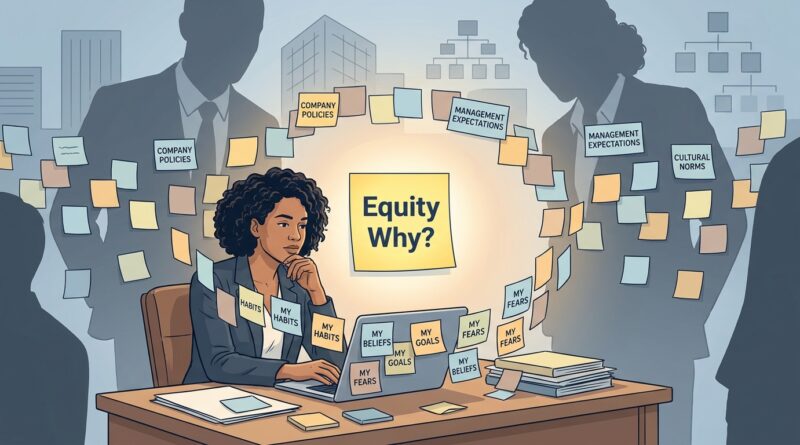
Why Your 5 Whys Keep Missing Power And Privilege: The Simple ‘Equity Why’ That Stops You Blaming Yourself For Systemic Problems
You ask why you are exhausted. Then why again. Then why again. By the end of the exercise, the answer somehow becomes, “I need better boundaries,” “I need to be more disciplined,” or “I am too sensitive.” That is frustrating for a reason. A lot of so-called root cause work quietly turns unfair systems into personal defects. If your boss changes priorities every week, if your family expects free emotional labor from you, or if your workplace rewards people who look and act a certain way, the problem is not just your mindset. Traditional 5 Whys can miss power, bias and unequal risk. That is where an Equity Why helps. It adds one simple question to root cause analysis. Who benefits from the current setup, who carries the cost, and what power is shaping this outcome? That shift can stop the spiral of self-blame and give you a clearer, more honest next step.
⚡ In a Hurry? Key Takeaways
- The equity why root cause analysis method adds power, privilege and unequal impact to the usual “why” chain, so you do not mistake a systemic problem for a personal failure.
- After your usual 5 Whys, ask: who has power here, who pays the price, and what part is actually mine to change today?
- This is not about dodging responsibility. It is about protecting your mental health while solving the real problem instead of just blaming yourself.
Why the usual 5 Whys can leave you feeling worse
The classic 5 Whys comes from problem-solving systems meant to find root causes. In factories and software teams, that can be useful. A machine failed. Why? A process broke. Why? A part was missing. Fine.
But people are not machines. Workplaces are not neutral. Families are not fair by default. Relationships are shaped by money, status, gender, race, age, disability, job security, immigration status, and all kinds of invisible rules.
So when you use a stripped-down root cause tool on a human problem, it often lands in the same place. You.
Why am I burnt out? Because I say yes too often.
Why do I say yes too often? Because I need approval.
Why do I need approval? Because I lack confidence.
That may contain some truth. But it may also skip a very big fact. Maybe you are in a team where saying no gets women labeled “difficult,” junior staff get punished for pushback, or neurodivergent employees get marked down for not performing cheerfulness on demand.
Without context, root cause analysis can become polished self-blame.
What the Equity Why adds
The Equity Why is a simple extra layer you add to any root cause conversation. Once you have asked your usual whys, stop and ask three more questions:
1. Who has power in this situation?
Who can set deadlines, define “professionalism,” assign blame, withhold support, or rewrite the story after the fact?
2. Who benefits from the current setup?
Does the system work smoothly for people with fewer caregiving duties, more money, more social confidence, or a closer match to the dominant culture?
3. Who carries the cost?
Who ends up tired, anxious, underpaid, overlooked, or always “needing to improve” in order to keep the whole thing running?
That is the heart of equity why root cause analysis. It does not remove personal agency. It puts agency in the right frame.
A quick example: burnout at work
Let’s say you are behind on everything and your manager says you need better time management.
Traditional 5 Whys might go like this:
Why am I behind? Too many missed deadlines.
Why did I miss them? I got distracted by urgent requests.
Why did that happen? I did not protect my calendar.
Why not? I struggle with boundaries.
Why? I need to be more assertive.
Now add the Equity Why:
Who has power? Your manager and the people who keep interrupting planned work.
Who benefits? The team gets instant help because you absorb every emergency.
Who carries the cost? You do. Your performance rating, stress level and evenings.
Now the story changes. You may still need a stronger system for handling interruptions. But the root cause is not simply “I am bad at boundaries.” It may be “Our team rewards reactive work, punishes delay unevenly, and pushes overflow onto the most responsive person.”
That leads to a different next step. Not just “fix yourself.” More like “track interruptions for two weeks, ask for priority rules in writing, and stop accepting performance feedback that ignores workload design.”
Why this matters most for people lower in the power stack
This is where the frustration is really growing. Younger workers, women, neurodivergent people, people of color, carers, disabled workers, and anyone with less institutional power often get told to “take ownership” of conditions they did not create and cannot fix alone.
That does real damage.
It can make you think your exhaustion is a character flaw. It can turn pattern recognition into shame. It can keep bad systems hidden because everyone is busy “working on themselves” instead of naming what the setup is doing to them.
And to be clear, this is not only a workplace issue. It shows up in friendships, families, classrooms and romantic relationships too.
The person with less power often ends up doing the most emotional adjusting.
How to use equity why root cause analysis without becoming stuck
There is a fair concern here. If we talk about systems and power, do we risk feeling helpless?
Only if we stop there.
The best use of the Equity Why does two jobs at once:
- It identifies what is unfair or structural.
- It separates out the part you can act on now.
That is the sweet spot. Honest, but not paralyzed.
Try this four-part script
Part 1: What happened?
“I am consistently drained after one-on-ones with my manager.”
Part 2: What is my part?
“I tend to overprepare and avoid asking clarifying questions in the moment.”
Part 3: What is the structural part?
“My manager gives vague feedback, changes expectations later, and I have less room to challenge that because I am newer on the team.”
Part 4: What can I change this week?
“I will send follow-up notes after meetings, ask for one priority list, and document when scope changes.”
See the difference? You are not pretending the system is fine. You are also not waiting for the world to become fair before doing anything.
Signs your root cause analysis is missing power and privilege
If your “why” exercise keeps ending in self-criticism, watch for these clues:
- The final answer is always a personality flaw.
- Context disappears as the questions go on.
- Other people’s choices are treated like weather. Yours are treated like moral tests.
- The person with less power gets the longest improvement plan.
- The proposed fix makes you adapt more, while the system stays exactly the same.
If that sounds familiar, the analysis is incomplete.
Where to use the Equity Why
At work
Use it in performance reviews, burnout check-ins, missed deadline postmortems, and role clarity conversations.
In relationships
Use it when one person always remembers birthdays, plans logistics, calms conflict, or absorbs family tension.
In therapy or coaching
Use it when every breakthrough seems to point back to your habits, but the environment keeps producing the same harm.
In family conflict
Use it when the “responsible” person keeps being asked to make peace while others get to stay messy.
Questions to bring into your next one-on-one or hard conversation
You do not need to give someone a lecture on power analysis. Keep it practical.
- What expectations here are written down, and what expectations are assumed?
- Who is expected to absorb urgent work when priorities shift?
- How are we measuring performance when workload changes week to week?
- What part of this issue is about my habits, and what part is about how the work is designed?
- If someone with more seniority faced this same issue, would the feedback be the same?
Those questions are calm, concrete and hard to dismiss.
What the Equity Why is not
It is not an excuse generator.
It is not “nothing is my fault.”
It is not a way to avoid skill-building, boundaries or hard conversations.
It is simply a more accurate lens. One that says, yes, look at your choices. Also look at the conditions those choices are happening inside.
Good analysis should make reality clearer. Not smaller.
At a Glance: Comparison
| Feature/Aspect | Details | Verdict |
|---|---|---|
| Traditional 5 Whys | Useful for process failures, but often strips out context when applied to people, stress and relationships. | Good starting tool, incomplete on human problems. |
| Equity Why layer | Adds questions about power, privilege, who benefits and who pays the price. | Better for burnout, feedback, conflict and unfair systems. |
| Best outcome | Separates your real agency from structural pressure, so you can act without swallowing blame that is not yours. | Most balanced and mentally healthy approach. |
Conclusion
Right now, a lot of people are tired of being told every hard thing is a mindset issue. That frustration is real. Traditional root cause analysis can quietly personalize what are actually structural problems, especially for younger workers, women, neurodivergent people and anyone living with a power imbalance. The usual advice to “take ownership” sounds responsible, but it often leaves people carrying the emotional bill for broken systems. A simple Equity Why gives you better language. It helps you claim the part you can genuinely change today without internalizing the cost of what is unfair. That is the value here. Better mental health. Sharper problem solving. A cleaner story. And when you walk into your next one-on-one, feedback session or family conflict with that clearer story, you are much less likely to leave thinking you were the whole problem all along.