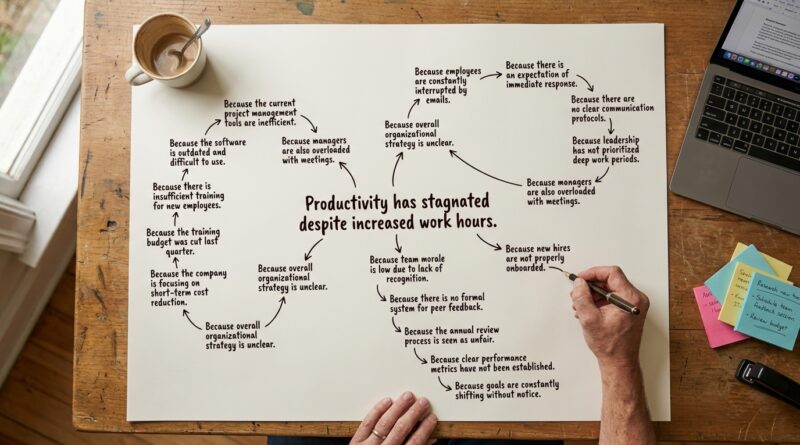
Why Your 5 Whys Keep Stopping Too Soon: The Simple ‘Chain Why’ That Maps Every Hidden Cause Instead of Just One
You know the feeling. The same problem keeps coming back, you run a neat little 5 Whys exercise, everybody agrees on a tidy root cause, and then nothing really changes. It is frustrating because you are not imagining the mess. Real problems usually do not come from one bad decision, one lazy person, or one broken process. They come from a chain of causes. A habit leads to a shortcut. A shortcut meets a time crunch. A time crunch meets unclear ownership. Then the same issue shows up again next week wearing a different hat. That is where classic 5 whys root cause analysis for complex problems often starts to wobble. It pushes you toward one clean answer when the truth is more like stacked dominoes. A simple fix is to stop asking only “why did this happen?” and start asking “what happened just before that, and what made that possible?” That is the heart of Chain Why.
⚡ In a Hurry? Key Takeaways
- Classic 5 Whys often fails on complex problems because it forces a single root cause when several causes are stacked together.
- Use Chain Why by mapping each cause as a link in sequence, then note the conditions that made each link likely.
- This keeps you honest without needing fancy software, and it works for work problems, personal habits, service failures, and team mistakes.
Why the usual 5 Whys keeps letting you down
The original idea behind 5 Whys is good. Keep asking why until you get past the obvious answer.
The trouble starts when the problem is not simple. In a factory line, maybe one broken part really did trigger the failure. But in offices, hospitals, schools, software teams, families, and even your own daily habits, problems are rarely that clean.
You miss a deadline. Why? You started late. Why? You were waiting on approval. Why? The manager was overloaded. Why? Too many projects. Why? Poor planning.
That sounds complete. It also hides a lot.
Maybe you also started late because the brief was vague. Maybe the manager was overloaded because one role stayed unfilled for months. Maybe poor planning came from sales promising impossible timelines. Maybe nobody pushed back because the culture punishes bad news.
See the issue? The standard method tends to make you pick one villain and move on.
What Chain Why does differently
Chain Why keeps the simplicity of 5 Whys but drops the fantasy that there is always one final answer.
Instead of forcing one straight line to one magic root cause, you map the chain of events and the conditions around each step.
Think of it like this:
Classic 5 Whys asks
What caused this?
Chain Why asks
What happened right before this, what made that likely, and what was sitting behind that?
That small change matters. It helps you see that causes stack. Some are immediate. Some are background conditions. Some are habits. Some are incentives. Some are emotional. Some are structural.
You are not replacing one answer. You are drawing a trail.
A simple example
Let us say a customer got sent the wrong invoice.
With standard 5 Whys, you might end up here:
Wrong invoice was sent. Why? Staff selected the wrong template. Why? They were rushing. Why? End-of-month workload was high. Why? Too many accounts assigned to one person. Why? Staffing shortage.
That is not wrong. It is just incomplete.
With Chain Why, you might map it like this:
Wrong invoice sent.
Just before that: Wrong template selected.
Made likely by: Similar template names in the system.
Also made likely by: Staff member was rushing.
Made likely by: End-of-month spike.
Made likely by: No review step for high-value invoices.
Made likely by: Team was short-staffed.
Made likely by: Hiring freeze.
Made likely by: Leadership trying to hit cost targets.
Now you have something useful. Not one cause. A chain of causes, with multiple points where the problem could have been stopped.
Why this works better for complex systems
Complex systems are full of interacting parts. People adapt. Priorities clash. Rules get bent. Technology behaves in weird ways. The same event can have several parents.
That is why 5 whys root cause analysis for complex problems often produces answers that feel suspiciously tidy.
Chain Why is more psychologically honest. It reflects how people actually experience failure. You were tired. The process was confusing. The deadline was silly. The software design invited mistakes. Nobody wanted to escalate. All of those can be true at once.
It also lowers blame. Instead of landing on “Jane failed to follow the process,” you can see the whole run-up that made Jane’s mistake more likely.
That is a much better place to start if you actually want fewer repeats.
How to do a Chain Why in 10 minutes
1. Start with the event, not the theory
Write one clear sentence about what happened.
Good: “The patch was deployed to production without approval.”
Bad: “Communication failed.”
2. Ask what happened immediately before it
Focus on sequence first. What was the step right before the visible failure?
This keeps you from jumping too quickly into opinions.
3. For each step, ask what made that step likely
This is the key move. Not just “why did that happen?” but “what conditions made that easier, faster, more tempting, or more probable?”
You will often get more than one answer. Good. Keep them.
4. Separate triggers from conditions
A trigger is the immediate thing. A condition is the background that let the trigger cause damage.
For example:
Trigger: A warning email was ignored.
Condition: The inbox gets flooded with low-value alerts every day.
5. Stop when you reach things you can actually change
You do not need to end with “human nature” or “capitalism” or “life is hard.” Stop when you can point to practical fixes.
That might be naming rules better, reducing workload spikes, creating a pause step, or making escalation safer.
6. Circle the weak links
Look for spots where a small change would break the chain.
That is where your action should start.
What a Chain Why looks like on paper
You do not need software. A notebook page works fine.
Try this simple format:
Event: Report sent with wrong figures
Before that: Analyst copied old spreadsheet tab
Made likely by: Tabs had nearly identical names
Made likely by: Report built from an old template
Made likely by: No shared current template folder
Made likely by: Team created local workarounds after file server issues
Made likely by: IT issue stayed unresolved for months
Notice how this naturally creates a chain. It can also branch when needed. That is fine. Real life branches.
When to branch, and when not to
If every line explodes into ten more lines, the exercise becomes a wall of spaghetti.
So keep one main chain first. Then add only the side causes that clearly increased the odds.
A good rule is this. If removing that side cause would have made the failure much less likely, include it. If it is just interesting background, leave it out for now.
Chain Why is not the same as “blame the system”
This part matters. Seeing broader causes does not mean individuals never matter.
Sometimes a person did skip a step. Sometimes somebody hid information. Sometimes a bad call was simply a bad call.
But even then, Chain Why asks a useful follow-up. What made that action more likely, easier, safer, or more rewarding than it should have been?
That question often gets you from moral outrage to prevention.
Watch for power, not just process
Some recurring problems survive because the people living with them are not the people benefiting from the current setup.
If your analysis keeps ending with vague phrases like “needs better communication” or “staff need more training,” it may help to also read Why Your 5 Whys Keep Ignoring Power: The Simple ‘Leverage Why’ That Reveals Who Actually Benefits From Your Problems.
That is a useful companion to Chain Why, because some chains stay in place for a reason. Not always a sinister one. But often a very human one.
Common mistakes people make with Chain Why
Stopping at the first respectable answer
“Lack of training” sounds serious, so people stop there. But why was training missing? Why did the work still go ahead? Why was the task easy to do incorrectly?
Confusing cause with judgment
“Carelessness” is not a complete cause. It is a label. Ask what carelessness looked like in practice and what made it more likely that day.
Trying to find the one true root
If your method demands one final root cause, you may be solving the worksheet, not the problem.
Making the chain too abstract
“Culture” can matter, but it should connect to something visible. What did the culture actually do? Did it punish escalation, reward speed, or normalize workarounds?
Where this is especially useful
Chain Why works well in places where cause and effect are messy:
- Recurring team mistakes
- Software bugs that keep coming back in new forms
- Customer service breakdowns
- Missed personal goals and habits
- Mental health reflection, where moods, routines, sleep, stress, and environment stack together
- AI failures, where bad outputs often come from data, prompts, incentives, review gaps, and overconfidence all at once
That last one is especially timely. People increasingly want better ways to think about failure without pretending everything is either random or caused by one obvious mistake.
At a Glance: Comparison
| Feature/Aspect | Details | Verdict |
|---|---|---|
| Classic 5 Whys | Fast and simple, but tends to force one tidy root cause even when several causes are stacked together. | Good for simple failures. Weak for messy recurring problems. |
| Chain Why | Maps the sequence of events plus the conditions that made each step likely. Can handle branching without becoming too technical. | Best balance of simplicity and realism for complex problems. |
| Heavyweight analysis methods | Very thorough, but often slow, formal, and hard to use in everyday teams or personal reflection. | Useful for high-risk industries. Overkill for many daily issues. |
Conclusion
If your 5 Whys keeps producing elegant answers and ugly repeat failures, the problem is probably not that you are bad at analysis. It is that the method is too narrow for the kind of mess you are dealing with. Chain Why gives you a plain-English way to map how motives, habits, context, and decisions stack together over time. That helps the community right now because more people are waking up to the limits of traditional root cause analysis in complex systems, from mental health to AI failures, but they are stuck between oversimplified 5 Whys and heavyweight methods like fault trees. Chain Why is the middle path. Simple enough to use today. Honest enough to show what is really going on. And practical enough to help you stop solving the wrong problem.