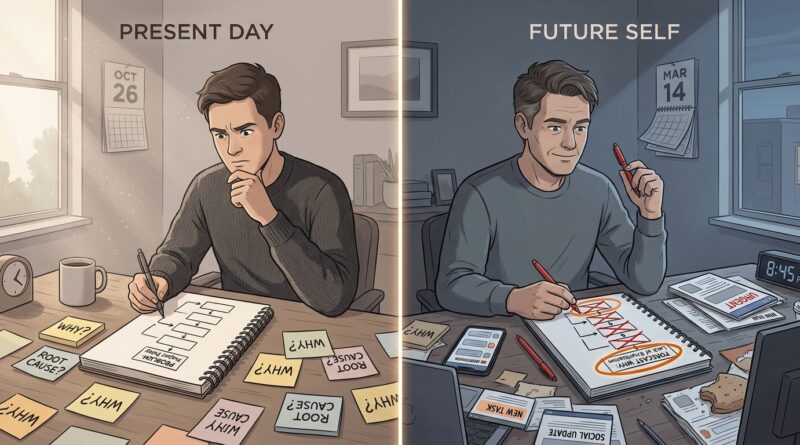
Why Your 5 Whys Keep Missing Your Future Self: The Simple ‘Forecast Why’ That Stops You Solving The Wrong Problem
You do the 5 Whys. You get honest. You even feel a little proud because you finally found the “real reason” behind the problem. Then a few weeks later, there you are again, making the same choice you swore you understood. That is frustrating, and it can make you feel like self-awareness is broken. Usually it is not. The problem is simpler. Classic root cause analysis is very good at explaining the version of you who already messed up. It is much worse at predicting the version of you who will be tired, rushed, annoyed, tempted, or running on autopilot next Tuesday. That is where a simple twist helps. If you want to know how to predict your future self with 5 whys, add one extra question at the end. Ask, “Why might future me ignore this answer?” That is the Forecast Why, and it can stop you from solving a smart-sounding problem that real-life you was never going to stick with.
⚡ In a Hurry? Key Takeaways
- Your 5 Whys often fail because they explain past behavior, but do not test whether future you will follow the fix.
- Add a “Forecast Why” question: “Why might future me still do this anyway?” Then build your solution around that answer.
- This is not about blaming yourself. It is a practical way to make plans that survive stress, low energy, habits, and changing moods.
Why the usual 5 Whys can feel so smart, yet work so poorly
The 5 Whys is a useful tool. It helps you keep asking “why?” until you stop blaming surface-level things and find a deeper cause.
Maybe you overspent.
Why? You were stressed.
Why? Work felt out of control.
Why? You avoided planning.
Why? Planning makes you anxious.
Why? You connect structure with feeling trapped.
That is interesting. It may even be true. But it still leaves out one huge detail. What will happen when future you is on the couch at 10:30 p.m., feeling drained, with a phone in hand and a one-click checkout button glowing like a bad idea?
That moment is where most plans die.
The usual 5 Whys gives you insight. The Forecast Why gives you traction.
What a Forecast Why actually is
A Forecast Why is one more layer added after your normal root cause analysis.
Once you finish your Whys, ask this:
“Why might future me ignore this solution?”
Or even more directly:
“In what mood, setting, or time of day will this plan fall apart?”
This small shift matters because people are not great at predicting their own future behavior. Psychology researchers sometimes call this affective forecasting and hot-cold empathy gaps. In plain English, calm you is bad at predicting emotional you. Motivated you is bad at predicting tired you. Present you keeps making plans for an imaginary adult who always has energy and patience.
That imaginary adult is not the one making choices most days.
How to predict your future self with 5 whys
If you want a simple method, use this five-step version.
Step 1: Do your normal 5 Whys
Start with the recurring problem and ask why until you hit something meaningful.
Example problem: “I keep skipping my evening workout.”
You might land on: “Because by evening I feel mentally spent, and the workout feels like one more demand.”
Step 2: Add the Forecast Why
Now ask:
“Why will future me still skip it, even knowing this?”
Possible answer: “Because after work I do not want effort. I want relief.”
That answer is gold. It tells you your real competition is not laziness. It is the need for relief.
Step 3: Name the future conditions
Get specific. What version of you are you planning for?
- Tired you
- Hungry you
- Lonely you
- Bored you
- Rushed you
- Stressed you
If your plan only works for calm, high-energy you, it is not really a plan. It is a wish.
Step 4: Test the fix against real life
Ask one brutal question:
“Would I still do this on a bad Tuesday?”
If the answer is no, the fix is too fragile.
Maybe “work out for an hour after work” sounds good in theory. But “change into walking clothes before leaving the office and do 10 minutes outside before going home” may survive the bad Tuesday test.
Step 5: Build for the likely failure, not the ideal outcome
This is the part most people skip. Do not just solve the root cause. Solve the predictable collapse point.
If future you seeks relief, build relief into the plan.
For example:
- Shorter workout
- Workout before work
- A relaxing playlist tied to exercise
- Permission to do “minimum version” days
A simple before-and-after example
Classic 5 Whys
Problem: “I keep doomscrolling before bed.”
- Why? I want to switch off.
- Why? My day feels intense.
- Why? I do not leave enough recovery time.
- Why? I fill every gap with work or chores.
- Why? I feel guilty resting.
That is useful. But watch what happens next.
Add the Forecast Why
“Why might future me still doomscroll even after learning this?”
Answer: “Because at night I am too depleted to create a better kind of rest. My phone is the easiest option within reach.”
Now the solution changes.
Instead of “I need to work on my guilt around rest,” which may be true but slow, you can also make a practical fix for the version of you who shows up at bedtime:
- Charge the phone outside the bedroom
- Put a low-effort alternative next to the bed, like a magazine or Kindle
- Set a 15-minute “collapse routine” that requires almost no thinking
You are not replacing insight. You are making insight usable.
The hidden reason people keep “knowing better” without doing better
A lot of self-help advice quietly assumes behavior comes from clear thinking. Real life is messier.
Behavior often comes from context first.
What is near you.
What is easy.
What matches your mood.
What gives fast relief.
That is why root cause work and habit work need each other. If this idea sounds familiar, it pairs well with Why Your 5 Whys Keep Ignoring Habits: The Simple ‘Autopilot Why’ That Exposes the Real Loop Running Your Life. Sometimes the issue is not that your Why is wrong. It is that your habit loop is stronger than your insight.
Three questions that make the Forecast Why sharper
If you want better answers, ask these after your normal Whys.
1. What will future me be feeling right before the problem happens?
Not what you hope to feel. What you actually feel.
This helps you stop building plans for your best self only.
2. What easier option will be available in that moment?
The easier option is usually the real rival.
Ordering takeout beats cooking because it is easier. Scrolling beats journaling because it is easier. Staying on the sofa beats the gym because it is easier.
3. What would make the better choice feel smaller, faster, or more comforting?
This is where good solutions live.
You are not trying to become a robot. You are trying to make the right move more doable for a human.
Common mistakes when using Forecast Why
Turning it into self-criticism
This is not “future me is weak.”
It is “future me will be operating under different conditions.”
Making the solution too big
If your fix requires motivation, focus, time, and perfect timing, it will probably fail when you need it most.
Ignoring emotion
Many recurring problems are not information problems. They are regulation problems. You are trying to change what you do when you need comfort, escape, control, or relief.
Confusing understanding with protection
Understanding why you do something does not automatically protect you from doing it again.
Seatbelts matter more than lectures when the crash comes.
When this works best
The Forecast Why is especially useful for repeat problems like:
- Overspending
- Skipping workouts
- Bedtime procrastination
- Stress eating
- Putting off hard conversations
- Checking your phone too much
- Breaking routines every weekend
These are exactly the kind of issues where people say, “I know what I should do. I just do not do it.”
That sentence is your clue. The gap is usually not knowledge. It is failed prediction.
A tiny template you can use today
Try writing this out:
Problem: I keep __________.
My 5 Whys answer: The deeper reason is __________.
Forecast Why: Future me will still do this when __________.
Because in that moment I will want: __________.
So the plan must make the better choice more: easy / comforting / quick / visible.
My smallest workable fix: __________.
Notice the goal. Not a perfect fix. A workable one.
At a Glance: Comparison
| Feature/Aspect | Details | Verdict |
|---|---|---|
| Classic 5 Whys | Great for finding a likely past cause or deeper motive behind a recurring problem. | Useful, but incomplete on its own. |
| Forecast Why | Tests whether future you, in a different mood or setting, will actually follow the plan. | Best add-on for making insight survive real life. |
| Best practical fix | A solution built for tired, stressed, busy, or emotional you, not ideal you. | More likely to stick long term. |
Conclusion
If your root cause work keeps sounding smart but changing nothing, do not give up on the tool. Upgrade it. Across psychology and behavior research there is growing attention on why people mispredict their own choices and keep “knowing better” without doing better. That is the leak in classic 5 Whys. It studies the past version of you, not the one who has to live with the fix. A Forecast Why closes that gap. It gives you a practical way to test your insight against your real future behavior, with all the mood shifts, energy dips, habits, and messy context that come with being human. And that is the real win. You do not need perfect self-control. You need solutions that can survive contact with actual life.