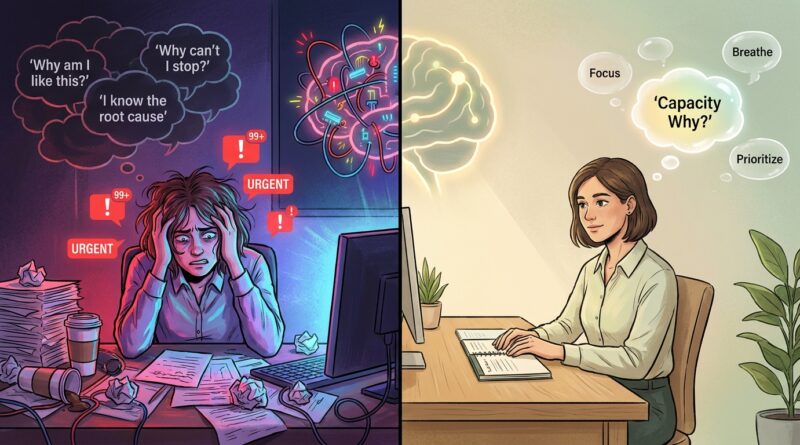
Why Your 5 Whys Collapse Under Real-Life Stress: The Simple ‘Capacity Why’ That Explains Why You Know The Root Cause And Still Don’t Change
You are not broken if you can explain your patterns perfectly and still repeat them by 9 p.m. when you are tired, stressed, and one minor inconvenience away from losing your patience. That gap is maddening. You know the root cause. You have done the journaling. You have asked why again and again. Then real life shows up, your nervous system gets overloaded, and all that insight seems to vanish. This is why root cause analysis does not change behavior as often as people hope. Knowing why matters, but it does not magically give you the energy, regulation, or mental space to act differently in the moment. What is often missing is one extra question, simple but honest. Do I actually have the capacity to change this right now? That is the Capacity Why. It does not excuse the behavior. It explains the behavior, which is the first step toward changing it without turning self-awareness into self-attack.
⚡ In a Hurry? Key Takeaways
- Your behavior may not change after root cause analysis because insight and capacity are not the same thing.
- Before trying to “do better,” ask, “Do I have the capacity to change this right now?” Then shrink the ask until the answer is yes.
- This question reduces self-blame and helps you use self-reflection safely when you are stressed, tired, or emotionally flooded.
Why knowing the root cause is often not enough
The usual advice sounds neat on paper. Identify the problem. Ask why five times. Find the root cause. Fix the system.
That works well for machines, workflows, and supply chains. Humans are a little messier.
You can know that you scroll because you are lonely. You can know that you snap because criticism makes you feel small. You can know that you overeat because food gives you relief when your day feels impossible. All true. All useful.
But at 11 a.m. after three meetings, a bad night of sleep, and one stressful text from family, your brain is not a calm boardroom of wise decision-makers. It is trying to survive the moment.
That is the missing piece in a lot of self-help around behavior change. It assumes you are always able to use the insight you worked so hard to find.
The Capacity Why
The Capacity Why is the question underneath the question.
Not just “Why do I do this?”
Also, “Why do I keep doing this even when I understand it?”
Often the answer is simple. Because when the moment comes, you do not have enough capacity to choose the better response.
Capacity is your available mental, emotional, physical, and nervous-system bandwidth. It is what lets you pause before reacting. It is what helps you remember your plan, resist the quick fix, and tolerate discomfort long enough to do something different.
When capacity drops, old habits win. Not because they are good. Because they are fast, familiar, and cheap for the brain.
What low capacity actually looks like
Low capacity does not always look dramatic. Sometimes it looks ordinary.
- Snapping because you cannot process one more demand
- Scrolling because your brain cannot handle one more decision
- Ordering takeout because cooking feels like climbing a mountain
- Picking a fight because your system is too flooded to name what hurts
- Ghosting a task because starting it feels physically heavy
In those moments, the issue is not always a lack of insight. It is often a lack of usable energy.
Why root cause analysis does not change behavior under stress
If you have ever thought, “I know exactly why I do this, so why am I still doing it?” here is the short answer.
Because insight lives in one part of you, and behavior under stress is often run by another.
When your nervous system is overloaded, your access to reflection, planning, patience, and self-control gets weaker. Your brain starts favoring what is immediate and practiced. That is why your best intentions disappear first when life gets hard.
This is also why people can sound incredibly wise in their journal and completely unlike themselves in traffic, during conflict, or at the end of a long day.
The problem is not hypocrisy. It is state.
The Three Whys, with capacity included
If you want a version of self-inquiry that works better in real life, try The Three Whys instead of interrogating yourself forever.
Why #1: Why does this pattern happen?
This is the classic root cause question. Maybe you procrastinate because you fear doing it badly. Maybe you shut down because conflict used to feel unsafe.
Why #2: Why does part of me still want this pattern?
Every stubborn habit usually offers some kind of payoff, even if it creates bigger problems later. Scrolling may numb you. Overworking may protect your identity. Avoiding the talk may spare you short-term discomfort.
If that piece sounds familiar, it connects closely with Why Your 5 Whys Keep Ignoring Hidden Payoffs: The Simple ‘Reward Why’ That Explains Why You Secretly Keep The Problem Alive. Sometimes you are not just fighting a bad habit. You are also fighting the relief or reward it gives you.
Why #3: Why can’t I do the better thing consistently right now?
This is the Capacity Why.
Maybe the better choice is clear, but your sleep is wrecked. Your workload is absurd. You are carrying grief. Your body is tense all day. You have no margin. The change you are asking for may be reasonable in theory and unrealistic in your current state.
That matters.
Capacity is not an excuse. It is a design rule.
Some people hear this and worry it sounds like letting yourself off the hook.
It is not.
Saying “I had no capacity” is not the same as saying “So none of this matters.” It means you stop making plans for a version of yourself that only exists on your best, most rested, least stressed day.
Instead, you build for the version of you who is tired, overloaded, and still trying.
That is the version who needs support systems, smaller steps, friction reduction, and more recovery.
How to ask the Capacity Why in real life
Try this the next time you catch yourself saying, “I know better.”
- Pause and name the behavior without drama.
- Ask, “What is my current capacity level?”
- Ask, “What choice is actually possible from this state?”
- Shrink the change until it fits your real bandwidth.
That last part is where things start to change.
Example: Scrolling at night
Root cause insight: “I scroll because I am avoiding the quiet after a stressful day.”
Capacity Why: “At 10:30 p.m., I am too drained to do a big perfect reset routine.”
Smaller change: Put the charger across the room and replace 45 minutes of scrolling with 5 minutes of low-effort decompression, like a shower, music, or lying down without your phone.
Example: Snapping at your partner
Root cause insight: “I react strongly because I feel criticized.”
Capacity Why: “I have zero emotional buffer after work, so even a normal question feels like pressure.”
Smaller change: Agree on a 20-minute transition window before discussing logistics.
Example: Emotional eating
Root cause insight: “Food helps me soothe stress fast.”
Capacity Why: “By evening, I am too depleted to cook or regulate well.”
Smaller change: Build easier defaults. Prepped food. Fewer decisions. A snack before the danger zone. Not because you are lazy, but because your evening brain needs less friction.
What to do when your capacity is low
You do not need a grand reinvention. You need a lower bar that still moves you forward.
Reduce the number of steps
If the healthy option takes seven steps and the old habit takes one, low-capacity you will pick the one-step option almost every time.
Make the first move tiny
Not “work out for an hour.” Try “put on shoes.” Not “have the full hard conversation.” Try “send one honest sentence.”
Protect the basics first
Sleep, food, water, quiet, transitions, and breaks sound boring until you notice how many “self-control problems” are really depletion problems.
Delay the self-judgment
Do not do a courtroom trial in the middle of a stress response. Review later, when your brain is back online.
A better question than “What is wrong with me?”
When behavior does not line up with insight, people often get harsh fast.
Why am I like this? Why can’t I just do the obvious thing? Why do I keep failing at something so simple?
Try a more useful question.
What state was I in when this happened?
That question tends to reveal more than shame ever does.
At a Glance: Comparison
| Feature/Aspect | Details | Verdict |
|---|---|---|
| Root cause insight | Helps you understand where the behavior comes from and what it means. | Useful, but not enough by itself. |
| Reward or payoff | Explains what the habit gives you in the short term, like relief, comfort, or avoidance. | Important for understanding why the pattern sticks. |
| Capacity Why | Checks whether your nervous system, energy, and real-life bandwidth can support the change right now. | Often the missing link between insight and action. |
Conclusion
Most advice about behavior change quietly assumes you are a calm, rational operator with full battery life and easy access to self-control. Real life is usually not like that. Sometimes the reason you are not changing is not that you missed the root cause. It is that your system is flooded, tired, or running on fumes. That is why asking, “Do I actually have the capacity to change this right now?” can be so helpful. It protects you from needless self-blame, explains why insight does not automatically become action, and turns The Three Whys into something kinder and more realistic. You still take responsibility. You just stop confusing exhaustion with failure. And from there, you can start making changes your real, human brain can actually carry.