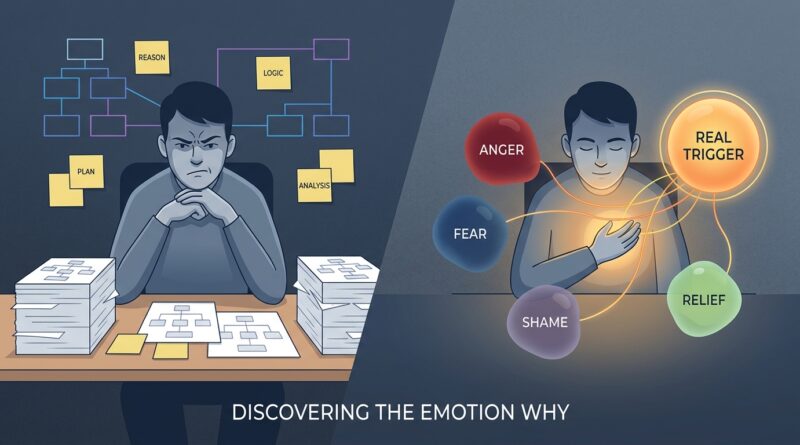
Why Your 5 Whys Keep Missing Your Feelings: The Simple ‘Emotion Why’ That Finds the Real Trigger, Not Just the Story
You sit down, do the “grown-up” thing, and run the 5 Whys on a blow-up, spiral, or bad habit. You get an answer that sounds smart. Maybe even true. “I overreacted because I felt criticized.” “I doomscrolled because I was avoiding work.” Great. So why does the same emotional mess show up again tomorrow? That is the frustrating part. You are not clueless. You are not lazy. You are often just solving for the story, while your nervous system is still reacting to the feeling underneath it. That gap matters.
A simple fix is to add one more question, not to the event, but to the emotion. Call it the Emotion Why. Instead of only asking why the problem happened, ask why that feeling hit so fast, so hard, or so familiarly. That small shift can reveal the real trigger, the emotional domino that starts the whole chain. And once you can see that domino, you have a much better shot at changing what happens next.
⚡ In a Hurry? Key Takeaways
- The usual 5 Whys often finds the logical explanation, but misses the emotional trigger that actually drives the repeat pattern.
- Try an Emotion Why by asking, “Why did that feeling land so sharply for me?” and keep following the feeling, not just the facts.
- This is a self-awareness tool, not a substitute for therapy or crisis support. If emotions feel overwhelming or unsafe, get real help.
Why the normal 5 Whys can miss the point
The classic 5 Whys is useful. It helps you trace cause and effect. That is great for a broken process at work. It is less great when the problem is, “Why did I snap at my partner because they asked a simple question?”
Most people use 5 Whys like this:
I snapped.
Why? Because I felt judged.
Why? Because they questioned me.
Why? Because I was already stressed.
Why? Because I had too much on my plate.
Why? Because I said yes to too much.
None of that is wrong. It is just incomplete.
You found a life pattern. You may not have found the live wire.
The live wire is often emotional. It sounds more like this: “Being questioned made me feel small.” Or, “The second I sensed disappointment, my body went into defense.” Or, “I was not avoiding the task. I was avoiding the shame I expected to feel while doing it.”
What an Emotion Why actually is
The Emotion Why is one focused question:
Why did this feeling get triggered so fast or so strongly here?
Not, “Why was I upset?” in a vague way. And not, “What is wrong with me?” Definitely not that.
You are looking for the meaning your system attached to the moment.
That meaning is often hidden under ordinary words like annoyed, stressed, or frustrated. Those words are real, but they can be too broad. The sharper truth is usually underneath them.
Common examples of the hidden feeling
What looks like anger may actually be humiliation.
What looks like procrastination may actually be dread.
What looks like neediness may actually be fear of being dropped.
What looks like laziness may actually be hopelessness.
Once you find that, your pattern starts making a lot more sense.
The difference between the story and the trigger
The story is the explanation your mind gives after the fact.
The trigger is the emotional cue your body reacted to before your explanation showed up.
Think of it like your phone buzzing before you read the message. The buzz is the trigger. The message is the story you build around it.
If you only work with the story, you may stay intellectually accurate but emotionally stuck.
That is why people say things like, “I know where this comes from, but I still do it.” They are not lying. They just have insight without access.
And if stress wipes out your ability to act on what you know, it is worth reading Why Your 5 Whys Collapse Under Real-Life Stress: The Simple ‘Capacity Why’ That Explains Why You Know The Root Cause And Still Don’t Change. It pairs well with this idea because emotions and capacity often crash into each other.
How to do a 5 whys emotional root cause check
You do not need a journal, color-coded chart, or a wellness retreat. You need about five honest minutes.
Step 1: Name the moment
Pick one recent spike. Not your entire personality. Just one thing.
Examples:
“I got weirdly upset when they took too long to text back.”
“I ate half a bag of chips after that meeting.”
“I shut down when my boss gave minor feedback.”
Step 2: Name the first obvious emotion
Keep it simple.
Mad. Anxious. Embarrassed. Numb. Restless.
Step 3: Ask the Emotion Why
Ask:
Why did that feeling hit me so hard in that moment?
Then answer in plain language.
Example: “Because it felt like they did not care.”
Step 4: Ask it again, but stay with the feeling
Now ask:
Why does that land so hard for me?
Example: “Because when I feel ignored, I instantly assume I do not matter.”
Step 5: Find the emotional domino
Keep going until you hit something that feels a little quieter and a little more honest.
Example chain:
They did not text back.
I felt anxious.
Why did anxiety spike? Because it felt like distance.
Why does distance hit so hard? Because I link distance with being unwanted.
Why do I link that so fast? Because my body learned to treat uncertainty like rejection.
Now you are getting somewhere.
What the answer usually sounds like
The real trigger is often not dramatic. It is usually painfully simple.
“I felt dismissed.”
“I felt trapped.”
“I felt stupid.”
“I felt replaceable.”
“I felt like I was about to fail in public.”
This is why the 5 whys emotional root cause approach helps. It moves you from broad analysis to the emotional meaning that actually kicks your pattern into motion.
A real-life example
The conflict
Your partner says, “Did you remember to pay that bill?”
You get instantly sharp and defensive.
The normal 5 Whys
Why did I snap? Because I do not like being reminded.
Why? Because it feels annoying.
Why? Because I have a lot to manage.
Why? Because I am carrying too much.
Why? Because we have poor division of labor.
That may be partly true. But it still may not explain the intensity.
The Emotion Why version
Why did that question sting so much?
Because it felt like they thought I was irresponsible.
Why does that hit hard?
Because I already worry I am dropping balls.
Why is that such a loaded fear?
Because making mistakes quickly turns into “I am failing” in my head.
Now the trigger is clearer. The comment did not just annoy you. It activated a fear of inadequacy.
That gives you better options. You can slow down, say what actually happened, and respond to the wound instead of only the words.
What to do once you find the emotional domino
Insight is step one. Response is step two.
1. Shrink the moment
Say to yourself, “This is the feeling. Not the whole truth.”
That creates a tiny bit of space.
2. Name the meaning
Try, “This made me feel dismissed,” or “I went straight to shame.”
Specific language calms confusion.
3. Check whether the trigger fits the current facts
Not every feeling is wrong. But not every feeling is current either.
Ask, “What happened here, and what did my system add to it?”
4. Pick the smallest useful next move
Take a walk. Send the text. Eat a real meal. Ask a clarifying question. Delay the big conversation by ten minutes.
You do not need a perfect breakthrough. You need one less automatic reaction.
What this is not
This is not an excuse to overanalyze every mood until midnight.
It is not a trick to prove your feelings are always right.
And it is not a replacement for therapy if your emotional reactions are tied to trauma, panic, depression, or anything that feels too big to hold alone.
Think of it as a flashlight. Helpful. Practical. Limited.
When the Emotion Why works best
It works well for:
Repeated conflicts.
Sudden shutdowns.
Stress eating or scrolling.
Defensiveness that feels bigger than the moment.
Spirals that start from tiny cues.
It is especially useful when you keep saying, “I know better, so why do I still do this?”
A simple script you can try tonight
Here is the quick version:
What happened?
What did I feel first?
Why did that feeling spike so fast?
What did that moment seem to mean about me, them, or the situation?
What is the emotional domino under the whole chain?
What one small thing would help right now?
That is it.
It is not fancy. But it is usable, which matters a lot more.
At a Glance: Comparison
| Feature/Aspect | Details | Verdict |
|---|---|---|
| Standard 5 Whys | Good at finding logical chains, behavior patterns, and practical causes. | Useful, but often too head-only for emotional loops. |
| Emotion Why | Focuses on why a feeling fired so fast and what meaning your system attached to the moment. | Best for finding the emotional trigger behind repeated reactions. |
| Best real-world use | Use both together. First find the pattern, then find the feeling underneath it. | Most effective and easiest to act on. |
Conclusion
People are swimming in advice about habits, systems, and motivation. That stuff helps, up to a point. But it often falls apart in the exact moment you need it most, when a fast emotional spike hijacks the room. That is where an Emotion Why earns its keep. It gives you a concrete way to link root cause analysis to what you actually feel in real time. Try it tonight on one conflict, one urge, or one spiral. You may not solve your whole history in five minutes. But you can stop arguing with your own feelings long enough to spot the emotional domino that starts the chain. And once you can see that domino, you are no longer just telling yourself a smarter story. You are finally working with the real trigger.