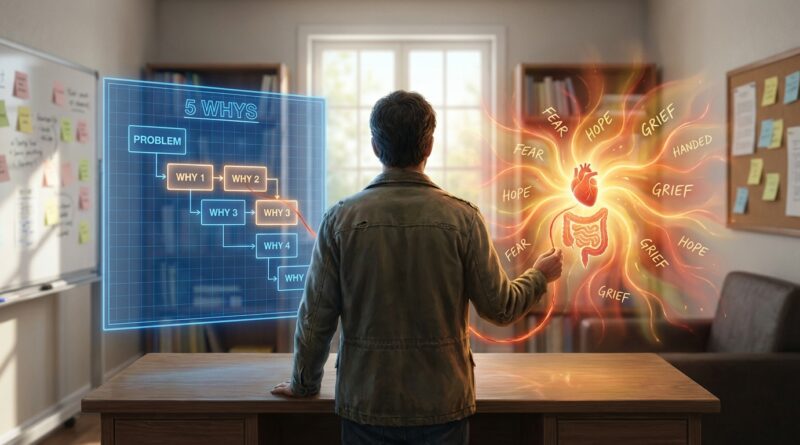
Why Your 5 Whys Keep Ignoring Emotion: The Simple ‘Feeling Why’ That Stops Logical Root Causes From Quietly Failing
You fix the calendar. You rewrite the checklist. You set the reminder. Then, somehow, you still miss the deadline, snap at the same person, or slide back into the same habit. That is the part that makes people feel broken. On paper, the root cause looks solved. In real life, nothing really changes. If that sounds familiar, your 5 Whys may be missing one very human piece: emotion. A clean process map can tell you what happened. It often does a poor job explaining what your nervous system was trying to avoid, protect, or control in that moment. That is where emotional root cause analysis 5 whys becomes useful. It adds one simple question to the chain: “What was I feeling right there?” Not as therapy-speak. Not as blame. Just as missing data. Once you include that “feeling why,” the pattern often stops looking irrational and starts making uncomfortable sense.
⚡ In a Hurry? Key Takeaways
- Your 5 Whys can fail when it explains the logic of a problem but skips the feeling that keeps driving the behavior.
- Add a simple “feeling why” after each why: “What was I feeling at that moment, and what was that feeling pushing me to do?”
- This is not about blaming emotion. It is about making better fixes that actually hold up under stress, burnout, and anxiety.
Why the usual 5 Whys sometimes falls flat
The classic 5 Whys is great at tracking process failure. A report was late. Why? The task started late. Why? The input never arrived. Why? The handoff was unclear. That is useful.
But people are not machines. We do not make choices in a calm lab with perfect sleep and zero fear. We make them while tired, embarrassed, rushed, defensive, overloaded, or afraid of disappointing someone.
That means a logical root cause can be true and still incomplete.
You may discover that you procrastinated because the task was unclear. Fair enough. But if the real moment of failure happened because “unclear” made you anxious, and anxiety pushed you to avoid the task, then your fix cannot stop at “clarify the task.” You also need a plan for what happens when that feeling shows up again.
What the “feeling why” is
The feeling why is a small add-on to root cause analysis. After each why, ask one more question:
The extra question
What was I feeling at that point?
Then ask:
What did that feeling make me want to do?
That second part matters. Feelings are not just moods floating in the background. They usually push behavior. Anxiety pushes avoidance. Shame pushes hiding. Frustration pushes shortcuts. Loneliness pushes comfort-seeking. Resentment pushes resistance.
Once you see that link, the pattern stops being “I know better, so why did I do that again?” and becomes “I had a system fix, but no plan for the emotional trigger that kept hijacking it.”
A quick example of emotional root cause analysis 5 whys
Let’s use a common one: repeatedly missing an important workout, writing session, or study block.
Problem: I keep skipping the session.
Why 1: Because I start scrolling instead.
Feeling why: I felt mentally drained and wanted relief.
Why 2: Because the session felt too big.
Feeling why: I felt overwhelmed and wanted escape.
Why 3: Because I had not broken it into a small first step.
Feeling why: I felt intimidated and did not want to feel bad at it.
Why 4: Because I was already behind from earlier in the week.
Feeling why: I felt shame, and shame made me avoid the thing that might confirm I was failing.
Why 5: Because my plan only covered time and logistics, not the emotional dip I hit when I felt behind.
Now the fix is different. You still might break the task into a smaller step. But you also add a “bad day version” of the task, remove easy escape routes, and build a script for the shame moment, like: “Doing ten minutes while behind still counts.”
That is a real-world fix. It respects both the system and the human running it.
Why emotion is not the enemy here
Some people hear this and think it sounds soft. It is not. It is practical.
If you ignore emotion, you are ignoring one of the biggest forces behind human decision-making. That is like troubleshooting a laptop and pretending the battery does not matter because you prefer talking about software.
Emotion is often the bridge between knowing and doing.
You can know the right choice and still not make it if the feeling in that moment is stronger than your plan. That does not mean you are weak. It means your plan was not built for live conditions.
How to add a feeling why without overcomplicating things
You do not need a giant worksheet. Start simple.
Step 1: Write the visible problem
Use plain language. “I keep postponing tough conversations.” “I keep buying things when I am stressed.” “Our team keeps rushing the last stage and making errors.”
Step 2: Run the usual why chain
Ask why the problem happened, then why that happened, and keep going.
Step 3: After each why, add the feeling check
Ask:
- What was I feeling there?
- What did that feeling push me toward?
- What was I trying to avoid, protect, or prove?
Step 4: Design fixes for both the process and the feeling
If the process issue is “unclear task,” fix clarity. If the feeling issue is “anxiety makes me freeze,” add a first tiny step, an accountability check, or a calmer handoff method.
Step 5: Test under stress, not just in theory
A fix that only works when you feel fresh is not much of a fix. Ask, “Will this still work when I am tired, embarrassed, angry, or overloaded?”
The feelings that most often get skipped
People often think they need a deep emotional vocabulary. You do not. Start with the usual suspects.
- Anxiety: pushes delay, overchecking, and avoidance
- Shame: pushes hiding, quitting, and self-sabotage
- Overwhelm: pushes shutdown and mindless distraction
- Resentment: pushes passive resistance and half-hearted effort
- Fear of failure: pushes perfectionism or not starting at all
- Fear of conflict: pushes vague communication and people-pleasing
You do not need the perfect label. You just need a useful one.
Where people go wrong with the feeling why
They use it to judge themselves
The point is not “Wow, I am a mess.” The point is “Now I can see what keeps happening.” Good analysis should reduce shame, not add to it.
They stop at insight
Insight feels good. Change needs design. If your emotional trigger is “I avoid tasks that make me feel incompetent,” then your fix must reduce that friction in the moment. For example, define the first two minutes of the task before you leave it for tomorrow.
They assume one root cause explains everything
Sometimes the pattern has layers. Process. Feeling. Belief. Environment. That is normal.
If you notice the emotional layer is tied to a deeper personal rule, this companion piece may help: Why Your 5 Whys Keep Ignoring Belief: The Simple ‘Core Story Why’ That Reveals The Hidden Rule Running Your Life. Sometimes the feeling is the doorway, and the belief underneath is what keeps rebuilding the same pattern.
What this looks like at work
This is not just for personal habits. Teams do this too.
Say a team keeps shipping rushed work.
The normal 5 Whys may show poor estimation, unclear approval, and late stakeholder feedback. Great. Fix those.
Now add the feeling why.
Maybe the team also feels afraid to push back on unrealistic deadlines. Maybe a manager gets tense when bad news appears early, so people hide delays until the last minute. Maybe everyone is so burned out that the shortest path wins, even when it is the sloppy one.
If that emotional layer stays untouched, the same clean-looking process will quietly fail again.
This is why some retrospectives sound smart but change nothing. They catch the workflow. They miss the emotional weather people are working inside.
A simple template you can use today
Try this on paper or in a notes app:
- Problem: What keeps happening?
- Why? What directly led to it?
- Feeling why: What was I feeling there?
- Behavior pull: What did that feeling make me want to do?
- Next why: Why was that situation there in the first place?
- Repeat: Keep going until you hit something you can actually change.
- Dual fix: One fix for the system, one fix for the feeling trigger.
That last line is the magic. One fix for structure. One fix for emotion.
Examples of fixes that actually stick
If anxiety causes delay
Use a tiny first action. Open the document. Write one ugly sentence. Send the draft with “rough version” in the subject line.
If shame causes avoidance
Lower the all-or-nothing standard. Build a recovery step instead of a punishment step. Missed one day? Resume with the smallest version the next day.
If overwhelm causes shutdown
Reduce choices. Pre-decide the next action before you stop. Put the first tool, file, or screen in place.
If resentment causes resistance
Find the unstated no. Are you overcommitted? Do you feel cornered? The fix may be a boundary, not a better checklist.
At a Glance: Comparison
| Feature/Aspect | Details | Verdict |
|---|---|---|
| Standard 5 Whys | Good at finding process gaps, sequencing problems, unclear ownership, and system breakdowns. | Useful, but often incomplete for repeated human behavior. |
| 5 Whys plus Feeling Why | Adds the emotional state and the behavior it triggered, such as avoidance, freezing, or overcompensating. | Best for habits, burnout patterns, conflict, procrastination, and relapse-prone problems. |
| Fix design | Standard fixes target the workflow. Emotion-aware fixes target the workflow and the stress response. | More likely to hold up in real life, especially on bad days. |
Conclusion
If your root cause work keeps producing smart answers and disappointing results, you are probably not failing at logic. You are missing part of the picture. Most root cause advice focuses on systems, data, and structure. That matters. But plenty of people are also dealing with burnout, anxiety, and repeated self-sabotage that do not respond to neat, clean logic alone. Adding a simple feeling why gives you a way to connect technical root cause thinking with the reality of how humans actually decide, change, and slip back into old patterns. That is the gap. Close it, and your fixes have a much better chance of sticking in real life instead of just looking tidy in a report.