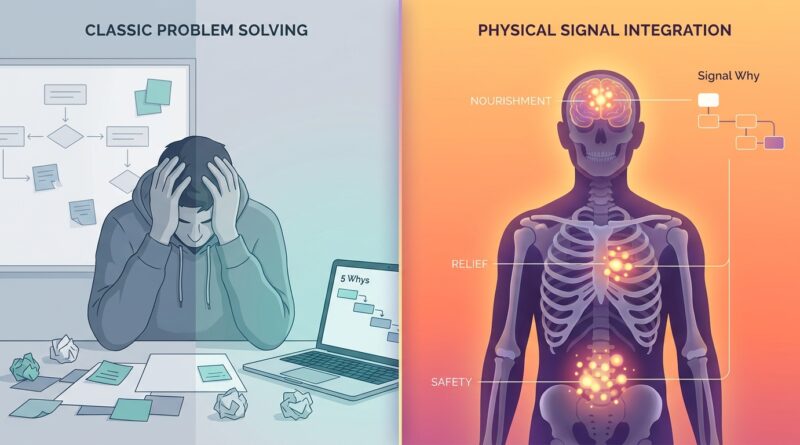
Why Your 5 Whys Keep Ignoring Your Body: The Simple ‘Signal Why’ That Explains Your Weird Cravings, Burnout And “Out‑Of‑Nowhere” Reactions
You are not imagining it. You can do all the smart “why” work in the world, map your habits, rethink your beliefs, fix your calendar, and still end up standing in the kitchen at 10:47 p.m. eating cereal straight from the box, or snapping at someone you actually like, or going completely blank when one more email lands. That is maddening. It also does not mean you are lazy, irrational, or “bad at self-awareness.” It usually means your root cause analysis stopped at the neck. Thoughts matter. Schedules matter. Relationships matter. But your body has its own alarm system, and it votes early. If you ignore that vote, your cravings, burnout, and out-of-nowhere reactions will keep looking random on paper. A simple “Signal Why” helps connect body signals to behavior, so your root cause analysis cravings body signals process finally includes the part of you that has been driving half the decisions all along.
⚡ In a Hurry? Key Takeaways
- Your “weird” cravings and reactions often make sense once you check body signals like sleep, stress, hunger, tension, and overstimulation.
- Before asking “Why did I do that?” ask the Signal Why. What was my body signaling in the 30 minutes before it happened?
- If reactions are intense, frequent, or tied to trauma, eating issues, panic, or health symptoms, this checklist helps, but it is not a replacement for medical or mental health care.
Why your usual 5 Whys can fail
The classic 5 Whys is great for machines, workflows, and certain habits. You ask why something happened, then keep going until you reach a root cause.
But people are not just logic engines with better shoes.
Sometimes the real chain looks like this. Why did I doom-scroll for 90 minutes? Because I had no discipline. Why no discipline? Because I was avoiding tomorrow. Why avoiding tomorrow? Because I am anxious about work.
That is not wrong. It is just incomplete.
The missing line might be this. I slept five hours, skipped lunch, drank too much coffee, and my nervous system was looking for relief fast.
That changes everything. Now the behavior is not only psychological. It is biological, too.
The simple fix: add a “Signal Why”
Think of it like this. The normal “why” asks what story explains my behavior. The Signal Why asks what state my body was in before the behavior showed up.
It is root cause analysis for the human operating system, not just the user interface.
Here is the simple question:
What was my body signaling right before this happened?
That one question can catch a shocking number of patterns that never appear in your notes app or habit tracker.
What counts as a body signal?
You are not looking for anything mystical here. Just practical clues.
- Low sleep or broken sleep
- Hunger, under-eating, or blood sugar swings
- Too much caffeine
- Dehydration
- Muscle tension, jaw clenching, shallow breathing
- Hormonal shifts
- Sensory overload, noise, clutter, too many tabs open
- Emotional hunger, meaning a need for comfort, safety, attention, or rest
- Stress chemistry, the wired-but-tired feeling
- Social depletion, especially after masking or people-pleasing
None of these excuse harmful behavior. But they do explain why your “best intentions” suddenly lose the election.
How the Signal Why works in real life
Cravings that seem to come from nowhere
You tell yourself you want sugar because you are weak around snacks.
Maybe. But maybe your body is running on fumes.
If you had a stressful day, ate too little protein, sat in adrenaline for six hours, and finally stopped moving at night, a craving is not random. It is your body asking for fast energy and fast comfort.
The Signal Why might be: “This is not just a cookie problem. This is a stress plus under-fueling problem.”
Burnout that feels like laziness
You keep asking why you cannot focus on simple tasks. You try productivity tricks. You color-code your calendar. You even simplify your to-do list.
Still nothing.
The Signal Why might be: “My brain is not refusing. It is protecting. I am underslept, overstimulated, and have not had a real recovery window in days.”
That points to a different fix. Not more pressure. More recovery.
Explosive reactions that surprise even you
You snap at your partner over a tiny comment. Later you think, “That made no sense.”
On paper, yes. In the body, maybe not.
If your shoulders were already up by your ears, your breathing was shallow, you were hungry, and your inbox had been poking your threat system all day, that “tiny comment” was not the whole event. It was the last straw.
The Signal Why helps you find the stack, not just the spark.
The 60-second Signal Why checklist
When you feel a craving, shutdown, rage spike, panic scroll, or “why am I like this?” moment, pause and run this quick check:
1. Sleep
How much sleep did I get, and how broken was it?
2. Fuel
When did I last eat real food? Did I under-eat earlier?
3. Stimulation
Am I overloaded by noise, screens, people, decisions, or clutter?
4. Stress posture
What is my body doing right now? Tight jaw? Raised shoulders? Fast heart? Shallow breath?
5. Emotional hunger
Am I actually needing comfort, reassurance, rest, or connection?
6. Fast relief pattern
What quick fix is my body trying to grab? Sugar? Phone? Shopping? Anger? Avoidance?
You do not need a perfect answer. You just need a more honest one.
A better root cause analysis cravings body signals method
If you want a simple formula, use this:
Behavior → Body Signal → Real Need → Small Response
For example:
- Behavior: I inhaled chips and ice cream at 9 p.m.
- Body Signal: I was shaky, tense, tired, and had barely eaten all afternoon.
- Real Need: Stable fuel and nervous system downshift.
- Small Response: Eat something balanced earlier tomorrow. Drink water. Add a 10-minute decompression before dinner.
Or:
- Behavior: I rage-texted after a small disagreement.
- Body Signal: High tension, no lunch, poor sleep, already flooded.
- Real Need: Regulation before conversation.
- Small Response: Delay reply 20 minutes. Walk. Breathe longer on the exhale. Eat first.
This is where people often get unstuck. They stop treating every problem like a character flaw.
What the Signal Why is not
It is not an excuse generator.
It is not “my body made me do it.”
It is not a ban on deeper therapy, reflection, or accountability.
It is just a missing layer. A practical one.
If your current self-help stack is all beliefs, goals, and systems, the Signal Why adds state. And state changes behavior fast.
Why this matters more right now
A lot of advice today lives entirely in the head. Clean frameworks. Smart prompts. Perfect plans. Even AI advice can sound brilliant while missing the fact that you are trying to make life decisions on three hours of sleep and a nervous system lit up like a Christmas tree.
That is why so many people feel broken. The plan makes sense. Their body does not cooperate.
But often your body is cooperating. It is responding to conditions. You just were not measuring the right conditions.
Three small ways to use this today
1. Put “state before story” on a sticky note
Before you interpret a craving or reaction, check your state first. Tired people create harsh stories about themselves.
2. Track the 30 minutes before the behavior
Not just the behavior itself. What happened before it? No food? Too much Slack? Family stress? Loud environment? That is often where the real clue lives.
3. Build one body-based rescue step
Pick one. Drink water. Eat something with protein. Step outside. Turn off one source of noise. Loosen your jaw. Sit down for five minutes without input.
Small moves count because they speak the body’s language.
When to get extra help
If your cravings, shutdowns, panic, anger spikes, or burnout are severe, getting worse, or linked to trauma, chronic pain, hormones, depression, ADHD, disordered eating, or medical issues, please bring in a professional. A doctor, therapist, dietitian, or other qualified clinician can help you sort out what is body state, what is mental health, and what needs treatment.
The Signal Why is a useful tool. It is not the whole toolbox.
At a Glance: Comparison
| Feature/Aspect | Details | Verdict |
|---|---|---|
| Traditional 5 Whys | Good at finding thought patterns, habits, and workflow issues, but can miss sleep debt, stress load, and under-fueling. | Helpful, but incomplete for human behavior. |
| Signal Why | Checks body signals before explaining behavior. Looks at tension, hunger, overstimulation, and fatigue. | Best missing link for cravings, shutdowns, and “random” reactions. |
| Best practical use | Pair both methods. Ask why, then ask what your body was signaling in the lead-up. | Most realistic approach for lasting behavior change. |
Conclusion
If you have been doing all the smart thinking and still feeling ambushed by your own cravings, burnout, or overreactions, the problem may not be that you need one more clever framework. It may be that your framework forgot your body. Right now people are drowning in cognitive systems and polished advice that lives only in the head, while actual decisions are being hijacked by stress chemistry, sleep debt, and emotional hunger that never shows up on a whiteboard. The Signal Why gives you a simple way to plug the body into root cause analysis. That means you can debug overeating, doom-scrolling, sudden shutdowns, or stress blowups in real time, without needing to turn every rough moment into a full personality investigation. Start small. Ask what your body was signaling before the behavior. You may find that what felt weird was actually clear all along. Your body was talking. Now you have a way to listen.