Why Your 5 Whys Keep Ignoring Your Thoughts: The Simple ‘Belief Why’ That Explains Why You Keep Repeating The Same Mistake
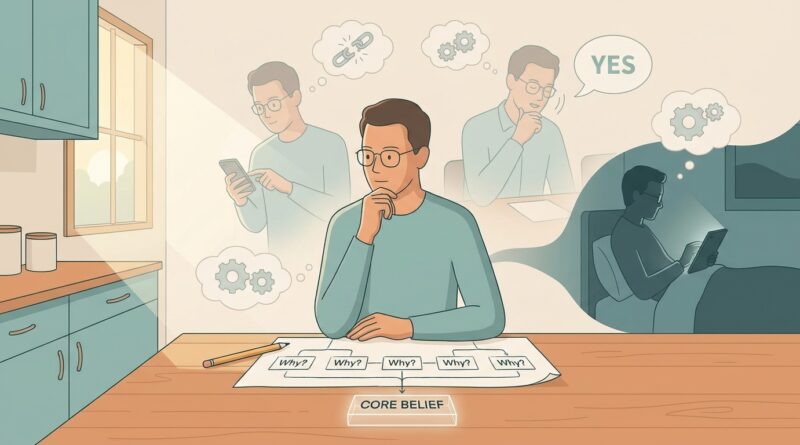
You fix the obvious problem, promise yourself you will not do it again, and then somehow end up right back in the same mess. That is maddening. It can make you feel lazy, weak, or like self-awareness is useless. Usually it is not that you missed a step. It is that your usual 5 Whys stopped too soon. You found the event, maybe even the habit, but not the belief underneath it. That hidden rule might sound like, “If I say no, people will stop liking me,” or “I only matter when I am productive.” Once that belief is in charge, your brain keeps steering you toward the same mistake, even when you know better on paper. If you want better results from 5 whys root cause analysis beliefs, you need one extra question. Not just “Why did I do that?” but “What did I seem to believe would happen if I did not?”
⚡ In a Hurry? Key Takeaways
- Your 5 Whys may miss the real driver when the repeated mistake is powered by a hidden belief, not a simple process failure.
- Add a “belief why” by asking, “What did I believe this action would protect me from, get me, or prove about me?”
- This is a practical self-reflection tool, not a substitute for mental health care. If the pattern is tied to trauma, severe anxiety, or depression, extra support can help.
Why the usual 5 Whys can feel smart but still not change anything
The classic 5 Whys works well for broken machines, missed shipments, and process problems. It can also help with human behavior. But people are not printers.
When the problem is procrastination, overwork, people-pleasing, or the same old argument with your partner, the surface answers are often true but incomplete.
For example:
I missed the deadline.
Why? I started too late.
Why? I avoided the task.
Why? It felt overwhelming.
Why? I did not break it into smaller steps.
Why? I was rushed last week.
None of that is wrong. It is also not enough. You can fix your calendar, make a checklist, and still repeat the pattern next month.
Why? Because there may be a deeper rule running in the background, like, “If I cannot do it perfectly, I should wait,” or, “Starting means risking proof that I am not good enough.”
That is the missing layer. The belief why.
What a “belief why” actually is
A belief why is the hidden rule, assumption, or identity statement that makes your behavior feel necessary in the moment.
It usually sounds like one of these:
- I must not disappoint people.
- If I rest, I am falling behind.
- If I speak up, I will cause conflict.
- Mistakes mean I am careless.
- My value comes from being useful.
These beliefs are powerful because they do not feel like beliefs. They feel like facts.
That is why you can “know better” and still do the same thing again. Your conscious plan says one thing. Your deeper rule says another.
The simple extra question that changes your 5 Whys
When you reach a point in your why chain that sounds like a feeling or a recurring behavior, pause and ask:
Ask these three belief-hunting questions
- What did I believe this action would help me avoid?
- What did I believe this action would help me prove, protect, or earn?
- If I had done the healthier option instead, what felt risky about that?
Those questions often pull out the hidden script faster than asking “why” five more times.
A quick example
Problem: I keep saying yes to extra work, then burn out.
Standard 5 Whys:
- Why am I burned out? Because I took on too much.
- Why did I take on too much? Because I said yes again.
- Why did I say yes? Because my manager asked at the last minute.
- Why did that matter? Because I did not want to let them down.
- Why not? Because I care about being reliable.
Useful. But now add the belief why:
- What did saying no seem to risk? Looking lazy or selfish.
- What did saying yes seem to prove? That I am valuable and dependable.
- What belief sits under that? “I am only valuable when I am useful.”
Now you are getting somewhere.
Why this matters more than most people realize
Once you spot the belief, you can connect patterns that used to seem unrelated.
Maybe your burnout, your trouble resting, your perfectionism, and your habit of answering emails at 11:30 p.m. are not four different problems. Maybe they are one belief wearing four different outfits.
That is a relief, actually.
It means you are not broken in ten random ways. There is often one invisible rule driving a whole cluster of behaviors.
Also, beliefs do not act alone. Your environment matters too. If your progress keeps disappearing the minute life gets chaotic, it is worth reading Why Your 5 Whys Keep Ignoring Your Environment: The Simple ‘Context Field Why’ That Explains Why You Relapse As Soon As Life Gets Busy. A hidden belief and a stressful context often team up.
How to do a belief-based 5 Whys without overthinking it
Step 1: Start with one specific repeat mistake
Pick one behavior you can actually picture.
Better: “I keep picking fights by text late at night.”
Worse: “My relationships are a mess.”
Step 2: Do your normal why chain first
Write three to five honest answers. Keep them plain. No therapy jargon needed.
Step 3: Circle the first emotional answer
Look for words like overwhelmed, guilty, ashamed, unsafe, pressured, ignored, or trapped.
That is often where the belief layer starts.
Step 4: Ask the belief why
Try these sentence starters:
- This made sense to me in the moment because I believed…
- If I had done the healthier thing, I feared…
- Deep down, I seem to assume that…
Step 5: Turn the belief into a testable experiment
This is the part most people skip.
You do not change a belief by arguing with it in your notes app. You change it by testing it in real life, on a small scale.
If the belief is, “If I say no once, people will think I am unreliable,” your experiment might be:
- Say, “I cannot take that on today, but I can help Thursday.”
- Then watch what actually happens.
You are gathering evidence, not trying to become a different person in one afternoon.
Common hidden beliefs behind repeated mistakes
Procrastination
- If I start and struggle, it means I am not capable.
- If I cannot do it perfectly, starting is dangerous.
Burnout
- Rest has to be earned.
- My needs matter less than everyone else’s.
Conflict avoidance
- Disagreement will damage the relationship.
- Keeping the peace is my job.
Overexplaining
- I need a watertight case before I am allowed to have a boundary.
- If someone is unhappy with me, I have done something wrong.
Perfectionism
- Good is not safe. Only flawless is safe.
- Errors expose who I really am.
What not to do
Do not use the belief why to blame yourself
The point is not “Aha, I found the weird thing wrong with me.” The point is “Now I can see the rule my brain has been following.” That is different.
Do not assume the first belief you find is the final answer
Sometimes the first answer is still a layer up. “I do not want to disappoint people” may sit on top of “If people are disappointed, I lose my worth.” Keep going gently.
Do not stop at insight
Insight feels productive. But behavior change usually comes from tiny experiments, repeated a few times.
A simple worksheet you can use tonight
Copy this:
- The repeated mistake is: ______
- What happened right before it: ______
- Why did I do it: ______
- Why did that make sense in the moment: ______
- What feeling was I trying to avoid: ______
- What was I trying to prove, protect, or earn: ______
- The belief underneath may be: ______
- One small experiment to test that belief: ______
That last line is where the real value is.
At a Glance: Comparison
| Feature/Aspect | Details | Verdict |
|---|---|---|
| Standard 5 Whys | Good at finding process gaps, triggers, and visible behavior patterns. | Helpful, but often incomplete for messy human habits. |
| Belief Why | Looks for the hidden rule or identity statement making the behavior feel necessary. | Best add-on when you keep repeating the same mistake despite insight. |
| Behavior Change Plan | Uses one small real-world experiment to test whether the belief is actually true. | Most likely to create change instead of just better explanations. |
Conclusion
If your 5 Whys keeps ending with a smart answer and the same old behavior, you are probably not failing at reflection. You may simply be missing the belief layer. That is why this matters right now. More people are trying to use root cause tools on burnout, procrastination, conflict, and people-pleasing, where the real driver is often an unexamined belief such as “I’m only valuable when I’m productive.” Once you add a belief why to your usual process, you can connect patterns across different situations, spot the invisible rule running the show, and design one small test that starts to loosen its grip. That helps the whole community because it turns self-analysis into something more useful. Not just explanation, but change.